

93
Hydroacoustic surveys can reveal the link between foraging habitat and the distribution of prey, and provide more
insight into different aspects of foraging behavior. Although
one might assume that predictable prey abundance determines foraging habitats, accessibility is an important factor
too, especially for surface foragers, as is the case for Peruvian
booby Sula variegata and guanay cormorant Phalacrocorax
bougainvilliorum (Boyd et al. 2015). A specific foraging
strategy may be influenced by several factors. Foraging
range may be determined by the overall distribution of prey,
the predators’ ability to detect prey may be influenced by the
distance between prey patches, and prey capture efficiency
may be affected by individual patch characteristics (Carroll
et al. 2017). Little penguins Eudyptula minor caught more
prey where aggregations were relatively dense, compact and
shallow (Carroll et al. 2017). Another study revealed that
masked boobies Sula dactylatra from Phillip Island,
Australia, showed a trade-off between strong foraging site
fidelity around their colony where less prey is available, and
more distant foraging trips with less predictable but larger
prey patches (Sommerfeld et al. 2015). Temporal differences
in foraging behavior can also be observed. For instance, dive
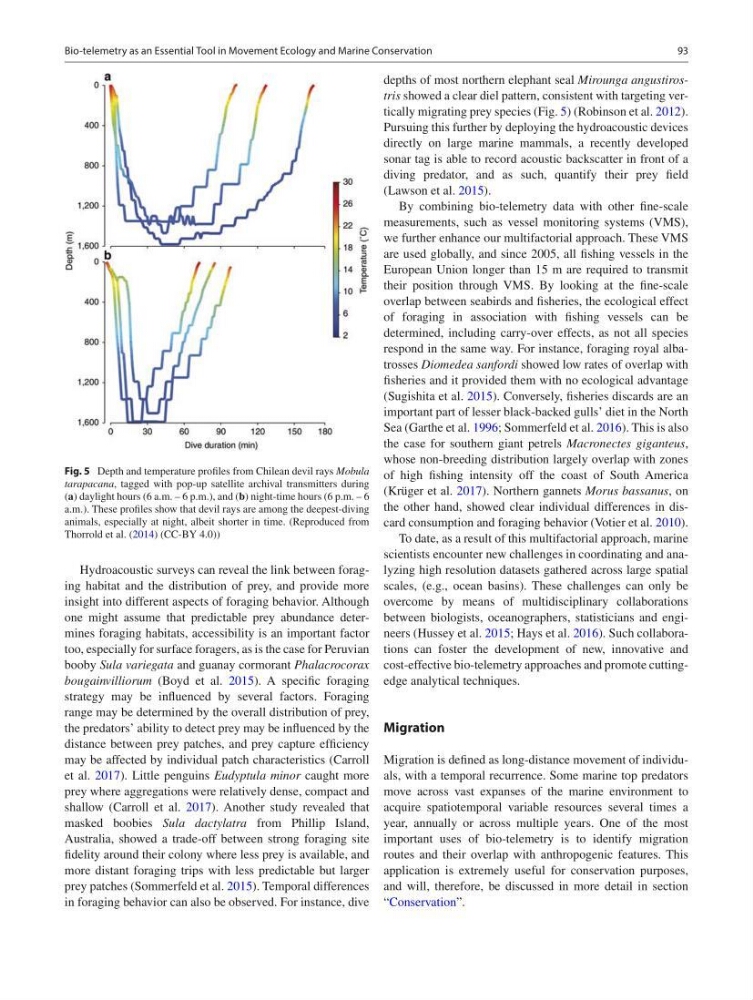
depths of most northern elephant seal Mirounga angustirostris showed a clear diel pattern, consistent with targeting vertically migrating prey species (Fig. 5) (Robinson et al. 2012).
Pursuing this further by deploying the hydroacoustic devices
directly on large marine mammals, a recently developed
sonar tag is able to record acoustic backscatter in front of a
diving predator, and as such, quantify their prey field
(Lawson et al. 2015).
By combining bio-telemetry data with other fine-scale
measurements, such as vessel monitoring systems (VMS),
we further enhance our multifactorial approach. These VMS
are used globally, and since 2005, all fishing vessels in the
European Union longer than 15 m are required to transmit
their position through VMS. By looking at the fine-scale
overlap between seabirds and fisheries, the ecological effect
of foraging in association with fishing vessels can be
determined, including carry-over effects, as not all species
respond in the same way. For instance, foraging royal albatrosses Diomedea sanfordi showed low rates of overlap with
fisheries and it provided them with no ecological advantage
(Sugishita et al. 2015). Conversely, fisheries discards are an
important part of lesser black-backed gulls’ diet in the North
Sea (Garthe et al. 1996; Sommerfeld et al. 2016). This is also
the case for southern giant petrels Macronectes giganteus,
whose non-breeding distribution largely overlap with zones
of high fishing intensity off the coast of South America
(Krüger et al. 2017). Northern gannets Morus bassanus, on
the other hand, showed clear individual differences in discard consumption and foraging behavior (Votier et al. 2010).
To date, as a result of this multifactorial approach, marine
scientists encounter new challenges in coordinating and analyzing high resolution datasets gathered across large spatial
scales, (e.g., ocean basins). These challenges can only be
overcome by means of multidisciplinary collaborations
between biologists, oceanographers, statisticians and engineers (Hussey et al. 2015; Hays et al. 2016). Such collaborations can foster the development of new, innovative and
cost-effective bio-telemetry approaches and promote cuttingedge analytical techniques.
Migration
Migration is defined as long-distance movement of individuals, with a temporal recurrence. Some marine top predators
move across vast expanses of the marine environment to
acquire spatiotemporal variable resources several times a
year, annually or across multiple years. One of the most
important uses of bio-telemetry is to identify migration
routes and their overlap with anthropogenic features. This
application is extremely useful for conservation purposes,
and will, therefore, be discussed in more detail in section
“Conservation”.
Fig. 5 Depth and temperature profiles from Chilean devil rays Mobula
tarapacana, tagged with pop-up satellite archival transmitters during
(a) daylight hours (6 a.m. – 6 p.m.), and (b) night-time hours (6 p.m. – 6
a.m.). These profiles show that devil rays are among the deepest-diving
animals, especially at night, albeit shorter in time. (Reproduced from
Thorrold et al. (2014) (CC-BY 4.0))
Bio-telemetry as an Essential Tool in Movement Ecology and Marine Conservation
Hydroacoustic surveys can reveal the link between foraging habitat and the distribution of prey, and provide more
insight into different aspects of foraging behavior. Although
one might assume that predictable prey abundance determines foraging habitats, accessibility is an important factor
too, especially for surface foragers, as is the case for Peruvian
booby Sula variegata and guanay cormorant Phalacrocorax
bougainvilliorum (Boyd et al. 2015). A specific foraging
strategy may be influenced by several factors. Foraging
range may be determined by the overall distribution of prey,
the predators’ ability to detect prey may be influenced by the
distance between prey patches, and prey capture efficiency
may be affected by individual patch characteristics (Carroll
et al. 2017). Little penguins Eudyptula minor caught more
prey where aggregations were relatively dense, compact and
shallow (Carroll et al. 2017). Another study revealed that
masked boobies Sula dactylatra from Phillip Island,
Australia, showed a trade-off between strong foraging site
fidelity around their colony where less prey is available, and
more distant foraging trips with less predictable but larger
prey patches (Sommerfeld et al. 2015). Temporal differences
in foraging behavior can also be observed. For instance, dive
depths of most northern elephant seal Mirounga angustirostris showed a clear diel pattern, consistent with targeting vertically migrating prey species (Fig. 5) (Robinson et al. 2012).
Pursuing this further by deploying the hydroacoustic devices
directly on large marine mammals, a recently developed
sonar tag is able to record acoustic backscatter in front of a
diving predator, and as such, quantify their prey field
(Lawson et al. 2015).
By combining bio-telemetry data with other fine-scale
measurements, such as vessel monitoring systems (VMS),
we further enhance our multifactorial approach. These VMS
are used globally, and since 2005, all fishing vessels in the
European Union longer than 15 m are required to transmit
their position through VMS. By looking at the fine-scale
overlap between seabirds and fisheries, the ecological effect
of foraging in association with fishing vessels can be
determined, including carry-over effects, as not all species
respond in the same way. For instance, foraging royal albatrosses Diomedea sanfordi showed low rates of overlap with
fisheries and it provided them with no ecological advantage
(Sugishita et al. 2015). Conversely, fisheries discards are an
important part of lesser black-backed gulls’ diet in the North
Sea (Garthe et al. 1996; Sommerfeld et al. 2016). This is also
the case for southern giant petrels Macronectes giganteus,
whose non-breeding distribution largely overlap with zones
of high fishing intensity off the coast of South America
(Krüger et al. 2017). Northern gannets Morus bassanus, on
the other hand, showed clear individual differences in discard consumption and foraging behavior (Votier et al. 2010).
To date, as a result of this multifactorial approach, marine
scientists encounter new challenges in coordinating and analyzing high resolution datasets gathered across large spatial
scales, (e.g., ocean basins). These challenges can only be
overcome by means of multidisciplinary collaborations
between biologists, oceanographers, statisticians and engineers (Hussey et al. 2015; Hays et al. 2016). Such collaborations can foster the development of new, innovative and
cost-effective bio-telemetry approaches and promote cuttingedge analytical techniques.
Migration
Migration is defined as long-distance movement of individuals, with a temporal recurrence. Some marine top predators
move across vast expanses of the marine environment to
acquire spatiotemporal variable resources several times a
year, annually or across multiple years. One of the most
important uses of bio-telemetry is to identify migration
routes and their overlap with anthropogenic features. This
application is extremely useful for conservation purposes,
and will, therefore, be discussed in more detail in section
“Conservation”.
Fig. 5 Depth and temperature profiles from Chilean devil rays Mobula
tarapacana, tagged with pop-up satellite archival transmitters during
(a) daylight hours (6 a.m. – 6 p.m.), and (b) night-time hours (6 p.m. – 6
a.m.). These profiles show that devil rays are among the deepest-diving
animals, especially at night, albeit shorter in time. (Reproduced from
Thorrold et al. (2014) (CC-BY 4.0))
Bio-telemetry as an Essential Tool in Movement Ecology and Marine Conservation