

90
6 Ratchet Dimer Brownian Motor with Hydrodynamic Interactions
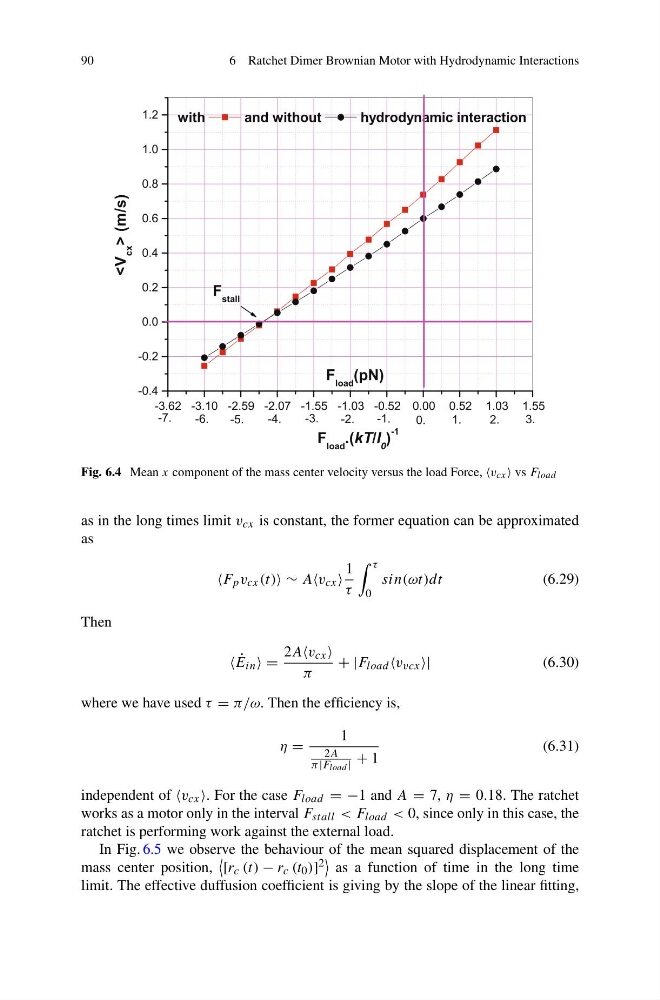
Fig. 6.4 Mean x component of the mass center velocity versus the load Force, v cx vs F load
as in the long times limit v cx is constant, the former equation can be approximated
as
F p v cx (t) ∼ Av cx
1
τ
τ
0
sin(ωt)dt
(6.29)
Then
˙
E in =
2Av cx
π
+ |F load v vcx |
(6.30)
where we have used τ = π/ω. Then the efficiency is,
η =
1
2A
π |F load | + 1
(6.31)
independent of v cx . For the case F load = −1 and A = 7, η = 0.18. The ratchet
works as a motor only in the interval F stall < F load < 0, since only in this case, the
ratchet is performing work against the external load.
In Fig. 6.5 we observe the behaviour of the mean squared displacement of the
mass center position,
[r c (t) − r c (t 0 )] 2
as a function of time in the long time
limit. The effective duffusion coefficient is giving by the slope of the linear fitting,
6 Ratchet Dimer Brownian Motor with Hydrodynamic Interactions
Fig. 6.4 Mean x component of the mass center velocity versus the load Force, v cx vs F load
as in the long times limit v cx is constant, the former equation can be approximated
as
F p v cx (t) ∼ Av cx
1
τ
τ
0
sin(ωt)dt
(6.29)
Then
˙
E in =
2Av cx
π
+ |F load v vcx |
(6.30)
where we have used τ = π/ω. Then the efficiency is,
η =
1
2A
π |F load | + 1
(6.31)
independent of v cx . For the case F load = −1 and A = 7, η = 0.18. The ratchet
works as a motor only in the interval F stall < F load < 0, since only in this case, the
ratchet is performing work against the external load.
In Fig. 6.5 we observe the behaviour of the mean squared displacement of the
mass center position,
[r c (t) − r c (t 0 )] 2
as a function of time in the long time
limit. The effective duffusion coefficient is giving by the slope of the linear fitting,