

6.4 Brownian Dynamics with Hydrodynamic Interactions
91
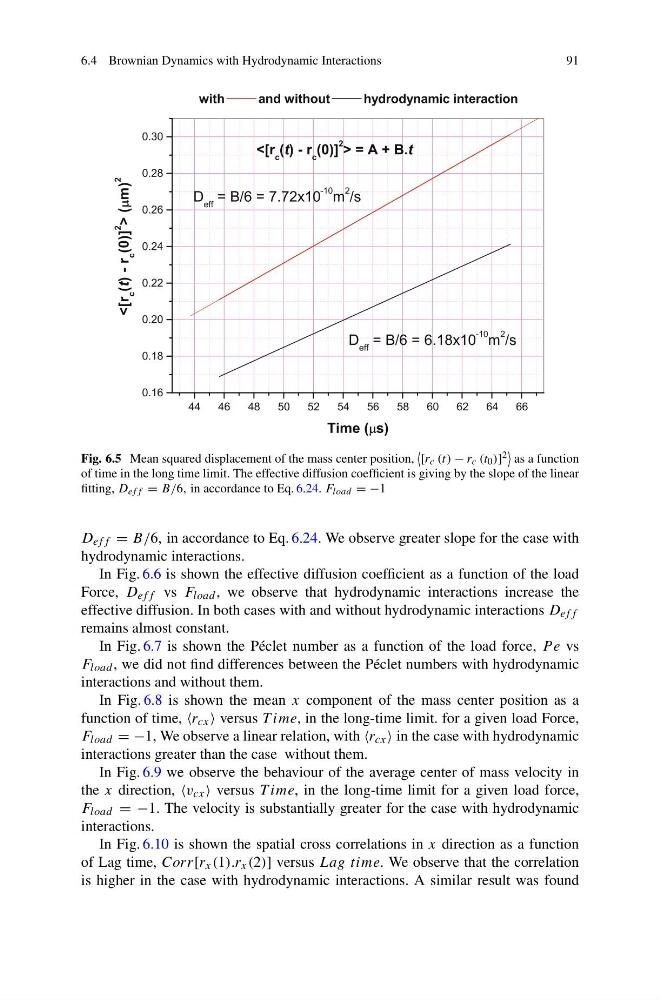
Fig. 6.5 Mean squared displacement of the mass center position,
[r c (t) − r c (t 0 )] 2
as a function
of time in the long time limit. The effective diffusion coefficient is giving by the slope of the linear
fitting, D eff = B/6, in accordance to Eq. 6.24. F load = −1
D eff = B/6, in accordance to Eq. 6.24. We observe greater slope for the case with
hydrodynamic interactions.
In Fig. 6.6 is shown the effective diffusion coefficient as a function of the load
Force, D eff vs F load , we observe that hydrodynamic interactions increase the
effective diffusion. In both cases with and without hydrodynamic interactions D eff
remains almost constant.
In Fig. 6.7 is shown the Péclet number as a function of the load force, P e vs
F load , we did not find differences between the Péclet numbers with hydrodynamic
interactions and without them.
In Fig. 6.8 is shown the mean x component of the mass center position as a
function of time, r cx versus T ime, in the long-time limit. for a given load Force,
F load = −1, We observe a linear relation, with r cx in the case with hydrodynamic
interactions greater than the case without them.
In Fig. 6.9 we observe the behaviour of the average center of mass velocity in
the x direction, v cx versus T ime, in the long-time limit for a given load force,
F load = −1. The velocity is substantially greater for the case with hydrodynamic
interactions.
In Fig. 6.10 is shown the spatial cross correlations in x direction as a function
of Lag time, Corr[r x (1).r x (2)] versus Lag time. We observe that the correlation
is higher in the case with hydrodynamic interactions. A similar result was found
91
Fig. 6.5 Mean squared displacement of the mass center position,
[r c (t) − r c (t 0 )] 2
as a function
of time in the long time limit. The effective diffusion coefficient is giving by the slope of the linear
fitting, D eff = B/6, in accordance to Eq. 6.24. F load = −1
D eff = B/6, in accordance to Eq. 6.24. We observe greater slope for the case with
hydrodynamic interactions.
In Fig. 6.6 is shown the effective diffusion coefficient as a function of the load
Force, D eff vs F load , we observe that hydrodynamic interactions increase the
effective diffusion. In both cases with and without hydrodynamic interactions D eff
remains almost constant.
In Fig. 6.7 is shown the Péclet number as a function of the load force, P e vs
F load , we did not find differences between the Péclet numbers with hydrodynamic
interactions and without them.
In Fig. 6.8 is shown the mean x component of the mass center position as a
function of time, r cx versus T ime, in the long-time limit. for a given load Force,
F load = −1, We observe a linear relation, with r cx in the case with hydrodynamic
interactions greater than the case without them.
In Fig. 6.9 we observe the behaviour of the average center of mass velocity in
the x direction, v cx versus T ime, in the long-time limit for a given load force,
F load = −1. The velocity is substantially greater for the case with hydrodynamic
interactions.
In Fig. 6.10 is shown the spatial cross correlations in x direction as a function
of Lag time, Corr[r x (1).r x (2)] versus Lag time. We observe that the correlation
is higher in the case with hydrodynamic interactions. A similar result was found