

88
6 Ratchet Dimer Brownian Motor with Hydrodynamic Interactions
D
0
ij = D 0 δ ij , i, j on the same particle,
(6.21)
D
0
ij =
3
4
D 0
a
r ij
I +
− → r ij ⊗ − → r ij
r 2
ij
, i, j on different particles
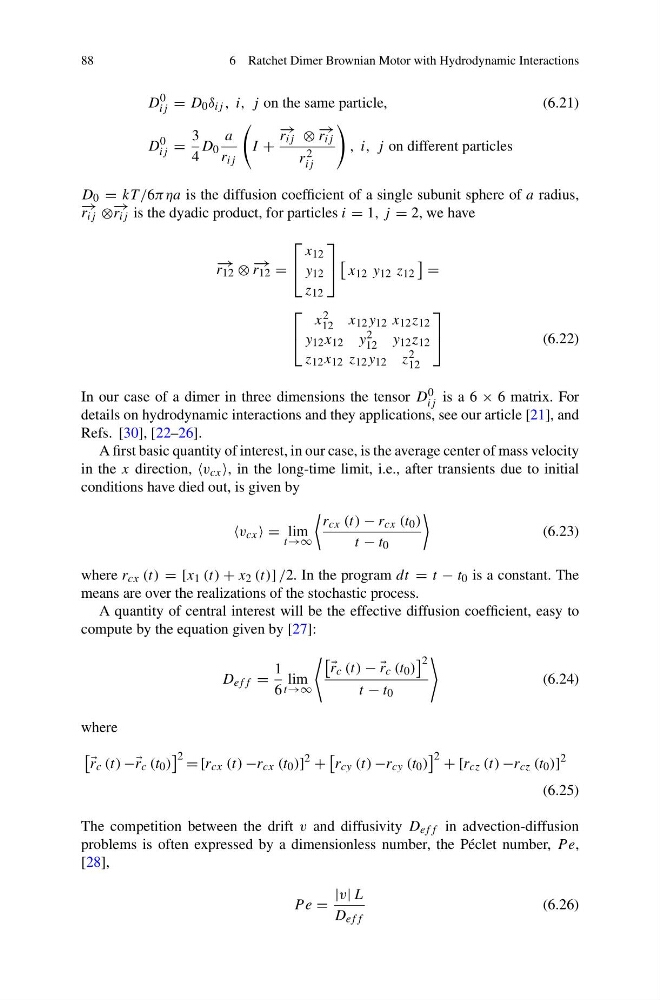
D 0 = kT /6πηa is the diffusion coefficient of a single subunit sphere of a radius,
− → r ij ⊗ − → r ij is the dyadic product, for particles i = 1, j = 2, we have
− →
r 12 ⊗ − →
r 12 =
⎡
⎣
x 12
y 12
z 12
⎤
⎦
x 12 y 12 z 12
=
⎡
⎣
x 2
12 x 12 y 12 x 12 z 12
y 12 x 12 y 2
12 y 12 z 12
z 12 x 12 z 12 y 12 z 2
12
⎤
⎦
(6.22)
In our case of a dimer in three dimensions the tensor D 0
ij is a 6 × 6 matrix. For
details on hydrodynamic interactions and they applications, see our article [21], and
Refs. [30], [22–26].
A first basic quantity of interest, in our case, is the average center of mass velocity
in the x direction, v cx , in the long-time limit, i.e., after transients due to initial
conditions have died out, is given by
v cx = lim
t→∞
r cx (t) − r cx (t 0 )
t − t 0
(6.23)
where r cx (t) = [x 1 (t) + x 2 (t)] /2. In the program dt = t − t 0 is a constant. The
means are over the realizations of the stochastic process.
A quantity of central interest will be the effective diffusion coefficient, easy to
compute by the equation given by [27]:
D eff =
1
6
lim
t→∞
r c (t) − −
r c (t 0 )
2
t − t 0
(6.24)
where
r c (t) −− r c (t 0 )
2 = [r cx (t) −r cx (t 0 )]
2
+
r cy (t) −r cy (t 0 )
2 + [r cz (t) −r cz (t 0 )]
2
(6.25)
The competition between the drift v and diffusivity D eff in advection-diffusion
problems is often expressed by a dimensionless number, the Péclet number, P e,
[28],
P e =
|v| L
D eff
(6.26)
6 Ratchet Dimer Brownian Motor with Hydrodynamic Interactions
D
0
ij = D 0 δ ij , i, j on the same particle,
(6.21)
D
0
ij =
3
4
D 0
a
r ij
I +
− → r ij ⊗ − → r ij
r 2
ij
, i, j on different particles
D 0 = kT /6πηa is the diffusion coefficient of a single subunit sphere of a radius,
− → r ij ⊗ − → r ij is the dyadic product, for particles i = 1, j = 2, we have
− →
r 12 ⊗ − →
r 12 =
⎡
⎣
x 12
y 12
z 12
⎤
⎦
x 12 y 12 z 12
=
⎡
⎣
x 2
12 x 12 y 12 x 12 z 12
y 12 x 12 y 2
12 y 12 z 12
z 12 x 12 z 12 y 12 z 2
12
⎤
⎦
(6.22)
In our case of a dimer in three dimensions the tensor D 0
ij is a 6 × 6 matrix. For
details on hydrodynamic interactions and they applications, see our article [21], and
Refs. [30], [22–26].
A first basic quantity of interest, in our case, is the average center of mass velocity
in the x direction, v cx , in the long-time limit, i.e., after transients due to initial
conditions have died out, is given by
v cx = lim
t→∞
r cx (t) − r cx (t 0 )
t − t 0
(6.23)
where r cx (t) = [x 1 (t) + x 2 (t)] /2. In the program dt = t − t 0 is a constant. The
means are over the realizations of the stochastic process.
A quantity of central interest will be the effective diffusion coefficient, easy to
compute by the equation given by [27]:
D eff =
1
6
lim
t→∞
r c (t) − −
r c (t 0 )
2
t − t 0
(6.24)
where
r c (t) −− r c (t 0 )
2 = [r cx (t) −r cx (t 0 )]
2
+
r cy (t) −r cy (t 0 )
2 + [r cz (t) −r cz (t 0 )]
2
(6.25)
The competition between the drift v and diffusivity D eff in advection-diffusion
problems is often expressed by a dimensionless number, the Péclet number, P e,
[28],
P e =
|v| L
D eff
(6.26)