

4.3 A Mechanochemical Model
57
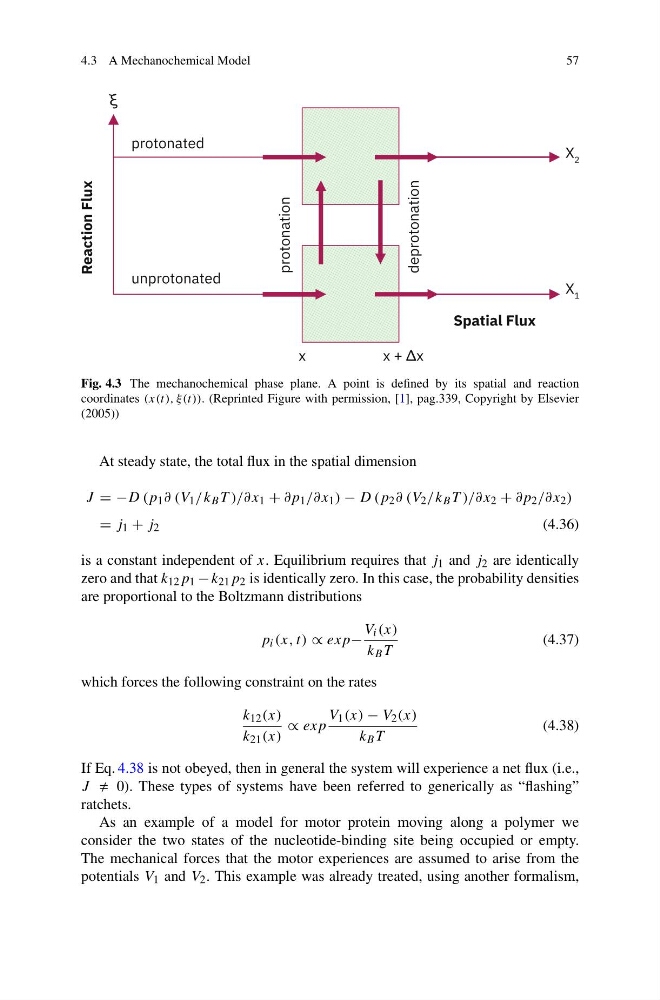
Fig. 4.3 The mechanochemical phase plane. A point is defined by its spatial and reaction
coordinates (x(t), ξ(t)). (Reprinted Figure with permission, [1], pag.339, Copyright by Elsevier
(2005))
At steady state, the total flux in the spatial dimension
J = −D (p 1 ∂ (V 1 /k B T )/∂x 1 + ∂p 1 /∂x 1 ) − D (p 2 ∂ (V 2 /k B T )/∂x 2 + ∂p 2 /∂x 2 )
= j 1 + j 2
(4.36)
is a constant independent of x. Equilibrium requires that j 1 and j 2 are identically
zero and that k 12 p 1 − k 21 p 2 is identically zero. In this case, the probability densities
are proportional to the Boltzmann distributions
p i (x, t) ∝ exp−
V i (x)
k B T
(4.37)
which forces the following constraint on the rates
k 12 (x)
k 21 (x)
∝ exp
V 1 (x) − V 2 (x)
k B T
(4.38)
If Eq. 4.38 is not obeyed, then in general the system will experience a net flux (i.e.,
J 0). These types of systems have been referred to generically as “flashing”
ratchets.
As an example of a model for motor protein moving along a polymer we
consider the two states of the nucleotide-binding site being occupied or empty.
The mechanical forces that the motor experiences are assumed to arise from the
potentials V 1 and V 2 . This example was already treated, using another formalism,
57
Fig. 4.3 The mechanochemical phase plane. A point is defined by its spatial and reaction
coordinates (x(t), ξ(t)). (Reprinted Figure with permission, [1], pag.339, Copyright by Elsevier
(2005))
At steady state, the total flux in the spatial dimension
J = −D (p 1 ∂ (V 1 /k B T )/∂x 1 + ∂p 1 /∂x 1 ) − D (p 2 ∂ (V 2 /k B T )/∂x 2 + ∂p 2 /∂x 2 )
= j 1 + j 2
(4.36)
is a constant independent of x. Equilibrium requires that j 1 and j 2 are identically
zero and that k 12 p 1 − k 21 p 2 is identically zero. In this case, the probability densities
are proportional to the Boltzmann distributions
p i (x, t) ∝ exp−
V i (x)
k B T
(4.37)
which forces the following constraint on the rates
k 12 (x)
k 21 (x)
∝ exp
V 1 (x) − V 2 (x)
k B T
(4.38)
If Eq. 4.38 is not obeyed, then in general the system will experience a net flux (i.e.,
J 0). These types of systems have been referred to generically as “flashing”
ratchets.
As an example of a model for motor protein moving along a polymer we
consider the two states of the nucleotide-binding site being occupied or empty.
The mechanical forces that the motor experiences are assumed to arise from the
potentials V 1 and V 2 . This example was already treated, using another formalism,