

2.2 The Fokker-Planck Equation
17
2.2 The Fokker-Planck Equation
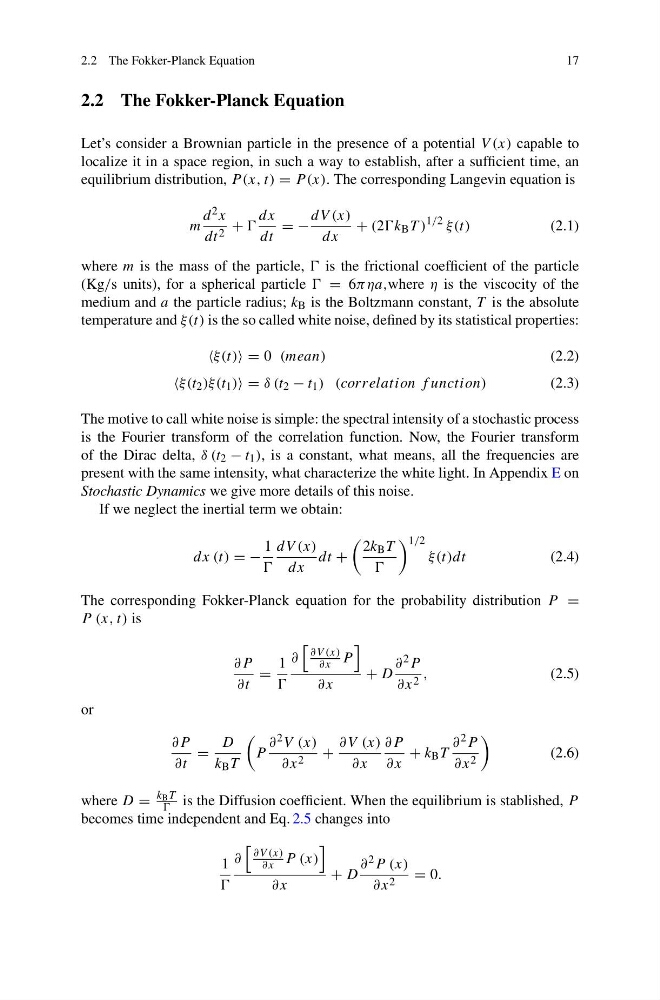
Let’s consider a Brownian particle in the presence of a potential V (x) capable to
localize it in a space region, in such a way to establish, after a sufficient time, an
equilibrium distribution, P (x, t) = P (x). The corresponding Langevin equation is
m
d 2 x
dt 2 +
dx
dt
= −
dV (x)
dx
+ (2k B T )
1/2 ξ(t)
(2.1)
where m is the mass of the particle, is the frictional coefficient of the particle
(Kg/s units), for a spherical particle = 6πηa,where η is the viscocity of the
medium and a the particle radius; k B is the Boltzmann constant, T is the absolute
temperature and ξ(t) is the so called white noise, defined by its statistical properties:
ξ(t) = 0 (mean)
(2.2)
ξ(t 2 )ξ(t 1 ) = δ (t 2 − t 1 ) (correlation f unction)
(2.3)
The motive to call white noise is simple: the spectral intensity of a stochastic process
is the Fourier transform of the correlation function. Now, the Fourier transform
of the Dirac delta, δ (t 2 − t 1 ), is a constant, what means, all the frequencies are
present with the same intensity, what characterize the white light. In Appendix E on
Stochastic Dynamics we give more details of this noise.
If we neglect the inertial term we obtain:
dx (t) = −
1
dV (x)
dx
dt +
2k B T
1/2
ξ(t)dt
(2.4)
The corresponding Fokker-Planck equation for the probability distribution P =
P (x, t) is
∂P
∂t
=
1
∂
∂V (x)
∂x P
∂x
+ D
∂ 2 P
∂x 2 ,
(2.5)
or
∂P
∂t
=
D
k B T
P
∂ 2 V (x)
∂x 2 +
∂V (x)
∂x
∂P
∂x
+ k B T
∂ 2 P
∂x 2
(2.6)
where D =
k B T
is the Diffusion coefficient. When the equilibrium is stablished, P
becomes time independent and Eq. 2.5 changes into
1
∂
∂V (x)
∂x P (x)
∂x
+ D
∂ 2 P (x)
∂x 2 = 0.
17
2.2 The Fokker-Planck Equation
Let’s consider a Brownian particle in the presence of a potential V (x) capable to
localize it in a space region, in such a way to establish, after a sufficient time, an
equilibrium distribution, P (x, t) = P (x). The corresponding Langevin equation is
m
d 2 x
dt 2 +
dx
dt
= −
dV (x)
dx
+ (2k B T )
1/2 ξ(t)
(2.1)
where m is the mass of the particle, is the frictional coefficient of the particle
(Kg/s units), for a spherical particle = 6πηa,where η is the viscocity of the
medium and a the particle radius; k B is the Boltzmann constant, T is the absolute
temperature and ξ(t) is the so called white noise, defined by its statistical properties:
ξ(t) = 0 (mean)
(2.2)
ξ(t 2 )ξ(t 1 ) = δ (t 2 − t 1 ) (correlation f unction)
(2.3)
The motive to call white noise is simple: the spectral intensity of a stochastic process
is the Fourier transform of the correlation function. Now, the Fourier transform
of the Dirac delta, δ (t 2 − t 1 ), is a constant, what means, all the frequencies are
present with the same intensity, what characterize the white light. In Appendix E on
Stochastic Dynamics we give more details of this noise.
If we neglect the inertial term we obtain:
dx (t) = −
1
dV (x)
dx
dt +
2k B T
1/2
ξ(t)dt
(2.4)
The corresponding Fokker-Planck equation for the probability distribution P =
P (x, t) is
∂P
∂t
=
1
∂
∂V (x)
∂x P
∂x
+ D
∂ 2 P
∂x 2 ,
(2.5)
or
∂P
∂t
=
D
k B T
P
∂ 2 V (x)
∂x 2 +
∂V (x)
∂x
∂P
∂x
+ k B T
∂ 2 P
∂x 2
(2.6)
where D =
k B T
is the Diffusion coefficient. When the equilibrium is stablished, P
becomes time independent and Eq. 2.5 changes into
1
∂
∂V (x)
∂x P (x)
∂x
+ D
∂ 2 P (x)
∂x 2 = 0.