

12
1 Brownian Ratchets and Molecular Motors
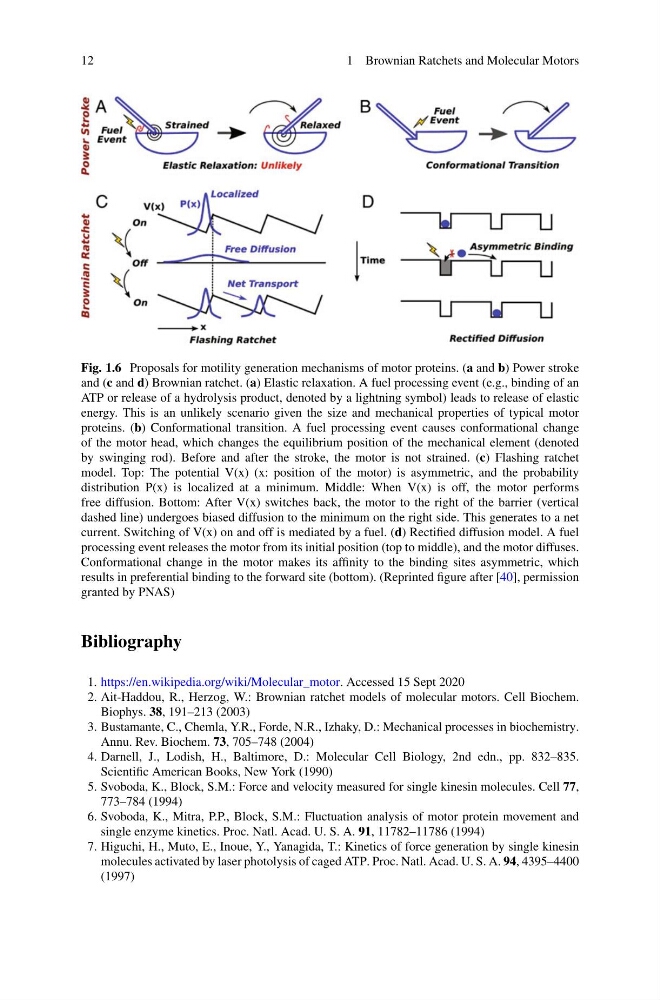
Fig. 1.6 Proposals for motility generation mechanisms of motor proteins. (a and b) Power stroke
and (c and d) Brownian ratchet. (a) Elastic relaxation. A fuel processing event (e.g., binding of an
ATP or release of a hydrolysis product, denoted by a lightning symbol) leads to release of elastic
energy. This is an unlikely scenario given the size and mechanical properties of typical motor
proteins. (b) Conformational transition. A fuel processing event causes conformational change
of the motor head, which changes the equilibrium position of the mechanical element (denoted
by swinging rod). Before and after the stroke, the motor is not strained. (c) Flashing ratchet
model. Top: The potential V(x) (x: position of the motor) is asymmetric, and the probability
distribution P(x) is localized at a minimum. Middle: When V(x) is off, the motor performs
free diffusion. Bottom: After V(x) switches back, the motor to the right of the barrier (vertical
dashed line) undergoes biased diffusion to the minimum on the right side. This generates to a net
current. Switching of V(x) on and off is mediated by a fuel. (d) Rectified diffusion model. A fuel
processing event releases the motor from its initial position (top to middle), and the motor diffuses.
Conformational change in the motor makes its affinity to the binding sites asymmetric, which
results in preferential binding to the forward site (bottom). (Reprinted figure after [40], permission
granted by PNAS)
Bibliography
1. https://en.wikipedia.org/wiki/Molecular_motor. Accessed 15 Sept 2020
2. Ait-Haddou, R., Herzog, W.: Brownian ratchet models of molecular motors. Cell Biochem.
Biophys. 38, 191–213 (2003)
3. Bustamante, C., Chemla, Y.R., Forde, N.R., Izhaky, D.: Mechanical processes in biochemistry.
Annu. Rev. Biochem. 73, 705–748 (2004)
4. Darnell, J., Lodish, H., Baltimore, D.: Molecular Cell Biology, 2nd edn., pp. 832–835.
Scientific American Books, New York (1990)
5. Svoboda, K., Block, S.M.: Force and velocity measured for single kinesin molecules. Cell 77,
773–784 (1994)
6. Svoboda, K., Mitra, P.P., Block, S.M.: Fluctuation analysis of motor protein movement and
single enzyme kinetics. Proc. Natl. Acad. U. S. A. 91, 11782–11786 (1994)
7. Higuchi, H., Muto, E., Inoue, Y., Yanagida, T.: Kinetics of force generation by single kinesin
molecules activated by laser photolysis of caged ATP. Proc. Natl. Acad. U. S. A. 94, 4395–4400
(1997)
1 Brownian Ratchets and Molecular Motors
Fig. 1.6 Proposals for motility generation mechanisms of motor proteins. (a and b) Power stroke
and (c and d) Brownian ratchet. (a) Elastic relaxation. A fuel processing event (e.g., binding of an
ATP or release of a hydrolysis product, denoted by a lightning symbol) leads to release of elastic
energy. This is an unlikely scenario given the size and mechanical properties of typical motor
proteins. (b) Conformational transition. A fuel processing event causes conformational change
of the motor head, which changes the equilibrium position of the mechanical element (denoted
by swinging rod). Before and after the stroke, the motor is not strained. (c) Flashing ratchet
model. Top: The potential V(x) (x: position of the motor) is asymmetric, and the probability
distribution P(x) is localized at a minimum. Middle: When V(x) is off, the motor performs
free diffusion. Bottom: After V(x) switches back, the motor to the right of the barrier (vertical
dashed line) undergoes biased diffusion to the minimum on the right side. This generates to a net
current. Switching of V(x) on and off is mediated by a fuel. (d) Rectified diffusion model. A fuel
processing event releases the motor from its initial position (top to middle), and the motor diffuses.
Conformational change in the motor makes its affinity to the binding sites asymmetric, which
results in preferential binding to the forward site (bottom). (Reprinted figure after [40], permission
granted by PNAS)
Bibliography
1. https://en.wikipedia.org/wiki/Molecular_motor. Accessed 15 Sept 2020
2. Ait-Haddou, R., Herzog, W.: Brownian ratchet models of molecular motors. Cell Biochem.
Biophys. 38, 191–213 (2003)
3. Bustamante, C., Chemla, Y.R., Forde, N.R., Izhaky, D.: Mechanical processes in biochemistry.
Annu. Rev. Biochem. 73, 705–748 (2004)
4. Darnell, J., Lodish, H., Baltimore, D.: Molecular Cell Biology, 2nd edn., pp. 832–835.
Scientific American Books, New York (1990)
5. Svoboda, K., Block, S.M.: Force and velocity measured for single kinesin molecules. Cell 77,
773–784 (1994)
6. Svoboda, K., Mitra, P.P., Block, S.M.: Fluctuation analysis of motor protein movement and
single enzyme kinetics. Proc. Natl. Acad. U. S. A. 91, 11782–11786 (1994)
7. Higuchi, H., Muto, E., Inoue, Y., Yanagida, T.: Kinetics of force generation by single kinesin
molecules activated by laser photolysis of caged ATP. Proc. Natl. Acad. U. S. A. 94, 4395–4400
(1997)