

1.6 Power Stroke
11
Ẇ τ = τ
Work by
External Torque
Work by
Motor Torque
Work by
Brownian Torque
Drag Torque
Motlon
the Load
Work by
Reactants
Products
r
of
ω
ω
s
Ẇ M = -ɸʹ
Q out = ζ
κ B Tζ
I
˙
ω
2
Q in =
˙
b
a
ChemIcal
ReactIon
Cycle
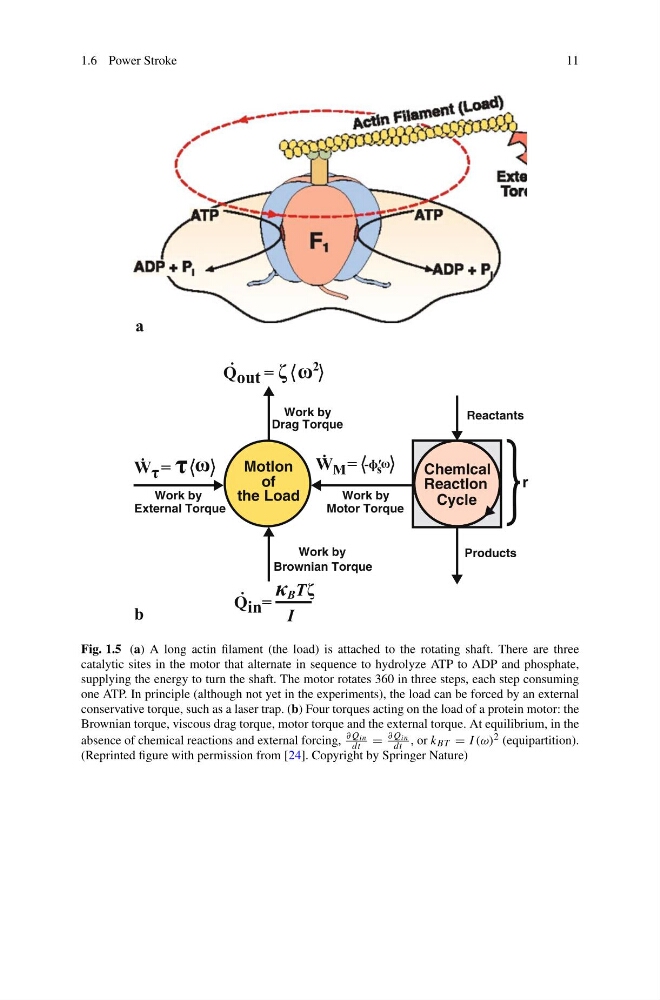
Fig. 1.5 (a) A long actin filament (the load) is attached to the rotating shaft. There are three
catalytic sites in the motor that alternate in sequence to hydrolyze ATP to ADP and phosphate,
supplying the energy to turn the shaft. The motor rotates 360 in three steps, each step consuming
one ATP. In principle (although not yet in the experiments), the load can be forced by an external
conservative torque, such as a laser trap. (b) Four torques acting on the load of a protein motor: the
Brownian torque, viscous drag torque, motor torque and the external torque. At equilibrium, in the
absence of chemical reactions and external forcing,
∂Q in
dt =
∂Q in
dt , or k BT = I (ω) 2 (equipartition).
(Reprinted figure with permission from [24]. Copyright by Springer Nature)
11
Ẇ τ = τ
Work by
External Torque
Work by
Motor Torque
Work by
Brownian Torque
Drag Torque
Motlon
the Load
Work by
Reactants
Products
r
of
ω
ω
s
Ẇ M = -ɸʹ
Q out = ζ
κ B Tζ
I
˙
ω
2
Q in =
˙
b
a
ChemIcal
ReactIon
Cycle
Fig. 1.5 (a) A long actin filament (the load) is attached to the rotating shaft. There are three
catalytic sites in the motor that alternate in sequence to hydrolyze ATP to ADP and phosphate,
supplying the energy to turn the shaft. The motor rotates 360 in three steps, each step consuming
one ATP. In principle (although not yet in the experiments), the load can be forced by an external
conservative torque, such as a laser trap. (b) Four torques acting on the load of a protein motor: the
Brownian torque, viscous drag torque, motor torque and the external torque. At equilibrium, in the
absence of chemical reactions and external forcing,
∂Q in
dt =
∂Q in
dt , or k BT = I (ω) 2 (equipartition).
(Reprinted figure with permission from [24]. Copyright by Springer Nature)