

178
Appendix F
where we have used − dU /dt = F M v, and dW ext /dt = F a v
F.1.2 Entropy Production
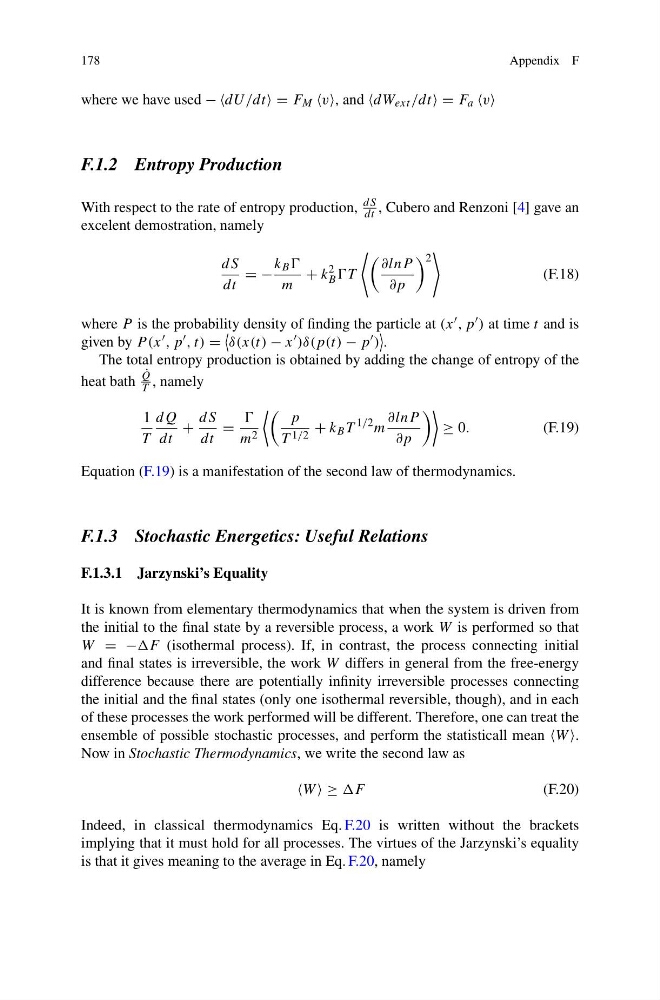
With respect to the rate of entropy production,
dS
dt , Cubero and Renzoni [4] gave an
excelent demostration, namely
dS
dt
= −
k B
m
+ k
2
B T
∂lnP
∂p
2
(F.18)
where P is the probability density of finding the particle at (x , p ) at time t and is
given by P (x , p , t) =
δ(x(t) − x )δ(p(t) − p )
.
The total entropy production is obtained by adding the change of entropy of the
heat bath
˙
Q
T , namely
1
T
dQ
dt
+
dS
dt
=
m 2
p
T 1/2 + k B T
1/2 m
∂lnP
∂p
≥ 0.
(F.19)
Equation (F.19) is a manifestation of the second law of thermodynamics.
F.1.3 Stochastic Energetics: Useful Relations
F.1.3.1 Jarzynski’s Equality
It is known from elementary thermodynamics that when the system is driven from
the initial to the final state by a reversible process, a work W is performed so that
W = −F (isothermal process). If, in contrast, the process connecting initial
and final states is irreversible, the work W differs in general from the free-energy
difference because there are potentially infinity irreversible processes connecting
the initial and the final states (only one isothermal reversible, though), and in each
of these processes the work performed will be different. Therefore, one can treat the
ensemble of possible stochastic processes, and perform the statisticall mean W .
Now in Stochastic Thermodynamics, we write the second law as
W ≥ F
(F.20)
Indeed, in classical thermodynamics Eq. F.20 is written without the brackets
implying that it must hold for all processes. The virtues of the Jarzynski’s equality
is that it gives meaning to the average in Eq. F.20, namely
Appendix F
where we have used − dU /dt = F M v, and dW ext /dt = F a v
F.1.2 Entropy Production
With respect to the rate of entropy production,
dS
dt , Cubero and Renzoni [4] gave an
excelent demostration, namely
dS
dt
= −
k B
m
+ k
2
B T
∂lnP
∂p
2
(F.18)
where P is the probability density of finding the particle at (x , p ) at time t and is
given by P (x , p , t) =
δ(x(t) − x )δ(p(t) − p )
.
The total entropy production is obtained by adding the change of entropy of the
heat bath
˙
Q
T , namely
1
T
dQ
dt
+
dS
dt
=
m 2
p
T 1/2 + k B T
1/2 m
∂lnP
∂p
≥ 0.
(F.19)
Equation (F.19) is a manifestation of the second law of thermodynamics.
F.1.3 Stochastic Energetics: Useful Relations
F.1.3.1 Jarzynski’s Equality
It is known from elementary thermodynamics that when the system is driven from
the initial to the final state by a reversible process, a work W is performed so that
W = −F (isothermal process). If, in contrast, the process connecting initial
and final states is irreversible, the work W differs in general from the free-energy
difference because there are potentially infinity irreversible processes connecting
the initial and the final states (only one isothermal reversible, though), and in each
of these processes the work performed will be different. Therefore, one can treat the
ensemble of possible stochastic processes, and perform the statisticall mean W .
Now in Stochastic Thermodynamics, we write the second law as
W ≥ F
(F.20)
Indeed, in classical thermodynamics Eq. F.20 is written without the brackets
implying that it must hold for all processes. The virtues of the Jarzynski’s equality
is that it gives meaning to the average in Eq. F.20, namely