

E.1 Stochastic Dynamics
171
t
0
G
X(t
), t
• (dW (t
))
m
= 0 f or m > 2.
(E.24)
besides
t
0
G
X(t
), t
• dW (t
)dt = 0
(E.25)
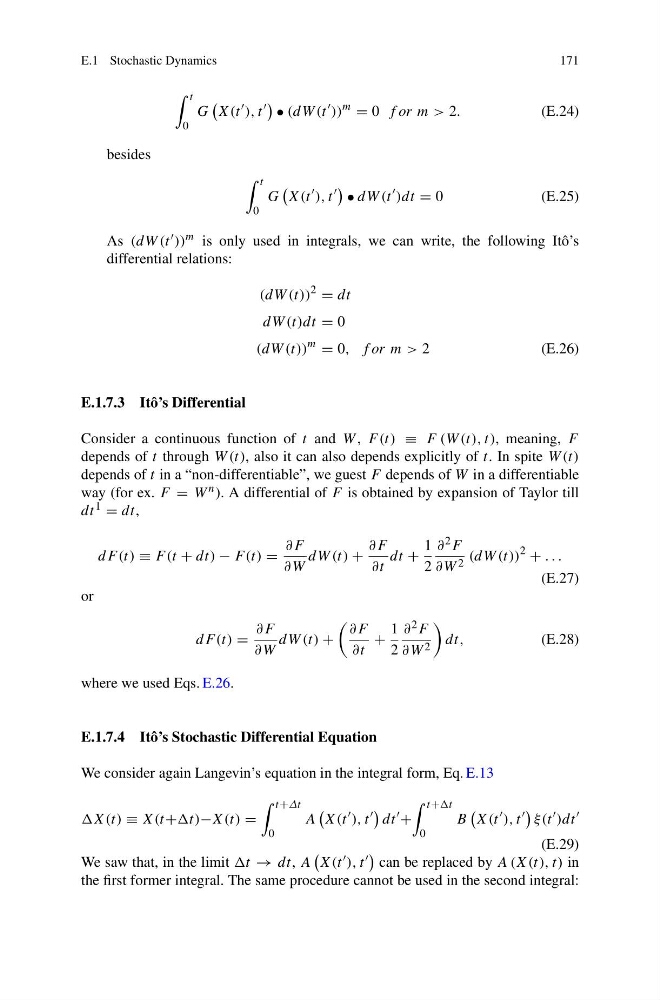
As (dW (t )) m is only used in integrals, we can write, the following Itô’s
differential relations:
(dW (t))
2
= dt
dW (t)dt = 0
(dW (t))
m
= 0, for m > 2
(E.26)
E.1.7.3 Itô’s Differential
Consider a continuous function of t and W , F (t) ≡ F (W (t), t), meaning, F
depends of t through W (t), also it can also depends explicitly of t. In spite W (t)
depends of t in a “non-differentiable”, we guest F depends of W in a differentiable
way (for ex. F = W n ). A differential of F is obtained by expansion of Taylor till
dt 1 = dt,
dF (t) ≡ F (t + dt) − F (t) =
∂F
∂W
dW (t) +
∂F
∂t
dt +
1
2
∂ 2 F
∂W 2 (dW (t))
2
+ . . .
(E.27)
or
dF (t) =
∂F
∂W
dW (t) +
∂F
∂t
+
1
2
∂ 2 F
∂W 2
dt,
(E.28)
where we used Eqs. E.26.
E.1.7.4 Itô’s Stochastic Differential Equation
We consider again Langevin’s equation in the integral form, Eq. E.13
≡ X(t+t)−X(t) =
t+Δt
0
A
X(t
), t
dt
+
t+t
0
B
X(t
), t
ξ(t
)dt
(E.29)
We saw that, in the limit t → dt, A
X(t ), t
can be replaced by A (X(t), t) in
the first former integral. The same procedure cannot be used in the second integral:
171
t
0
G
X(t
), t
• (dW (t
))
m
= 0 f or m > 2.
(E.24)
besides
t
0
G
X(t
), t
• dW (t
)dt = 0
(E.25)
As (dW (t )) m is only used in integrals, we can write, the following Itô’s
differential relations:
(dW (t))
2
= dt
dW (t)dt = 0
(dW (t))
m
= 0, for m > 2
(E.26)
E.1.7.3 Itô’s Differential
Consider a continuous function of t and W , F (t) ≡ F (W (t), t), meaning, F
depends of t through W (t), also it can also depends explicitly of t. In spite W (t)
depends of t in a “non-differentiable”, we guest F depends of W in a differentiable
way (for ex. F = W n ). A differential of F is obtained by expansion of Taylor till
dt 1 = dt,
dF (t) ≡ F (t + dt) − F (t) =
∂F
∂W
dW (t) +
∂F
∂t
dt +
1
2
∂ 2 F
∂W 2 (dW (t))
2
+ . . .
(E.27)
or
dF (t) =
∂F
∂W
dW (t) +
∂F
∂t
+
1
2
∂ 2 F
∂W 2
dt,
(E.28)
where we used Eqs. E.26.
E.1.7.4 Itô’s Stochastic Differential Equation
We consider again Langevin’s equation in the integral form, Eq. E.13
≡ X(t+t)−X(t) =
t+Δt
0
A
X(t
), t
dt
+
t+t
0
B
X(t
), t
ξ(t
)dt
(E.29)
We saw that, in the limit t → dt, A
X(t ), t
can be replaced by A (X(t), t) in
the first former integral. The same procedure cannot be used in the second integral: