

150
Appendix A
P i (t + dt) = P i (t) −
j
J i→j dt
(A.2)
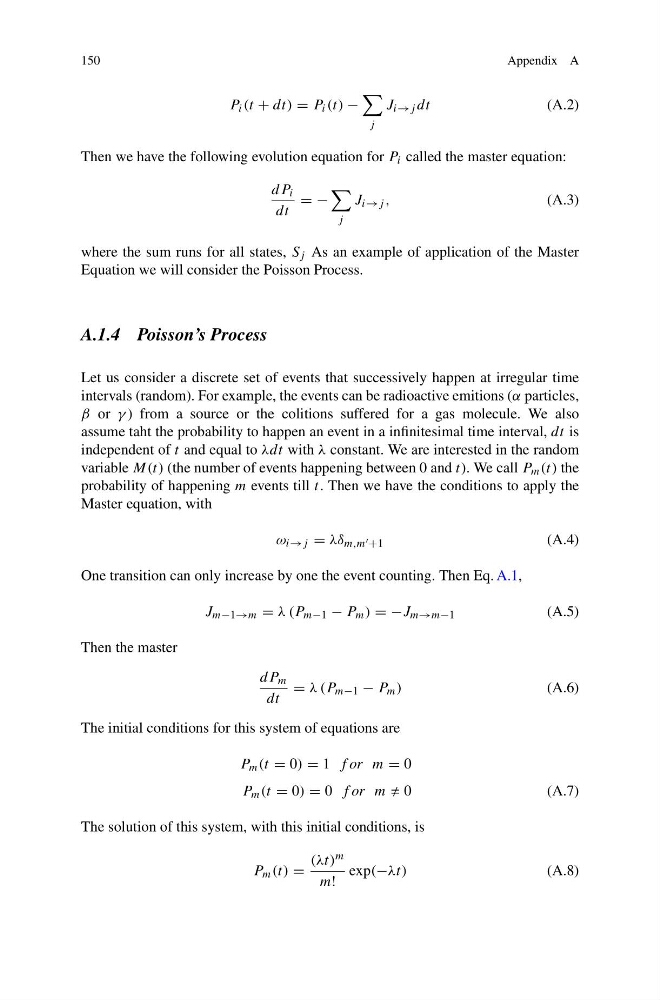
Then we have the following evolution equation for P i called the master equation:
dP i
dt
= −
j
J i→j ,
(A.3)
where the sum runs for all states, S j As an example of application of the Master
Equation we will consider the Poisson Process.
A.1.4 Poisson’s Process
Let us consider a discrete set of events that successively happen at irregular time
intervals (random). For example, the events can be radioactive emitions (α particles,
β or γ ) from a source or the colitions suffered for a gas molecule. We also
assume taht the probability to happen an event in a infinitesimal time interval, dt is
independent of t and equal to λdt with λ constant. We are interested in the random
variable M(t) (the number of events happening between 0 and t). We call P m (t) the
probability of happening m events till t. Then we have the conditions to apply the
Master equation, with
ω i→j = λδ m,m +1
(A.4)
One transition can only increase by one the event counting. Then Eq. A.1,
J m−1→m = λ (P m−1 − P m ) = −J m→m−1
(A.5)
Then the master
dP m
dt
= λ (P m−1 − P m )
(A.6)
The initial conditions for this system of equations are
P m (t = 0) = 1 f or m = 0
P m (t = 0) = 0 f or m 0
( A . 7 )
The solution of this system, with this initial conditions, is
P m (t) =
(λt) m
m!
exp(−λt)
(A.8)
Appendix A
P i (t + dt) = P i (t) −
j
J i→j dt
(A.2)
Then we have the following evolution equation for P i called the master equation:
dP i
dt
= −
j
J i→j ,
(A.3)
where the sum runs for all states, S j As an example of application of the Master
Equation we will consider the Poisson Process.
A.1.4 Poisson’s Process
Let us consider a discrete set of events that successively happen at irregular time
intervals (random). For example, the events can be radioactive emitions (α particles,
β or γ ) from a source or the colitions suffered for a gas molecule. We also
assume taht the probability to happen an event in a infinitesimal time interval, dt is
independent of t and equal to λdt with λ constant. We are interested in the random
variable M(t) (the number of events happening between 0 and t). We call P m (t) the
probability of happening m events till t. Then we have the conditions to apply the
Master equation, with
ω i→j = λδ m,m +1
(A.4)
One transition can only increase by one the event counting. Then Eq. A.1,
J m−1→m = λ (P m−1 − P m ) = −J m→m−1
(A.5)
Then the master
dP m
dt
= λ (P m−1 − P m )
(A.6)
The initial conditions for this system of equations are
P m (t = 0) = 1 f or m = 0
P m (t = 0) = 0 f or m 0
( A . 7 )
The solution of this system, with this initial conditions, is
P m (t) =
(λt) m
m!
exp(−λt)
(A.8)