

4
1 Brownian Ratchets and Molecular Motors
1.2 Smoluchowski-Feynman’s Ratchet as a Heat Engine
Feynman famous lectures, [11, 13] include an imaginary microscopic ratchet
device to illustrate the second law of thermodynamics. The basic idea belongs
to Smoluchowski who discussed it during a conference talk in Munster in 1912
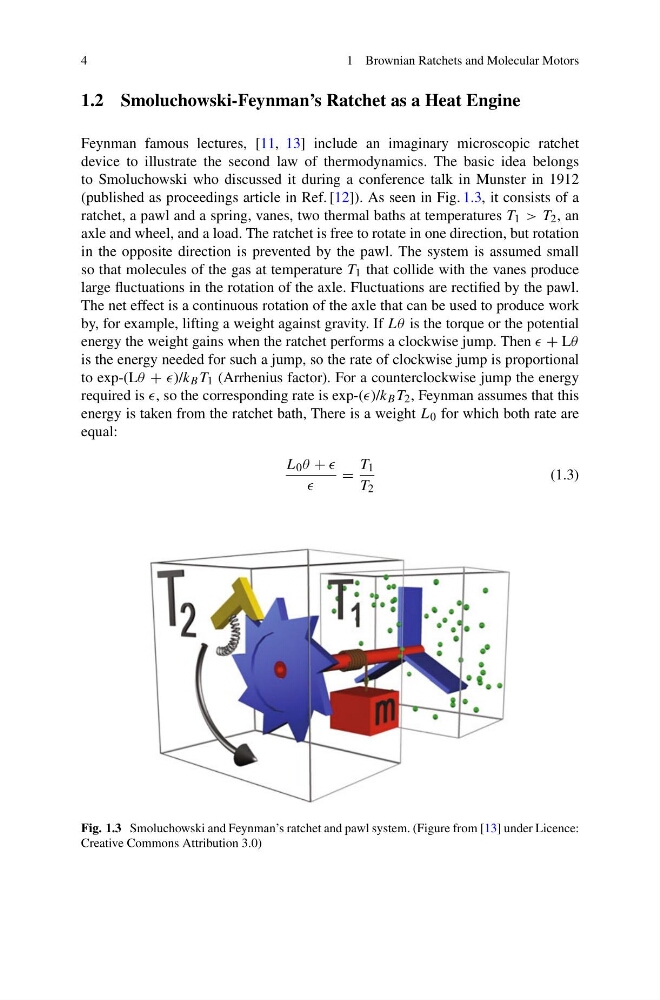
(published as proceedings article in Ref. [12]). As seen in Fig. 1.3, it consists of a
ratchet, a pawl and a spring, vanes, two thermal baths at temperatures T 1 > T 2 , an
axle and wheel, and a load. The ratchet is free to rotate in one direction, but rotation
in the opposite direction is prevented by the pawl. The system is assumed small
so that molecules of the gas at temperature T 1 that collide with the vanes produce
large fluctuations in the rotation of the axle. Fluctuations are rectified by the pawl.
The net effect is a continuous rotation of the axle that can be used to produce work
by, for example, lifting a weight against gravity. If Lθ is the torque or the potential
energy the weight gains when the ratchet performs a clockwise jump. Then + Lθ
is the energy needed for such a jump, so the rate of clockwise jump is proportional
to exp-(Lθ + )/k B T 1 (Arrhenius factor). For a counterclockwise jump the energy
required is , so the corresponding rate is exp-()/k B T 2 , Feynman assumes that this
energy is taken from the ratchet bath, There is a weight L 0 for which both rate are
equal:
L 0 θ +
=
T 1
T 2
(1.3)
Fig. 1.3 Smoluchowski and Feynman’s ratchet and pawl system. (Figure from [13] under Licence:
Creative Commons Attribution 3.0)
1 Brownian Ratchets and Molecular Motors
1.2 Smoluchowski-Feynman’s Ratchet as a Heat Engine
Feynman famous lectures, [11, 13] include an imaginary microscopic ratchet
device to illustrate the second law of thermodynamics. The basic idea belongs
to Smoluchowski who discussed it during a conference talk in Munster in 1912
(published as proceedings article in Ref. [12]). As seen in Fig. 1.3, it consists of a
ratchet, a pawl and a spring, vanes, two thermal baths at temperatures T 1 > T 2 , an
axle and wheel, and a load. The ratchet is free to rotate in one direction, but rotation
in the opposite direction is prevented by the pawl. The system is assumed small
so that molecules of the gas at temperature T 1 that collide with the vanes produce
large fluctuations in the rotation of the axle. Fluctuations are rectified by the pawl.
The net effect is a continuous rotation of the axle that can be used to produce work
by, for example, lifting a weight against gravity. If Lθ is the torque or the potential
energy the weight gains when the ratchet performs a clockwise jump. Then + Lθ
is the energy needed for such a jump, so the rate of clockwise jump is proportional
to exp-(Lθ + )/k B T 1 (Arrhenius factor). For a counterclockwise jump the energy
required is , so the corresponding rate is exp-()/k B T 2 , Feynman assumes that this
energy is taken from the ratchet bath, There is a weight L 0 for which both rate are
equal:
L 0 θ +
=
T 1
T 2
(1.3)
Fig. 1.3 Smoluchowski and Feynman’s ratchet and pawl system. (Figure from [13] under Licence:
Creative Commons Attribution 3.0)