

136
8 Quantum Ratchets
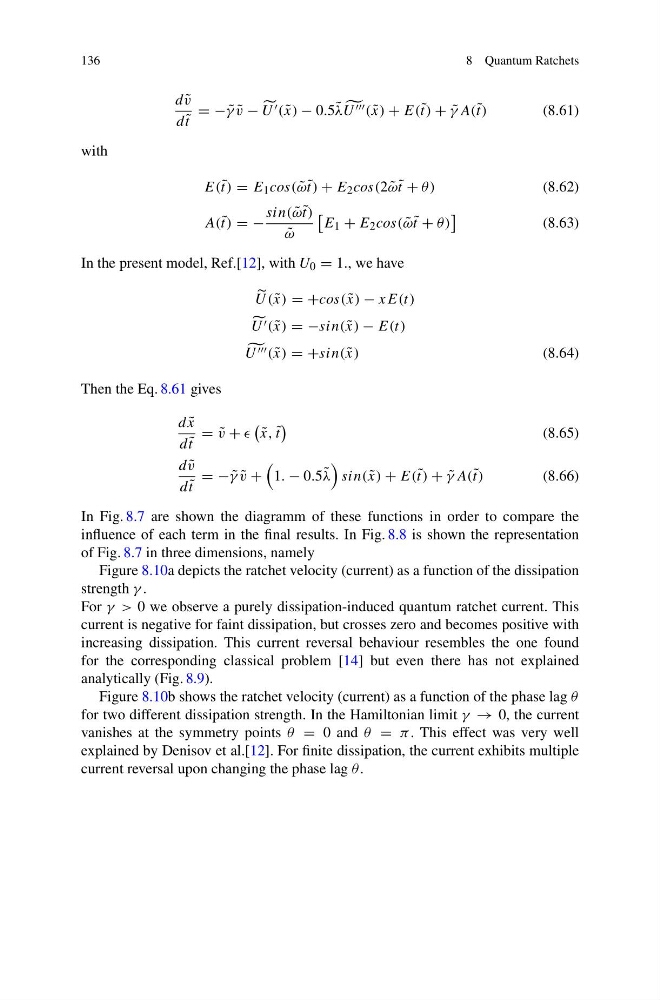
d ˜
v
d ˜
t
= − ˜
γ ˜
v −
U ( ˜
x) − 0.5 ˜
λ
U ( ˜
x) + E(˜ t) + ˜
γ A(˜ t)
(8.61)
with
E(˜ t) = E 1 cos( ˜
ω˜ t) + E 2 cos(2 ˜
ω˜ t + θ)
(8.62)
A(˜ t) = −
sin( ˜
ω˜ t)
˜
ω
E 1 + E 2 cos( ˜
ω˜ t + θ)
(8.63)
In the present model, Ref.[12], with U 0 = 1., we have
U( ˜
x) = +cos( ˜
x) − xE(t)
U ( ˜
x) = −sin( ˜
x) − E(t)
U ( ˜
x) = +sin( ˜
x)
(8.64)
Then the Eq. 8.61 gives
d ˜
x
d ˜
t
= ˜
v +
˜
x, ˜
t
(8.65)
d ˜
v
d ˜
t
= − ˜
γ ˜
v +
1. − 0.5 ˜
λ
sin( ˜
x) + E(˜ t) + ˜
γ A(˜ t)
(8.66)
In Fig. 8.7 are shown the diagramm of these functions in order to compare the
influence of each term in the final results. In Fig. 8.8 is shown the representation
of Fig. 8.7 in three dimensions, namely
Figure 8.10a depicts the ratchet velocity (current) as a function of the dissipation
strength γ .
For γ > 0 we observe a purely dissipation-induced quantum ratchet current. This
current is negative for faint dissipation, but crosses zero and becomes positive with
increasing dissipation. This current reversal behaviour resembles the one found
for the corresponding classical problem [14] but even there has not explained
analytically (Fig. 8.9).
Figure 8.10b shows the ratchet velocity (current) as a function of the phase lag θ
for two different dissipation strength. In the Hamiltonian limit γ → 0, the current
vanishes at the symmetry points θ = 0 and θ = π . This effect was very well
explained by Denisov et al.[12]. For finite dissipation, the current exhibits multiple
current reversal upon changing the phase lag θ .
8 Quantum Ratchets
d ˜
v
d ˜
t
= − ˜
γ ˜
v −
U ( ˜
x) − 0.5 ˜
λ
U ( ˜
x) + E(˜ t) + ˜
γ A(˜ t)
(8.61)
with
E(˜ t) = E 1 cos( ˜
ω˜ t) + E 2 cos(2 ˜
ω˜ t + θ)
(8.62)
A(˜ t) = −
sin( ˜
ω˜ t)
˜
ω
E 1 + E 2 cos( ˜
ω˜ t + θ)
(8.63)
In the present model, Ref.[12], with U 0 = 1., we have
U( ˜
x) = +cos( ˜
x) − xE(t)
U ( ˜
x) = −sin( ˜
x) − E(t)
U ( ˜
x) = +sin( ˜
x)
(8.64)
Then the Eq. 8.61 gives
d ˜
x
d ˜
t
= ˜
v +
˜
x, ˜
t
(8.65)
d ˜
v
d ˜
t
= − ˜
γ ˜
v +
1. − 0.5 ˜
λ
sin( ˜
x) + E(˜ t) + ˜
γ A(˜ t)
(8.66)
In Fig. 8.7 are shown the diagramm of these functions in order to compare the
influence of each term in the final results. In Fig. 8.8 is shown the representation
of Fig. 8.7 in three dimensions, namely
Figure 8.10a depicts the ratchet velocity (current) as a function of the dissipation
strength γ .
For γ > 0 we observe a purely dissipation-induced quantum ratchet current. This
current is negative for faint dissipation, but crosses zero and becomes positive with
increasing dissipation. This current reversal behaviour resembles the one found
for the corresponding classical problem [14] but even there has not explained
analytically (Fig. 8.9).
Figure 8.10b shows the ratchet velocity (current) as a function of the phase lag θ
for two different dissipation strength. In the Hamiltonian limit γ → 0, the current
vanishes at the symmetry points θ = 0 and θ = π . This effect was very well
explained by Denisov et al.[12]. For finite dissipation, the current exhibits multiple
current reversal upon changing the phase lag θ .