

2
1 Brownian Ratchets and Molecular Motors
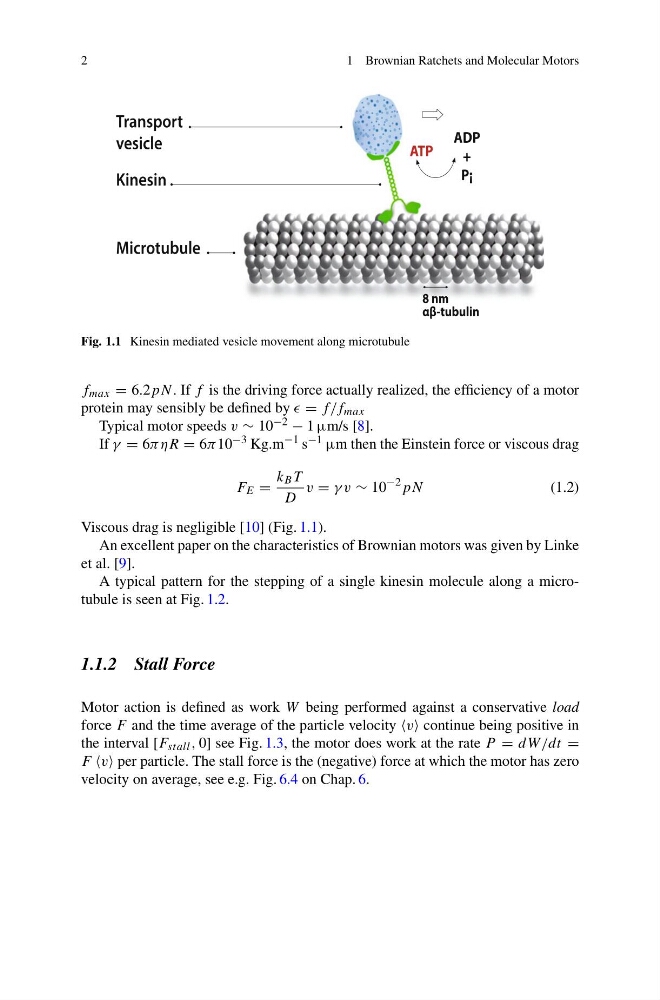
Fig. 1.1 Kinesin mediated vesicle movement along microtubule
f max = 6.2pN. If f is the driving force actually realized, the efficiency of a motor
protein may sensibly be defined by = f/f max
Typical motor speeds v ∼ 10 −2 − 1 μm/s [8].
If γ = 6πηR = 6π 10 −3 Kg.m
−1 s −1 μm then the Einstein force or viscous drag
F E =
k B T
D
v = γ v ∼ 10
−2 pN
(1.2)
Viscous drag is negligible [10] (Fig. 1.1).
An excellent paper on the characteristics of Brownian motors was given by Linke
et al. [9].
A typical pattern for the stepping of a single kinesin molecule along a microtubule is seen at Fig. 1.2.
1.1.2 Stall Force
Motor action is defined as work W being performed against a conservative load
force F and the time average of the particle velocity v continue being positive in
the interval [F stall , 0] see Fig. 1.3, the motor does work at the rate P = dW/dt =
F v per particle. The stall force is the (negative) force at which the motor has zero
velocity on average, see e.g. Fig. 6.4 on Chap. 6.
1 Brownian Ratchets and Molecular Motors
Fig. 1.1 Kinesin mediated vesicle movement along microtubule
f max = 6.2pN. If f is the driving force actually realized, the efficiency of a motor
protein may sensibly be defined by = f/f max
Typical motor speeds v ∼ 10 −2 − 1 μm/s [8].
If γ = 6πηR = 6π 10 −3 Kg.m
−1 s −1 μm then the Einstein force or viscous drag
F E =
k B T
D
v = γ v ∼ 10
−2 pN
(1.2)
Viscous drag is negligible [10] (Fig. 1.1).
An excellent paper on the characteristics of Brownian motors was given by Linke
et al. [9].
A typical pattern for the stepping of a single kinesin molecule along a microtubule is seen at Fig. 1.2.
1.1.2 Stall Force
Motor action is defined as work W being performed against a conservative load
force F and the time average of the particle velocity v continue being positive in
the interval [F stall , 0] see Fig. 1.3, the motor does work at the rate P = dW/dt =
F v per particle. The stall force is the (negative) force at which the motor has zero
velocity on average, see e.g. Fig. 6.4 on Chap. 6.