

118
7 Fluctuations of the Proton Electromotive Force Across Inner Mitochondrial. . .
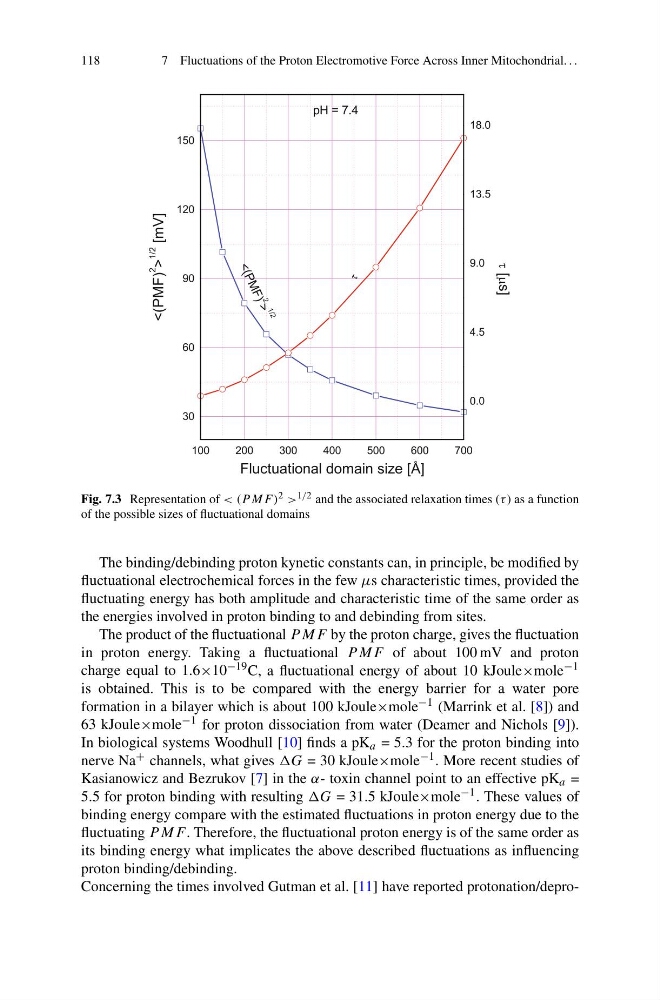
Fig. 7.3 Representation of < (P MF ) 2 > 1/2 and the associated relaxation times (τ ) as a function
of the possible sizes of fluctuational domains
The binding/debinding proton kynetic constants can, in principle, be modified by
fluctuational electrochemical forces in the few μs characteristic times, provided the
fluctuating energy has both amplitude and characteristic time of the same order as
the energies involved in proton binding to and debinding from sites.
The product of the fluctuational P MF by the proton charge, gives the fluctuation
in proton energy. Taking a fluctuational P MF of about 100 mV and proton
charge equal to 1.6×10 −19 C, a fluctuational energy of about 10 kJoule×mole −1
is obtained. This is to be compared with the energy barrier for a water pore
formation in a bilayer which is about 100 kJoule×mole −1 (Marrink et al. [8]) and
63 kJoule×mole −1 for proton dissociation from water (Deamer and Nichols [9]).
In biological systems Woodhull [10] finds a pK a = 5.3 for the proton binding into
nerve Na + channels, what gives G = 30 kJoule×mole −1 . More recent studies of
Kasianowicz and Bezrukov [7] in the α- toxin channel point to an effective pK a =
5.5 for proton binding with resulting G = 31.5 kJoule×mole −1 . These values of
binding energy compare with the estimated fluctuations in proton energy due to the
fluctuating P MF . Therefore, the fluctuational proton energy is of the same order as
its binding energy what implicates the above described fluctuations as influencing
proton binding/debinding.
Concerning the times involved Gutman et al. [11] have reported protonation/depro-
7 Fluctuations of the Proton Electromotive Force Across Inner Mitochondrial. . .
Fig. 7.3 Representation of < (P MF ) 2 > 1/2 and the associated relaxation times (τ ) as a function
of the possible sizes of fluctuational domains
The binding/debinding proton kynetic constants can, in principle, be modified by
fluctuational electrochemical forces in the few μs characteristic times, provided the
fluctuating energy has both amplitude and characteristic time of the same order as
the energies involved in proton binding to and debinding from sites.
The product of the fluctuational P MF by the proton charge, gives the fluctuation
in proton energy. Taking a fluctuational P MF of about 100 mV and proton
charge equal to 1.6×10 −19 C, a fluctuational energy of about 10 kJoule×mole −1
is obtained. This is to be compared with the energy barrier for a water pore
formation in a bilayer which is about 100 kJoule×mole −1 (Marrink et al. [8]) and
63 kJoule×mole −1 for proton dissociation from water (Deamer and Nichols [9]).
In biological systems Woodhull [10] finds a pK a = 5.3 for the proton binding into
nerve Na + channels, what gives G = 30 kJoule×mole −1 . More recent studies of
Kasianowicz and Bezrukov [7] in the α- toxin channel point to an effective pK a =
5.5 for proton binding with resulting G = 31.5 kJoule×mole −1 . These values of
binding energy compare with the estimated fluctuations in proton energy due to the
fluctuating P MF . Therefore, the fluctuational proton energy is of the same order as
its binding energy what implicates the above described fluctuations as influencing
proton binding/debinding.
Concerning the times involved Gutman et al. [11] have reported protonation/depro-