

7.7 Relaxation Times of the Electrical and Buffer Reservoirs
117
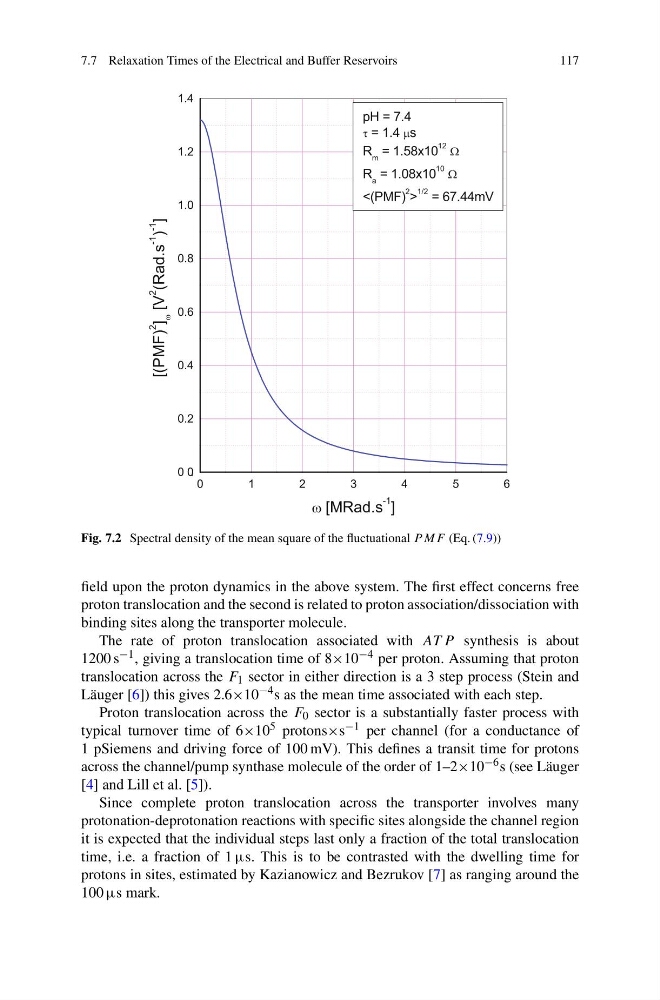
Fig. 7.2 Spectral density of the mean square of the fluctuational P MF (Eq. (7.9))
field upon the proton dynamics in the above system. The first effect concerns free
proton translocation and the second is related to proton association/dissociation with
binding sites along the transporter molecule.
The rate of proton translocation associated with AT P synthesis is about
1200 s −1 , giving a translocation time of 8×10 −4 per proton. Assuming that proton
translocation across the F 1 sector in either direction is a 3 step process (Stein and
Läuger [6]) this gives 2.6×10 −4 s as the mean time associated with each step.
Proton translocation across the F 0 sector is a substantially faster process with
typical turnover time of 6×10 5 protons×s −1 per channel (for a conductance of
1 pSiemens and driving force of 100 mV). This defines a transit time for protons
across the channel/pump synthase molecule of the order of 1–2×10 −6 s (see Läuger
[4] and Lill et al. [5]).
Since complete proton translocation across the transporter involves many
protonation-deprotonation reactions with specific sites alongside the channel region
it is expected that the individual steps last only a fraction of the total translocation
time, i.e. a fraction of 1 μs. This is to be contrasted with the dwelling time for
protons in sites, estimated by Kazianowicz and Bezrukov [7] as ranging around the
100 μs mark.
117
Fig. 7.2 Spectral density of the mean square of the fluctuational P MF (Eq. (7.9))
field upon the proton dynamics in the above system. The first effect concerns free
proton translocation and the second is related to proton association/dissociation with
binding sites along the transporter molecule.
The rate of proton translocation associated with AT P synthesis is about
1200 s −1 , giving a translocation time of 8×10 −4 per proton. Assuming that proton
translocation across the F 1 sector in either direction is a 3 step process (Stein and
Läuger [6]) this gives 2.6×10 −4 s as the mean time associated with each step.
Proton translocation across the F 0 sector is a substantially faster process with
typical turnover time of 6×10 5 protons×s −1 per channel (for a conductance of
1 pSiemens and driving force of 100 mV). This defines a transit time for protons
across the channel/pump synthase molecule of the order of 1–2×10 −6 s (see Läuger
[4] and Lill et al. [5]).
Since complete proton translocation across the transporter involves many
protonation-deprotonation reactions with specific sites alongside the channel region
it is expected that the individual steps last only a fraction of the total translocation
time, i.e. a fraction of 1 μs. This is to be contrasted with the dwelling time for
protons in sites, estimated by Kazianowicz and Bezrukov [7] as ranging around the
100 μs mark.