

241
environmental governance. Taken together we see possibilities that these measures
and reforms could promote a pathway towards regionally integrated and refl exive
governance arrangements .
First, based on previous literature, it is known that there often is a synergetic
relationship between the processes of Europeanisation and regionalisation (e.g. in
the Baltic Sea region) in marine environmental policy (Gilek et al. 2015a ). This can,
for example, be illustrated by the mutually reinforcing relationships between the EU
MSFD and HELCOM BSAP (Gilek et al. 2015b ). We argue that these synergistic
multilevel relationships can be strengthened further by coordinating implementation, but moreover by actually adjusting each of these policy schemes so that they
address gaps and ineffective overlaps. In addition, coordination is needed with the
EU Strategy for BSR, which ideally could serve as a bridging instrument. It would
also be highly benefi cial to, as far as needed and possible, attempt to ‘rescale’
regional initiatives from, for example, HELCOM, and make them into binding EU
directives or regulations as a means to improve enforcement possibilities in the EU
members states around the Baltic Sea.
Second, to improve possibilities for multisectoral coordination and integration,
we see substantial possibilities to reform sectoral policies such as CAP, CFP and
REACH in order to strengthen their interactions with environmental policies, such
as WFD, MSFD and BSAP. Without overlooking strong stakeholder interests striving to preserve as much control over policies as possible, we argue that coordination
would be more of a win-win exercise than non-coordination, since present sector
policies allow or even subsidise a development that society then tries to govern by
imposing environmental policies in terms of laws and taxation. Basically, such
insuffi cient multisectoral coordination creates a situation of confl ictual incentives
and suboptimal measures for farmers, fi shermen, etc., without any long-term safety
from either an environmental or market point of view. Well-coordinated frameworks
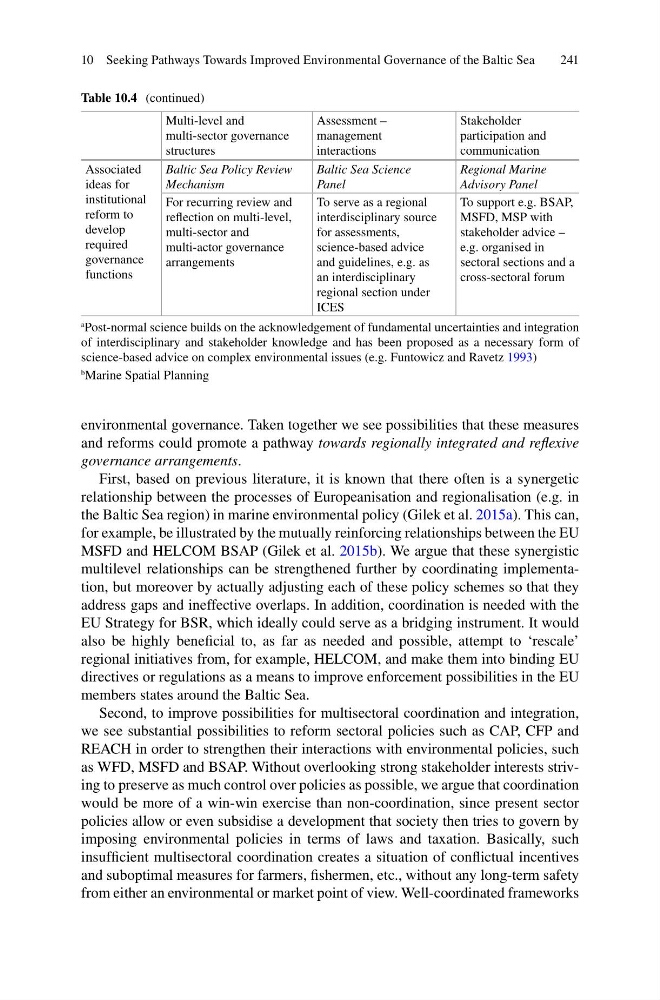
Table 10.4 (continued)
Multi-level and
multi-sector governance
structures
Assessment –
management
interactions
Stakeholder
participation and
communication
Associated
ideas for
institutional
reform to
develop
required
governance
functions
Baltic Sea Policy Review
Mechanism
Baltic Sea Science
Panel
Regional Marine
Advisory Panel
For recurring review and
refl ection on multi-level,
multi- sector and
multi-actor governance
arrangements
To serve as a regional
interdisciplinary source
for assessments,
science-based advice
and guidelines, e.g. as
an interdisciplinary
regional section under
ICES
To support e.g. BSAP,
MSFD, MSP with
stakeholder advice –
e.g. organised in
sectoral sections and a
cross- sectoral forum
a
Post-normal science builds on the acknowledgement of fundamental uncertainties and integration
of interdisciplinary and stakeholder knowledge and has been proposed as a necessary form of
science-based advice on complex environmental issues (e.g. Funtowicz and Ravetz 1993 )
b
Marine Spatial Planning
10 Seeking Pathways Towards Improved Environmental Governance of the Baltic Sea
environmental governance. Taken together we see possibilities that these measures
and reforms could promote a pathway towards regionally integrated and refl exive
governance arrangements .
First, based on previous literature, it is known that there often is a synergetic
relationship between the processes of Europeanisation and regionalisation (e.g. in
the Baltic Sea region) in marine environmental policy (Gilek et al. 2015a ). This can,
for example, be illustrated by the mutually reinforcing relationships between the EU
MSFD and HELCOM BSAP (Gilek et al. 2015b ). We argue that these synergistic
multilevel relationships can be strengthened further by coordinating implementation, but moreover by actually adjusting each of these policy schemes so that they
address gaps and ineffective overlaps. In addition, coordination is needed with the
EU Strategy for BSR, which ideally could serve as a bridging instrument. It would
also be highly benefi cial to, as far as needed and possible, attempt to ‘rescale’
regional initiatives from, for example, HELCOM, and make them into binding EU
directives or regulations as a means to improve enforcement possibilities in the EU
members states around the Baltic Sea.
Second, to improve possibilities for multisectoral coordination and integration,
we see substantial possibilities to reform sectoral policies such as CAP, CFP and
REACH in order to strengthen their interactions with environmental policies, such
as WFD, MSFD and BSAP. Without overlooking strong stakeholder interests striving to preserve as much control over policies as possible, we argue that coordination
would be more of a win-win exercise than non-coordination, since present sector
policies allow or even subsidise a development that society then tries to govern by
imposing environmental policies in terms of laws and taxation. Basically, such
insuffi cient multisectoral coordination creates a situation of confl ictual incentives
and suboptimal measures for farmers, fi shermen, etc., without any long-term safety
from either an environmental or market point of view. Well-coordinated frameworks
Table 10.4 (continued)
Multi-level and
multi-sector governance
structures
Assessment –
management
interactions
Stakeholder
participation and
communication
Associated
ideas for
institutional
reform to
develop
required
governance
functions
Baltic Sea Policy Review
Mechanism
Baltic Sea Science
Panel
Regional Marine
Advisory Panel
For recurring review and
refl ection on multi-level,
multi- sector and
multi-actor governance
arrangements
To serve as a regional
interdisciplinary source
for assessments,
science-based advice
and guidelines, e.g. as
an interdisciplinary
regional section under
ICES
To support e.g. BSAP,
MSFD, MSP with
stakeholder advice –
e.g. organised in
sectoral sections and a
cross- sectoral forum
a
Post-normal science builds on the acknowledgement of fundamental uncertainties and integration
of interdisciplinary and stakeholder knowledge and has been proposed as a necessary form of
science-based advice on complex environmental issues (e.g. Funtowicz and Ravetz 1993 )
b
Marine Spatial Planning
10 Seeking Pathways Towards Improved Environmental Governance of the Baltic Sea