

239
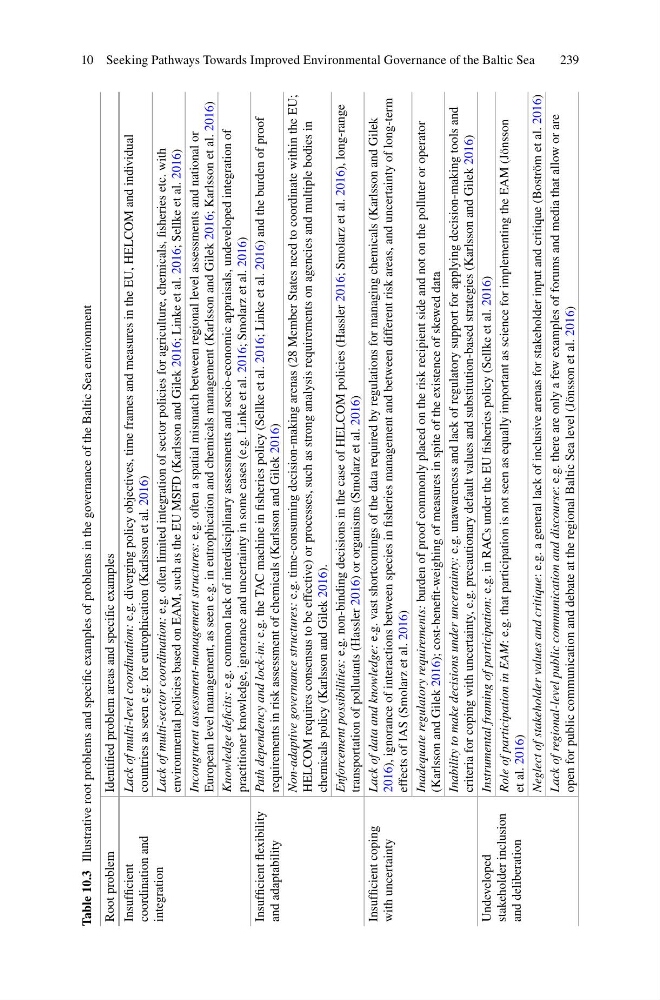
Table 10.3
Illustrative root problems and specifi c examples of problems in the governance of the Baltic Sea environment
Root problem
Identifi ed problem areas and specifi c examples
Insuffi cient
coordination and
integration
Lack of multi-level coordination:
e.g. diverging policy objectives, time frames and measures in the EU, HELCOM and individual
countries as seen e.g. for eutrophication (Karlsson et al. 2016 )
Lack of multi-sector coordination:
e.g. often limited integration of sector policies for agriculture, chemicals, fi sheries etc. with
environmental policies based on EAM, such as the EU MSFD (Karlsson and Gilek 2016 ; Linke et al. 2016 ; Sellke et al. 2016 )
Incongruent assessment-management structures:
e.g. often a spatial mismatch between regional level assessments and national or
European level management, as seen e.g. in eutrophication and chemicals management (Karlsson and Gilek 2016 ; Karlsson et al. 2016 )
Knowledge defi cits:
e.g. common lack of interdisciplinary assessments and socio-economic appraisals, undeveloped integration of
practitioner knowledge, ignorance and uncertainty in some cases (e.g. Linke et al. 2016 ; Smolarz et al. 2016 )
Insuffi cient fl exibility
and adaptability
Path dependency and lock-in:
e.g. the TAC machine in fi sheries policy (Sellke et al. 2016 ; Linke et al. 2016 ) and the burden of proof
requirements in risk assessment of chemicals (Karlsson and Gilek 2016 )
Non-adaptive governance structures:
e.g. time-consuming decision- making arenas (28 Member States need to coordinate within the EU;
HELCOM requires consensus to be effective) or processes, such as strong analysis requirements on agencies and multiple bodies in
chemicals policy (Karlsson and Gilek 2016 ).
Enforcement possibilities:
e.g. non-binding decisions in the case of HELCOM policies (Hassler 2016 ; Smolarz et al. 2016 ), long-range
transportation of pollutants (Hassler 2016 ) or organisms (Smolarz et al. 2016 )
Insuffi cient coping
with uncertainty
Lack of data and knowledge:
e.g. vast shortcomings of the data required by regulations for managing chemicals (Karlsson and Gilek
2016 ), ignorance of interactions between species in fi sheries management and between different risk areas, and uncertainty of long-term
effects of IAS (Smolarz et al. 2016 )
Inadequate regulatory requirements:
burden of proof commonly placed on the risk recipient side and not on the polluter or operator
(Karlsson and Gilek 2016 ); cost-benefi t-weighing of measures in spite of the existence of skewed data
Inability to make decisions under uncertainty:
e.g. unawareness and lack of regulatory support for applying decision-making tools and
criteria for coping with uncertainty, e.g. precautionary default values and substitution-based strategies (Karlsson and Gilek
2016 )
Undeveloped
stakeholder inclusion
and deliberation
Instrumental framing of participation:
e.g. in RACs under the EU fi sheries policy (Sellke et al. 2016 )
Role of participation in EAM
: e.g. that participation is not seen as equally important as science for implementing the EAM (Jönsson
et al. 2016 )
Neglect of stakeholder values and critique
: e.g. a general lack of inclusive arenas for stakeholder input and critique (Boström et al.
2016 )
Lack of regional-level public communication and discourse
: e.g. there are only a few examples of forums and media that allow or are
open for public communication and debate at the regional Baltic Sea level (Jönsson et al. 2016 )
10 Seeking Pathways Towards Improved Environmental Governance of the Baltic Sea
Table 10.3
Illustrative root problems and specifi c examples of problems in the governance of the Baltic Sea environment
Root problem
Identifi ed problem areas and specifi c examples
Insuffi cient
coordination and
integration
Lack of multi-level coordination:
e.g. diverging policy objectives, time frames and measures in the EU, HELCOM and individual
countries as seen e.g. for eutrophication (Karlsson et al. 2016 )
Lack of multi-sector coordination:
e.g. often limited integration of sector policies for agriculture, chemicals, fi sheries etc. with
environmental policies based on EAM, such as the EU MSFD (Karlsson and Gilek 2016 ; Linke et al. 2016 ; Sellke et al. 2016 )
Incongruent assessment-management structures:
e.g. often a spatial mismatch between regional level assessments and national or
European level management, as seen e.g. in eutrophication and chemicals management (Karlsson and Gilek 2016 ; Karlsson et al. 2016 )
Knowledge defi cits:
e.g. common lack of interdisciplinary assessments and socio-economic appraisals, undeveloped integration of
practitioner knowledge, ignorance and uncertainty in some cases (e.g. Linke et al. 2016 ; Smolarz et al. 2016 )
Insuffi cient fl exibility
and adaptability
Path dependency and lock-in:
e.g. the TAC machine in fi sheries policy (Sellke et al. 2016 ; Linke et al. 2016 ) and the burden of proof
requirements in risk assessment of chemicals (Karlsson and Gilek 2016 )
Non-adaptive governance structures:
e.g. time-consuming decision- making arenas (28 Member States need to coordinate within the EU;
HELCOM requires consensus to be effective) or processes, such as strong analysis requirements on agencies and multiple bodies in
chemicals policy (Karlsson and Gilek 2016 ).
Enforcement possibilities:
e.g. non-binding decisions in the case of HELCOM policies (Hassler 2016 ; Smolarz et al. 2016 ), long-range
transportation of pollutants (Hassler 2016 ) or organisms (Smolarz et al. 2016 )
Insuffi cient coping
with uncertainty
Lack of data and knowledge:
e.g. vast shortcomings of the data required by regulations for managing chemicals (Karlsson and Gilek
2016 ), ignorance of interactions between species in fi sheries management and between different risk areas, and uncertainty of long-term
effects of IAS (Smolarz et al. 2016 )
Inadequate regulatory requirements:
burden of proof commonly placed on the risk recipient side and not on the polluter or operator
(Karlsson and Gilek 2016 ); cost-benefi t-weighing of measures in spite of the existence of skewed data
Inability to make decisions under uncertainty:
e.g. unawareness and lack of regulatory support for applying decision-making tools and
criteria for coping with uncertainty, e.g. precautionary default values and substitution-based strategies (Karlsson and Gilek
2016 )
Undeveloped
stakeholder inclusion
and deliberation
Instrumental framing of participation:
e.g. in RACs under the EU fi sheries policy (Sellke et al. 2016 )
Role of participation in EAM
: e.g. that participation is not seen as equally important as science for implementing the EAM (Jönsson
et al. 2016 )
Neglect of stakeholder values and critique
: e.g. a general lack of inclusive arenas for stakeholder input and critique (Boström et al.
2016 )
Lack of regional-level public communication and discourse
: e.g. there are only a few examples of forums and media that allow or are
open for public communication and debate at the regional Baltic Sea level (Jönsson et al. 2016 )
10 Seeking Pathways Towards Improved Environmental Governance of the Baltic Sea