

233
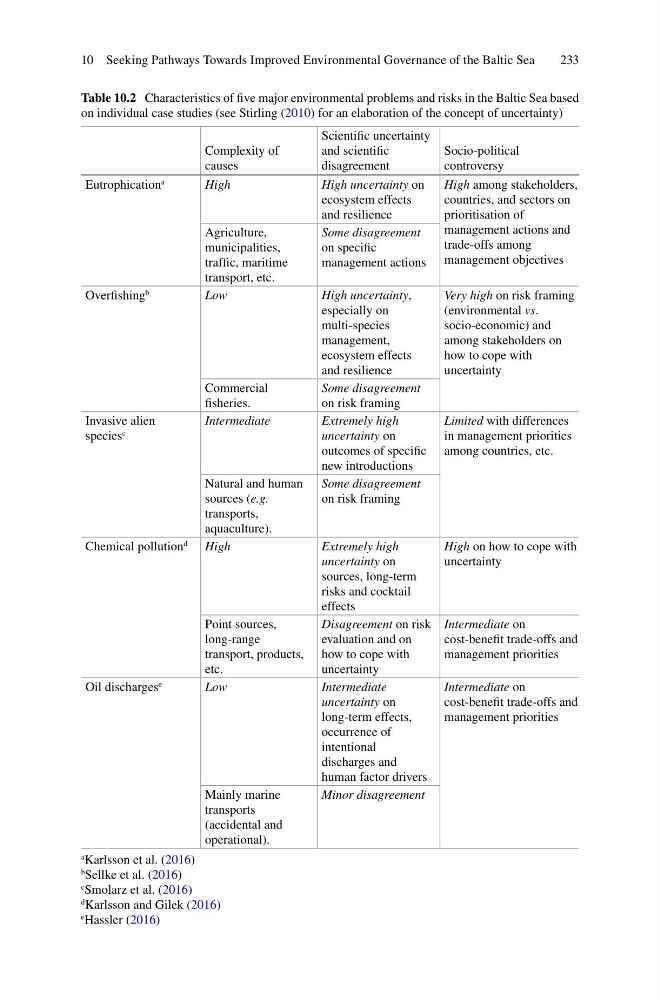
Table 10.2 Characteristics of fi ve major environmental problems and risks in the Baltic Sea based
on individual case studies (see Stirling ( 2010 ) for an elaboration of the concept of uncertainty)
Complexity of
causes
Scientifi c uncertainty
and scientifi c
disagreement
Socio-political
controversy
Eutrophication
a
High
High uncertainty on
ecosystem effects
and resilience
High among stakeholders,
countries, and sectors on
prioritisation of
management actions and
trade-offs among
management objectives
Agriculture,
municipalities,
traffi c, maritime
transport, etc.
Some disagreement
on specifi c
management actions
Overfi shing
b
Low
High uncertainty ,
especially on
multi-species
management,
ecosystem effects
and resilience
Very high on risk framing
(environmental vs .
socio-economic) and
among stakeholders on
how to cope with
uncertainty
Commercial
fi sheries.
Some disagreement
on risk framing
Invasive alien
species
c
Intermediate
Extremely high
uncertainty on
outcomes of specifi c
new introductions
Limited with differences
in management priorities
among countries, etc.
Natural and human
sources ( e.g.
transports,
aquaculture).
Some disagreement
on risk framing
Chemical pollution
d
High
Extremely high
uncertainty on
sources, long-term
risks and cocktail
effects
High on how to cope with
uncertainty
Point sources,
long-range
transport, products,
etc.
Disagreement on risk
evaluation and on
how to cope with
uncertainty
Intermediate on
cost-benefi t trade-offs and
management priorities
Oil discharges
e
Low
Intermediate
uncertainty on
long-term effects,
occurrence of
intentional
discharges and
human factor drivers
Intermediate on
cost-benefi t trade-offs and
management priorities
Mainly marine
transports
(accidental and
operational).
Minor disagreement
a
Karlsson et al. ( 2016 )
b
Sellke et al. ( 2016 )
c
Smolarz et al. ( 2016 )
d
Karlsson and Gilek ( 2016 )
e
Hassler ( 2016 )
10 Seeking Pathways Towards Improved Environmental Governance of the Baltic Sea
Table 10.2 Characteristics of fi ve major environmental problems and risks in the Baltic Sea based
on individual case studies (see Stirling ( 2010 ) for an elaboration of the concept of uncertainty)
Complexity of
causes
Scientifi c uncertainty
and scientifi c
disagreement
Socio-political
controversy
Eutrophication
a
High
High uncertainty on
ecosystem effects
and resilience
High among stakeholders,
countries, and sectors on
prioritisation of
management actions and
trade-offs among
management objectives
Agriculture,
municipalities,
traffi c, maritime
transport, etc.
Some disagreement
on specifi c
management actions
Overfi shing
b
Low
High uncertainty ,
especially on
multi-species
management,
ecosystem effects
and resilience
Very high on risk framing
(environmental vs .
socio-economic) and
among stakeholders on
how to cope with
uncertainty
Commercial
fi sheries.
Some disagreement
on risk framing
Invasive alien
species
c
Intermediate
Extremely high
uncertainty on
outcomes of specifi c
new introductions
Limited with differences
in management priorities
among countries, etc.
Natural and human
sources ( e.g.
transports,
aquaculture).
Some disagreement
on risk framing
Chemical pollution
d
High
Extremely high
uncertainty on
sources, long-term
risks and cocktail
effects
High on how to cope with
uncertainty
Point sources,
long-range
transport, products,
etc.
Disagreement on risk
evaluation and on
how to cope with
uncertainty
Intermediate on
cost-benefi t trade-offs and
management priorities
Oil discharges
e
Low
Intermediate
uncertainty on
long-term effects,
occurrence of
intentional
discharges and
human factor drivers
Intermediate on
cost-benefi t trade-offs and
management priorities
Mainly marine
transports
(accidental and
operational).
Minor disagreement
a
Karlsson et al. ( 2016 )
b
Sellke et al. ( 2016 )
c
Smolarz et al. ( 2016 )
d
Karlsson and Gilek ( 2016 )
e
Hassler ( 2016 )
10 Seeking Pathways Towards Improved Environmental Governance of the Baltic Sea