

232
disagreements seem to impede governance to any signifi cant extent. Risk assessment and risk management are relatively straightforward exercises mostly characterised by monitoring and surveillance on the assessment side and a combination of
fl ag and port state controls in terms of management. Creating incentives for key
actors has been important, as have been measures taken by proactive states. We
consider that continuing along these lines through EU and HELCOM initiatives
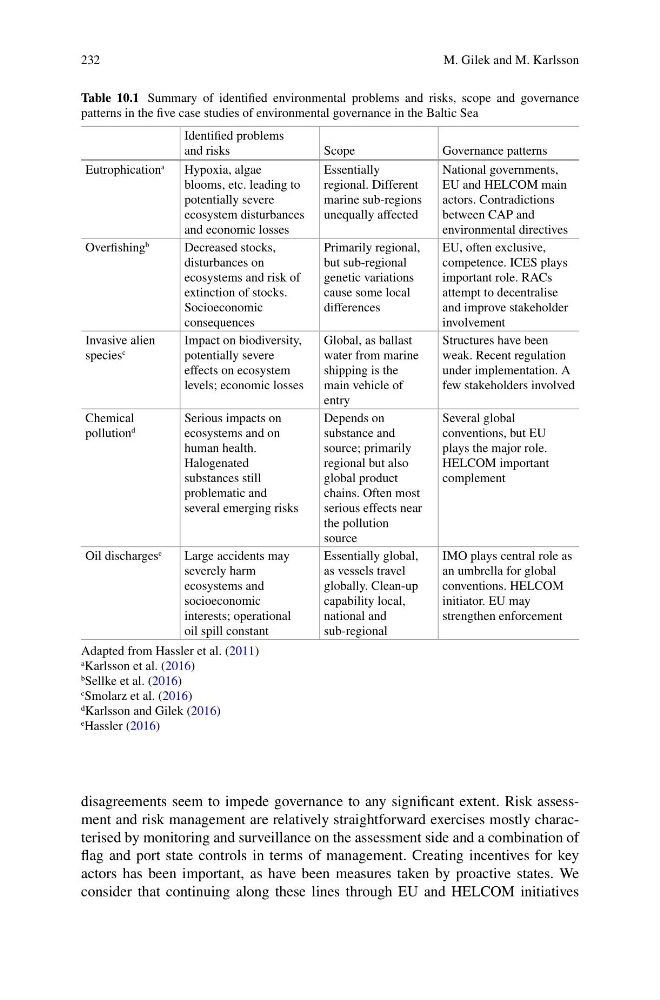
Table 10.1 Summary of identifi ed environmental problems and risks, scope and governance
patterns in the fi ve case studies of environmental governance in the Baltic Sea
Identifi ed problems
and risks
Scope
Governance patterns
Eutrophication
a
Hypoxia, algae
blooms, etc. leading to
potentially severe
ecosystem disturbances
and economic losses
Essentially
regional. Different
marine sub-regions
unequally affected
National governments,
EU and HELCOM main
actors. Contradictions
between CAP and
environmental directives
Overfi shing
b
Decreased stocks,
disturbances on
ecosystems and risk of
extinction of stocks.
Socioeconomic
consequences
Primarily regional,
but sub-regional
genetic variations
cause some local
differences
EU, often exclusive,
competence. ICES plays
important role. RACs
attempt to decentralise
and improve stakeholder
involvement
Invasive alien
species
c
Impact on biodiversity,
potentially severe
effects on ecosystem
levels; economic losses
Global, as ballast
water from marine
shipping is the
main vehicle of
entry
Structures have been
weak. Recent regulation
under implementation. A
few stakeholders involved
Chemical
pollution
d
Serious impacts on
ecosystems and on
human health.
Halogenated
substances still
problematic and
several emerging risks
Depends on
substance and
source; primarily
regional but also
global product
chains. Often most
serious effects near
the pollution
source
Several global
conventions, but EU
plays the major role.
HELCOM important
complement
Oil discharges
e
Large accidents may
severely harm
ecosystems and
socioeconomic
interests; operational
oil spill constant
Essentially global,
as vessels travel
globally. Clean-up
capability local,
national and
sub-regional
IMO plays central role as
an umbrella for global
conventions. HELCOM
initiator. EU may
strengthen enforcement
Adapted from Hassler et al. ( 2011 )
a
Karlsson et al. ( 2016 )
b
Sellke et al. ( 2016 )
c
Smolarz et al. ( 2016 )
d
Karlsson and Gilek ( 2016 )
e
Hassler ( 2016 )
M. Gilek and M. Karlsson
disagreements seem to impede governance to any signifi cant extent. Risk assessment and risk management are relatively straightforward exercises mostly characterised by monitoring and surveillance on the assessment side and a combination of
fl ag and port state controls in terms of management. Creating incentives for key
actors has been important, as have been measures taken by proactive states. We
consider that continuing along these lines through EU and HELCOM initiatives
Table 10.1 Summary of identifi ed environmental problems and risks, scope and governance
patterns in the fi ve case studies of environmental governance in the Baltic Sea
Identifi ed problems
and risks
Scope
Governance patterns
Eutrophication
a
Hypoxia, algae
blooms, etc. leading to
potentially severe
ecosystem disturbances
and economic losses
Essentially
regional. Different
marine sub-regions
unequally affected
National governments,
EU and HELCOM main
actors. Contradictions
between CAP and
environmental directives
Overfi shing
b
Decreased stocks,
disturbances on
ecosystems and risk of
extinction of stocks.
Socioeconomic
consequences
Primarily regional,
but sub-regional
genetic variations
cause some local
differences
EU, often exclusive,
competence. ICES plays
important role. RACs
attempt to decentralise
and improve stakeholder
involvement
Invasive alien
species
c
Impact on biodiversity,
potentially severe
effects on ecosystem
levels; economic losses
Global, as ballast
water from marine
shipping is the
main vehicle of
entry
Structures have been
weak. Recent regulation
under implementation. A
few stakeholders involved
Chemical
pollution
d
Serious impacts on
ecosystems and on
human health.
Halogenated
substances still
problematic and
several emerging risks
Depends on
substance and
source; primarily
regional but also
global product
chains. Often most
serious effects near
the pollution
source
Several global
conventions, but EU
plays the major role.
HELCOM important
complement
Oil discharges
e
Large accidents may
severely harm
ecosystems and
socioeconomic
interests; operational
oil spill constant
Essentially global,
as vessels travel
globally. Clean-up
capability local,
national and
sub-regional
IMO plays central role as
an umbrella for global
conventions. HELCOM
initiator. EU may
strengthen enforcement
Adapted from Hassler et al. ( 2011 )
a
Karlsson et al. ( 2016 )
b
Sellke et al. ( 2016 )
c
Smolarz et al. ( 2016 )
d
Karlsson and Gilek ( 2016 )
e
Hassler ( 2016 )
M. Gilek and M. Karlsson