

139
darkness) and place (areas where surveillance is known to be lax) to make intentional spills. If this is correct, the number of undetected oil spills could be substantial. Possible partial solutions to this problem could be more effective satellite
surveillance, increasing the number of fl ight hours in darkness and using and intensifying the use of joint surveillance efforts that are not announced beforehand
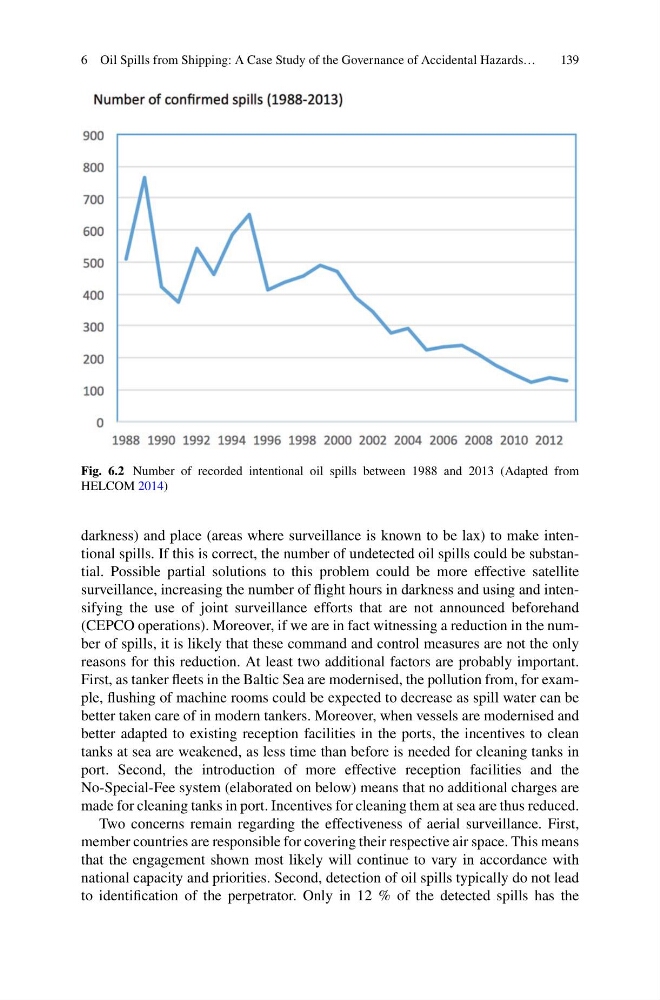
(CEPCO operations). Moreover, if we are in fact witnessing a reduction in the number of spills, it is likely that these command and control measures are not the only
reasons for this reduction. At least two additional factors are probably important.
First, as tanker fl eets in the Baltic Sea are modernised, the pollution from, for example, fl ushing of machine rooms could be expected to decrease as spill water can be
better taken care of in modern tankers. Moreover, when vessels are modernised and
better adapted to existing reception facilities in the ports, the incentives to clean
tanks at sea are weakened, as less time than before is needed for cleaning tanks in
port. Second, the introduction of more effective reception facilities and the
No-Special- Fee system (elaborated on below) means that no additional charges are
made for cleaning tanks in port. Incentives for cleaning them at sea are thus reduced.
Two concerns remain regarding the effectiveness of aerial surveillance . First,
member countries are responsible for covering their respective air space. This means
that the engagement shown most likely will continue to vary in accordance with
national capacity and priorities. Second, detection of oil spills typically do not lead
to identifi cation of the perpetrator. Only in 12 % of the detected spills has the
Fig. 6.2 Number of recorded intentional oil spills between 1988 and 2013 (Adapted from
HELCOM 2014 )
6 Oil Spills from Shipping: A Case Study of the Governance of Accidental Hazards…
darkness) and place (areas where surveillance is known to be lax) to make intentional spills. If this is correct, the number of undetected oil spills could be substantial. Possible partial solutions to this problem could be more effective satellite
surveillance, increasing the number of fl ight hours in darkness and using and intensifying the use of joint surveillance efforts that are not announced beforehand
(CEPCO operations). Moreover, if we are in fact witnessing a reduction in the number of spills, it is likely that these command and control measures are not the only
reasons for this reduction. At least two additional factors are probably important.
First, as tanker fl eets in the Baltic Sea are modernised, the pollution from, for example, fl ushing of machine rooms could be expected to decrease as spill water can be
better taken care of in modern tankers. Moreover, when vessels are modernised and
better adapted to existing reception facilities in the ports, the incentives to clean
tanks at sea are weakened, as less time than before is needed for cleaning tanks in
port. Second, the introduction of more effective reception facilities and the
No-Special- Fee system (elaborated on below) means that no additional charges are
made for cleaning tanks in port. Incentives for cleaning them at sea are thus reduced.
Two concerns remain regarding the effectiveness of aerial surveillance . First,
member countries are responsible for covering their respective air space. This means
that the engagement shown most likely will continue to vary in accordance with
national capacity and priorities. Second, detection of oil spills typically do not lead
to identifi cation of the perpetrator. Only in 12 % of the detected spills has the
Fig. 6.2 Number of recorded intentional oil spills between 1988 and 2013 (Adapted from
HELCOM 2014 )
6 Oil Spills from Shipping: A Case Study of the Governance of Accidental Hazards…