

(b) the amount of the absorbed heat.
The gas is assumed to be a Van der Waals gas.
2.59. For a Van der Waals gas find:
(a) the equation of the adiabatic curve in the variables T, V;
(b) the difference of the molar heat capacities CI, — Cv as a function of T and V.
2.60. Two thermally insulated vessels are interconnected by a
tube equipped with a valve. One vessel of volume V1 = 10 1 contains
v = 2.5 moles of carbon dioxide. The other vessel of volume V 2 =
100 1 is evacuated. The valve having been opened, the gas adiabatically expanded. Assuming the gas to obey the Van der Waals equation,
find its temperature change accompanying the expansion.
2.61. What amount of heat has to be transferred to v = 3.0 moles
of carbon dioxide to keep its temperature constant while it expands into vacuum from the volume V1 = 5.0 1 to V 2 = 10 1? The
gas is assumed to be a Van der Waals gas.
2.3. KINETIC THEORY OF GASES.
BOLTZMANN' S LAW AND MAXWELL'S DISTRIBUTION
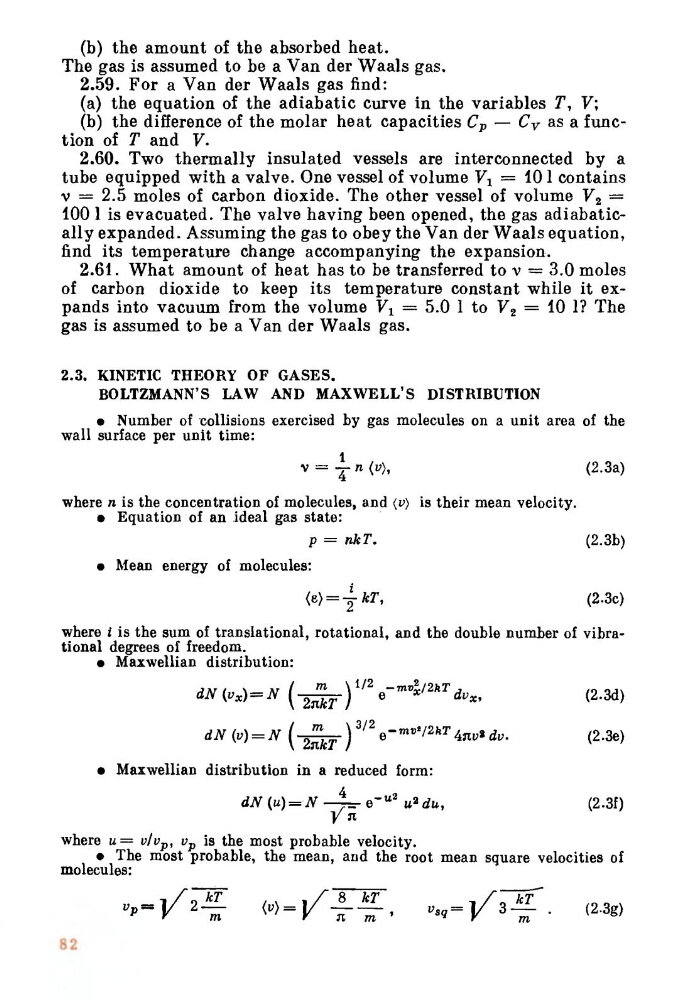
• Number of collisions exercised by gas molecules on a unit area of the
wall surface per unit time:
1
v= 4
— n (v),
where n is the concentration of molecules, and (v) is their mean velocity.
• Equation of an ideal gas state:
p = nkT.
• Mean energy of molecules:
(e) = 2
— kT,
(2.3c)
where i is the sum of translational, rotational, and the double number of vibrational degrees of freedom.
• Maxwellian distribution:
m 1 1/2 -mv2/21a dvx,
(2.3d)
dN (vx)=- - N ( 2nkT ) e s
dN (v)= N
e-mv2/2kT 4:tv2 dv.
(2.3e)
(
m \ 3/
2
2nkT )
• Maxwellian distribution in a reduced form:
dN (u)= N
4 e-u2 U2 du,
(2.3f)
where u = v/vp, vp is the most probable velocity.
• The most probable, the mean, and the root mean square velocities of
molecules:
(2.3a)
(2.3b)
n kT
kT
kT
Vp
(V) =
Vsq =
- .
(2.3g)
The gas is assumed to be a Van der Waals gas.
2.59. For a Van der Waals gas find:
(a) the equation of the adiabatic curve in the variables T, V;
(b) the difference of the molar heat capacities CI, — Cv as a function of T and V.
2.60. Two thermally insulated vessels are interconnected by a
tube equipped with a valve. One vessel of volume V1 = 10 1 contains
v = 2.5 moles of carbon dioxide. The other vessel of volume V 2 =
100 1 is evacuated. The valve having been opened, the gas adiabatically expanded. Assuming the gas to obey the Van der Waals equation,
find its temperature change accompanying the expansion.
2.61. What amount of heat has to be transferred to v = 3.0 moles
of carbon dioxide to keep its temperature constant while it expands into vacuum from the volume V1 = 5.0 1 to V 2 = 10 1? The
gas is assumed to be a Van der Waals gas.
2.3. KINETIC THEORY OF GASES.
BOLTZMANN' S LAW AND MAXWELL'S DISTRIBUTION
• Number of collisions exercised by gas molecules on a unit area of the
wall surface per unit time:
1
v= 4
— n (v),
where n is the concentration of molecules, and (v) is their mean velocity.
• Equation of an ideal gas state:
p = nkT.
• Mean energy of molecules:
(e) = 2
— kT,
(2.3c)
where i is the sum of translational, rotational, and the double number of vibrational degrees of freedom.
• Maxwellian distribution:
m 1 1/2 -mv2/21a dvx,
(2.3d)
dN (vx)=- - N ( 2nkT ) e s
dN (v)= N
e-mv2/2kT 4:tv2 dv.
(2.3e)
(
m \ 3/
2
2nkT )
• Maxwellian distribution in a reduced form:
dN (u)= N
4 e-u2 U2 du,
(2.3f)
where u = v/vp, vp is the most probable velocity.
• The most probable, the mean, and the root mean square velocities of
molecules:
(2.3a)
(2.3b)
n kT
kT
kT
Vp
(V) =
Vsq =
- .
(2.3g)