

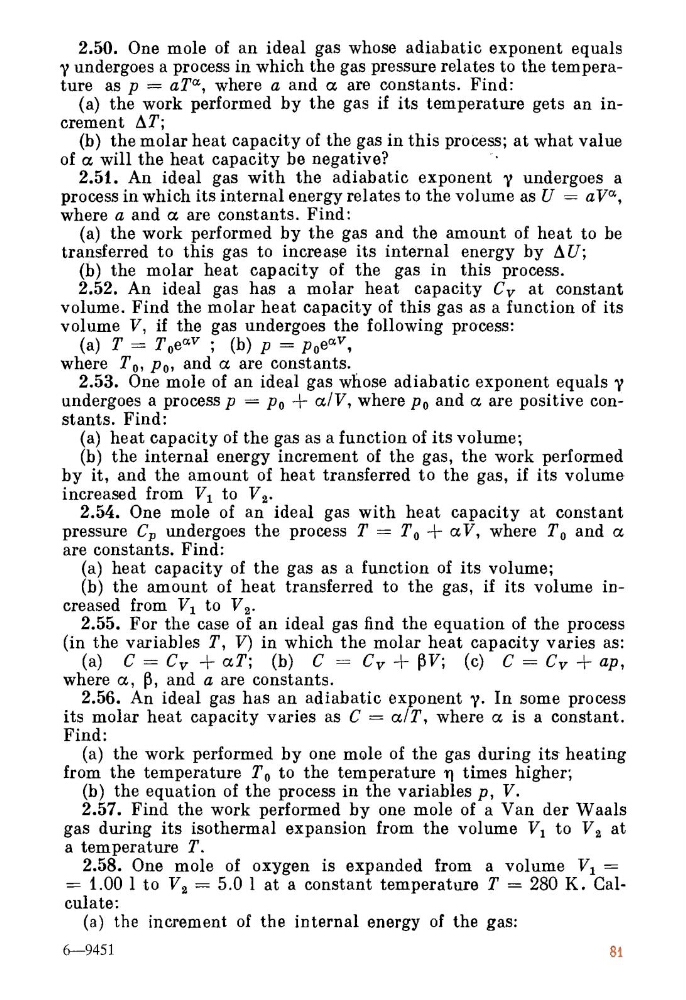
2.50. One mole of an ideal gas whose adiabatic exponent equals
y undergoes a process in which the gas pressure relates to the temperature as p = aTa, where a and a are constants. Find:
(a) the work performed by the gas if its temperature gets an increment AT;
(b) the molar heat capacity of the gas in this process; at what value
of a will the heat capacity be negative?
2.51. An ideal gas with the adiabatic exponent y undergoes a
process in which its internal energy relates to the volume as U = aVa,
where a and a are constants. Find:
(a) the work performed by the gas and the amount of heat to be
transferred to this gas to increase its internal energy by AU;
(b) the molar heat capacity of the gas in this process.
2.52. An ideal gas has a molar heat capacity Cv at constant
volume. Find the molar heat capacity of this gas as a function of its
volume V, if the gas undergoes the following process:
(a) T = T oeav ; (b) p = poeary,
where To, po, and a are constants.
2.53. One mole of an ideal gas whose adiabatic exponent equals y
undergoes a process p = po alV, where Po and a are positive constants. Find:
(a) heat capacity of the gas as a function of its volume;
(b) the internal energy increment of the gas, the work performed
by it, and the amount of heat transferred to the gas, if its volume
increased from V1 to V2.
2.54. One mole of an ideal gas with heat capacity at constant
pressure Cp undergoes the process T = T o + aV, where T o and a
are constants. Find:
(a) heat capacity of the gas as a function of its volume;
(b) the amount of heat transferred to the gas, if its volume increased from V1 to V 2.
2.55. For the case of an ideal gas find the equation of the process
(in the variables T, V) in which the molar heat capacity varies as:
(a) C Cv aT; (b) C = Cv 1W; (c) C = Cv ap,
where a, 3, and a are constants.
2.56. An ideal gas has an adiabatic exponent y. In some process
its molar heat capacity varies as C = alT, where a is a constant.
Find:
(a) the work performed by one mole of the gas during its heating
from the temperature To to the temperature n times higher;
(b) the equation of the process in the variables p, V.
2.57. Find the work performed by one mole of a Van der Waals
gas during its isothermal expansion from the volume V1 to V2 at
a temperature T.
2.58. One mole of oxygen is expanded from a volume V1 =
= 1.00 1 to V2 = 5.0 1 at a constant temperature T = 280 K. Calculate:
(a) the increment of the internal energy of the gas:
6-9451
81
y undergoes a process in which the gas pressure relates to the temperature as p = aTa, where a and a are constants. Find:
(a) the work performed by the gas if its temperature gets an increment AT;
(b) the molar heat capacity of the gas in this process; at what value
of a will the heat capacity be negative?
2.51. An ideal gas with the adiabatic exponent y undergoes a
process in which its internal energy relates to the volume as U = aVa,
where a and a are constants. Find:
(a) the work performed by the gas and the amount of heat to be
transferred to this gas to increase its internal energy by AU;
(b) the molar heat capacity of the gas in this process.
2.52. An ideal gas has a molar heat capacity Cv at constant
volume. Find the molar heat capacity of this gas as a function of its
volume V, if the gas undergoes the following process:
(a) T = T oeav ; (b) p = poeary,
where To, po, and a are constants.
2.53. One mole of an ideal gas whose adiabatic exponent equals y
undergoes a process p = po alV, where Po and a are positive constants. Find:
(a) heat capacity of the gas as a function of its volume;
(b) the internal energy increment of the gas, the work performed
by it, and the amount of heat transferred to the gas, if its volume
increased from V1 to V2.
2.54. One mole of an ideal gas with heat capacity at constant
pressure Cp undergoes the process T = T o + aV, where T o and a
are constants. Find:
(a) heat capacity of the gas as a function of its volume;
(b) the amount of heat transferred to the gas, if its volume increased from V1 to V 2.
2.55. For the case of an ideal gas find the equation of the process
(in the variables T, V) in which the molar heat capacity varies as:
(a) C Cv aT; (b) C = Cv 1W; (c) C = Cv ap,
where a, 3, and a are constants.
2.56. An ideal gas has an adiabatic exponent y. In some process
its molar heat capacity varies as C = alT, where a is a constant.
Find:
(a) the work performed by one mole of the gas during its heating
from the temperature To to the temperature n times higher;
(b) the equation of the process in the variables p, V.
2.57. Find the work performed by one mole of a Van der Waals
gas during its isothermal expansion from the volume V1 to V2 at
a temperature T.
2.58. One mole of oxygen is expanded from a volume V1 =
= 1.00 1 to V2 = 5.0 1 at a constant temperature T = 280 K. Calculate:
(a) the increment of the internal energy of the gas:
6-9451
81