

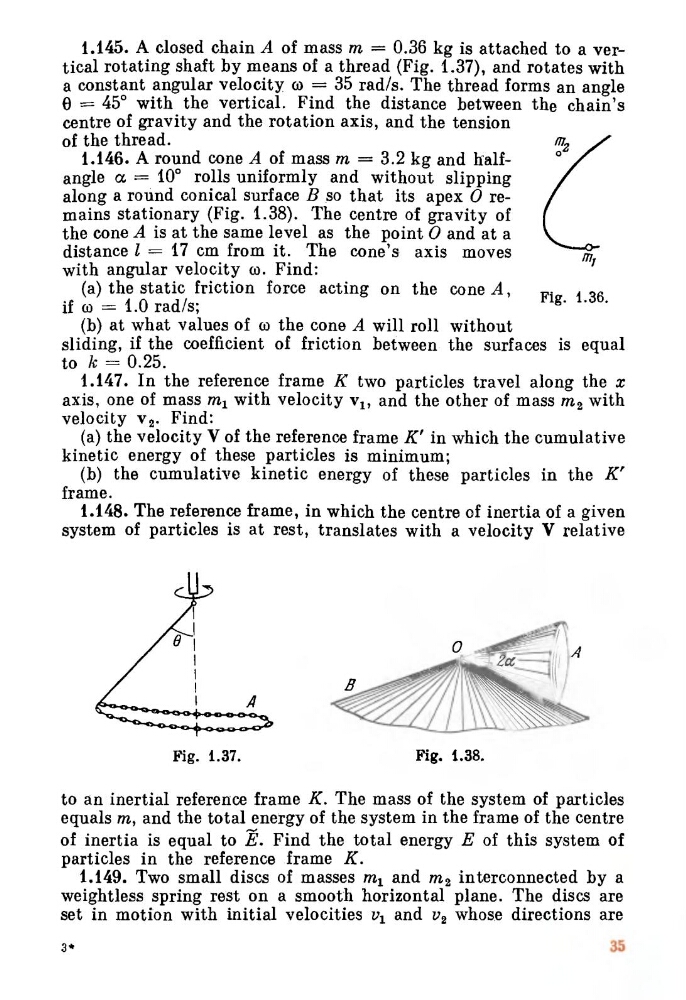
1.145. A closed chain A of mass m = 0.36 kg is attached to a vertical rotating shaft by means of a thread (Fig. 1.37), and rotates with
a constant angular velocity co = 35 rad/s. The thread forms an angle
0 = 45° with the vertical. Find the distance between the chain's
centre of gravity and the rotation axis, and the tension
of the thread.
1.146. A round cone A of mass m = 3.2 kg and halfangle a = 10° rolls uniformly and without slipping
along a round conical surface B so that its apex 0 remains stationary (Fig. 1.38). The centre of gravity of
the cone A is at the same level as the point 0 and at a
distance 1 = 17 cm from it. The cone's axis moves
with angular velocity w. Find:
(a) the static friction force acting on the cone A,
Fig. 1.36.
if co = 1.0 rad/s;
(b) at what values of co the cone A will roll without
sliding, if the coefficient of friction between the surfaces is equal
to k = 0.25.
1.147. In the reference frame K two particles travel along the x
axis, one of mass m1 with velocity v1, and the other of mass m2 with
velocity v2. Find:
(a) the velocity V of the reference frame K' in which the cumulative
kinetic energy of these particles is minimum;
(b) the cumulative kinetic energy of these particles in the K'
frame.
1.148. The reference frame, in which the centre of inertia of a given
system of particles is at rest, translates with a velocity V relative
Bj
I
Fig. 1.37.
Fig. 1.38.
to an inertial reference frame K. The mass of the system of particles
equals m, and the total energy of the system in the frame of the centre
of inertia is equal to E. Find the total energy E of this system of
particles in the reference frame K.
1.149. Two small discs of masses m1 and m2 interconnected by a
weightless spring rest on a smooth horizontal plane. The discs are
set in motion with initial velocities v1 and v2 whose directions are
3*
a constant angular velocity co = 35 rad/s. The thread forms an angle
0 = 45° with the vertical. Find the distance between the chain's
centre of gravity and the rotation axis, and the tension
of the thread.
1.146. A round cone A of mass m = 3.2 kg and halfangle a = 10° rolls uniformly and without slipping
along a round conical surface B so that its apex 0 remains stationary (Fig. 1.38). The centre of gravity of
the cone A is at the same level as the point 0 and at a
distance 1 = 17 cm from it. The cone's axis moves
with angular velocity w. Find:
(a) the static friction force acting on the cone A,
Fig. 1.36.
if co = 1.0 rad/s;
(b) at what values of co the cone A will roll without
sliding, if the coefficient of friction between the surfaces is equal
to k = 0.25.
1.147. In the reference frame K two particles travel along the x
axis, one of mass m1 with velocity v1, and the other of mass m2 with
velocity v2. Find:
(a) the velocity V of the reference frame K' in which the cumulative
kinetic energy of these particles is minimum;
(b) the cumulative kinetic energy of these particles in the K'
frame.
1.148. The reference frame, in which the centre of inertia of a given
system of particles is at rest, translates with a velocity V relative
Bj
I
Fig. 1.37.
Fig. 1.38.
to an inertial reference frame K. The mass of the system of particles
equals m, and the total energy of the system in the frame of the centre
of inertia is equal to E. Find the total energy E of this system of
particles in the reference frame K.
1.149. Two small discs of masses m1 and m2 interconnected by a
weightless spring rest on a smooth horizontal plane. The discs are
set in motion with initial velocities v1 and v2 whose directions are
3*