

1.139. A smooth rubber cord of length 1 whose coefficient of elasticity is k is suspended by one end from the point 0 (Fig. L33).
The other end is fitted with a catch B. A small sleeve A of mass m
starts falling from the point 0. Neglecting the masses of the thread
and the catch, find the maximum elongation of the cord.
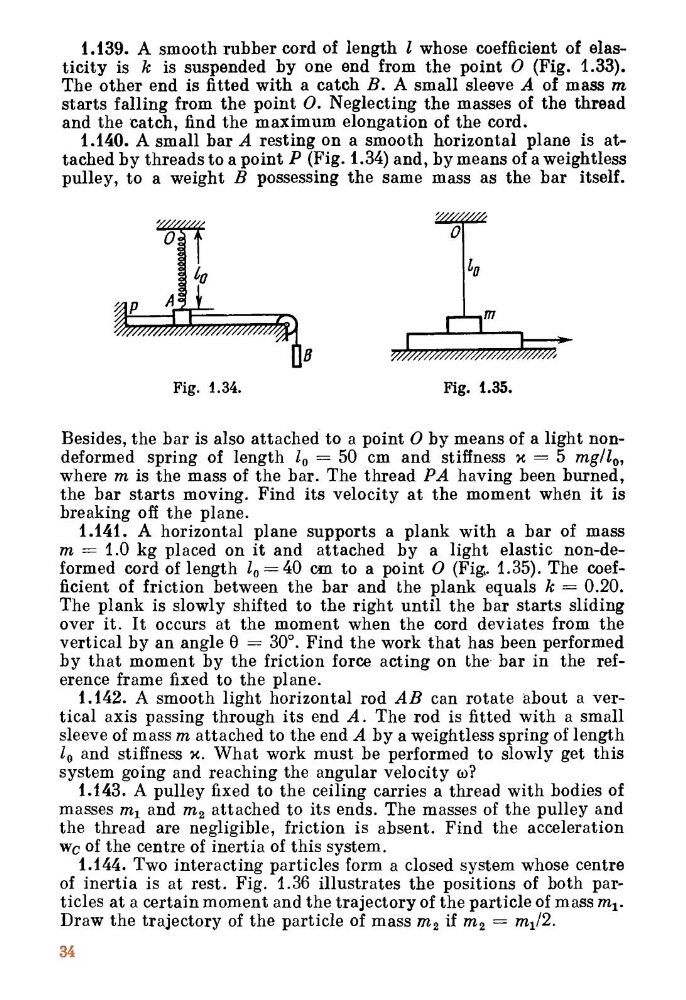
1.140. A small bar A resting on a smooth horizontal plane is attached by threads to a point P (Fig. 1.34) and, by means of a weightless
pulley, to a weight B possessing the same mass as the bar itself.
Fig. 1.34.
Fig. 1.35.
Besides, the bar is also attached to a point 0 by means of a light nondeformed spring of length 1, = 50 cm and stiffness x = 5 mg/to,
where m is the mass of the bar. The thread PA having been burned,
the bar starts moving. Find its velocity at the moment when it is
breaking off the plane.
1.141. A horizontal plane supports a plank with a bar of mass
m = 1.0 kg placed on it and attached by a light elastic non-deformed cord of length /0 = 40 cm to a point 0 (Fig. 1.35). The coefficient of friction between the bar and the plank equals k = 0.20.
The plank is slowly shifted to the right until the bar starts sliding
over it. It occurs at the moment when the cord deviates from the
vertical by an angle 0 = 30°. Find the work that has been performed
by that moment by the friction force acting on the bar in the reference frame fixed to the plane.
1.142. A smooth light horizontal rod AB can rotate about a vertical axis passing through its end A. The rod is fitted with a small
sleeve of mass m attached to the end A by a weightless spring of length
to and stiffness x. What work must be performed to slowly get this
system going and reaching the angular velocity o?
1.143. A pulley fixed to the ceiling carries a thread with bodies of
masses m1 and m2 attached to its ends. The masses of the pulley and
the thread are negligible, friction is absent. Find the acceleration
we of the centre of inertia of this system.
1.144. Two interacting particles form a closed system whose centre
of inertia is at rest. Fig. 1.36 illustrates the positions of both particles at a certain moment and the trajectory of the particle of mass
Draw the trajectory of the particle of mass m2 if m2 = m1/2.
34
The other end is fitted with a catch B. A small sleeve A of mass m
starts falling from the point 0. Neglecting the masses of the thread
and the catch, find the maximum elongation of the cord.
1.140. A small bar A resting on a smooth horizontal plane is attached by threads to a point P (Fig. 1.34) and, by means of a weightless
pulley, to a weight B possessing the same mass as the bar itself.
Fig. 1.34.
Fig. 1.35.
Besides, the bar is also attached to a point 0 by means of a light nondeformed spring of length 1, = 50 cm and stiffness x = 5 mg/to,
where m is the mass of the bar. The thread PA having been burned,
the bar starts moving. Find its velocity at the moment when it is
breaking off the plane.
1.141. A horizontal plane supports a plank with a bar of mass
m = 1.0 kg placed on it and attached by a light elastic non-deformed cord of length /0 = 40 cm to a point 0 (Fig. 1.35). The coefficient of friction between the bar and the plank equals k = 0.20.
The plank is slowly shifted to the right until the bar starts sliding
over it. It occurs at the moment when the cord deviates from the
vertical by an angle 0 = 30°. Find the work that has been performed
by that moment by the friction force acting on the bar in the reference frame fixed to the plane.
1.142. A smooth light horizontal rod AB can rotate about a vertical axis passing through its end A. The rod is fitted with a small
sleeve of mass m attached to the end A by a weightless spring of length
to and stiffness x. What work must be performed to slowly get this
system going and reaching the angular velocity o?
1.143. A pulley fixed to the ceiling carries a thread with bodies of
masses m1 and m2 attached to its ends. The masses of the pulley and
the thread are negligible, friction is absent. Find the acceleration
we of the centre of inertia of this system.
1.144. Two interacting particles form a closed system whose centre
of inertia is at rest. Fig. 1.36 illustrates the positions of both particles at a certain moment and the trajectory of the particle of mass
Draw the trajectory of the particle of mass m2 if m2 = m1/2.
34