

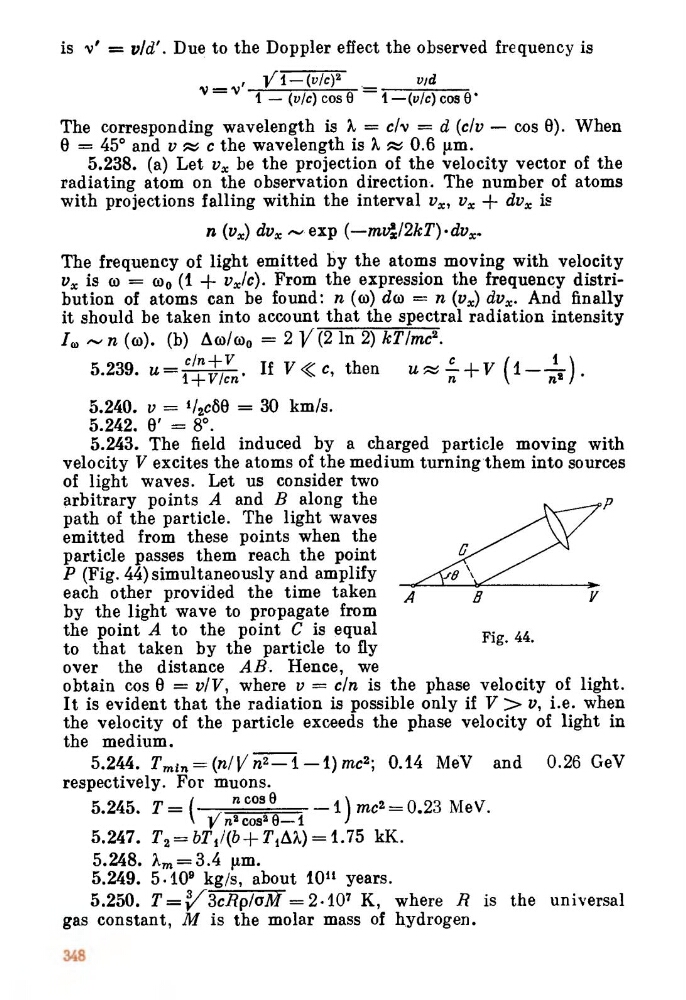
Fig. 44.
is v' = vld' . Due to the Doppler effect the observed frequency is
, 111—(v/02
yid
The corresponding wavelength is X, = c/v = d (c/v — cos 0). When
0 = 45° and v
c the wavelength is
0.6 p,m.
5.238. (a) Let vs be the projection of the velocity vector of the
radiating atom on the observation direction. The number of atoms
with projections falling within the interval vs, vs + dvx is
n (vx) dvx exp (—mv:12kT)•dvx.
The frequency of light emitted by the atoms moving with velocity
vs is o) = (.1)0 (1 -I- vx/c). From the expression the frequency distribution of atoms can be found: n (e) do) = n (vx) dvx. And finally
it should be taken into account that the spectral radiation intensity
n (co). (b) 6.o)/6)0 = 2 V(2 In 2) kr/mc2.
5.239. u— cin +17 If V c, then
1+ V lcn'
5.240. v = 1/2c60 = 30 km/s.
5.242. 0' = 8°.
5.243. The field induced by a charged particle moving with
velocity V excites the atoms of the medium turning them into sources
of light waves. Let us consider two
arbitrary points A and B along the
path of the particle. The light waves
emitted from these points when the
particle passes them reach the point
P (Fig. 44) simultaneously and amplify
each other provided the time taken
by the light wave to propagate from
the point A to the point C is equal
to that taken by the particle to fly
over the distance AB. Hence, we
obtain cos 0 = v/V, where v = c/n is the phase velocity of light.
It is evident that the radiation is possible only if V > v, i.e. when
the velocity of the particle exceeds the phase velocity of light in
the medium.
5.244. Tmin = (nl V n2 — 1 — 1)mc2; 0.14 MeV and 0.26 GeV
respectively. For muons.
5.245. T —
n cos0
1) mcz = 0.23 MeV.
I/ n2 cos2
5.247. T2 = bT il(b-FT jAX)= 1.75 kK.
5.248. Am = 3.4 Rm.
5.249. 5.109 kg/s, about 1011 years.
5.250. T =V 3cRpluM =2.107 K, where R is the universal
gas constant, M is the molar mass of hydrogen.
V
— (v/c) cos 0 — —WO cos 0
u
v
)
is v' = vld' . Due to the Doppler effect the observed frequency is
, 111—(v/02
yid
The corresponding wavelength is X, = c/v = d (c/v — cos 0). When
0 = 45° and v
c the wavelength is
0.6 p,m.
5.238. (a) Let vs be the projection of the velocity vector of the
radiating atom on the observation direction. The number of atoms
with projections falling within the interval vs, vs + dvx is
n (vx) dvx exp (—mv:12kT)•dvx.
The frequency of light emitted by the atoms moving with velocity
vs is o) = (.1)0 (1 -I- vx/c). From the expression the frequency distribution of atoms can be found: n (e) do) = n (vx) dvx. And finally
it should be taken into account that the spectral radiation intensity
n (co). (b) 6.o)/6)0 = 2 V(2 In 2) kr/mc2.
5.239. u— cin +17 If V c, then
1+ V lcn'
5.240. v = 1/2c60 = 30 km/s.
5.242. 0' = 8°.
5.243. The field induced by a charged particle moving with
velocity V excites the atoms of the medium turning them into sources
of light waves. Let us consider two
arbitrary points A and B along the
path of the particle. The light waves
emitted from these points when the
particle passes them reach the point
P (Fig. 44) simultaneously and amplify
each other provided the time taken
by the light wave to propagate from
the point A to the point C is equal
to that taken by the particle to fly
over the distance AB. Hence, we
obtain cos 0 = v/V, where v = c/n is the phase velocity of light.
It is evident that the radiation is possible only if V > v, i.e. when
the velocity of the particle exceeds the phase velocity of light in
the medium.
5.244. Tmin = (nl V n2 — 1 — 1)mc2; 0.14 MeV and 0.26 GeV
respectively. For muons.
5.245. T —
n cos0
1) mcz = 0.23 MeV.
I/ n2 cos2
5.247. T2 = bT il(b-FT jAX)= 1.75 kK.
5.248. Am = 3.4 Rm.
5.249. 5.109 kg/s, about 1011 years.
5.250. T =V 3cRpluM =2.107 K, where R is the universal
gas constant, M is the molar mass of hydrogen.
V
— (v/c) cos 0 — —WO cos 0
u
v
)