

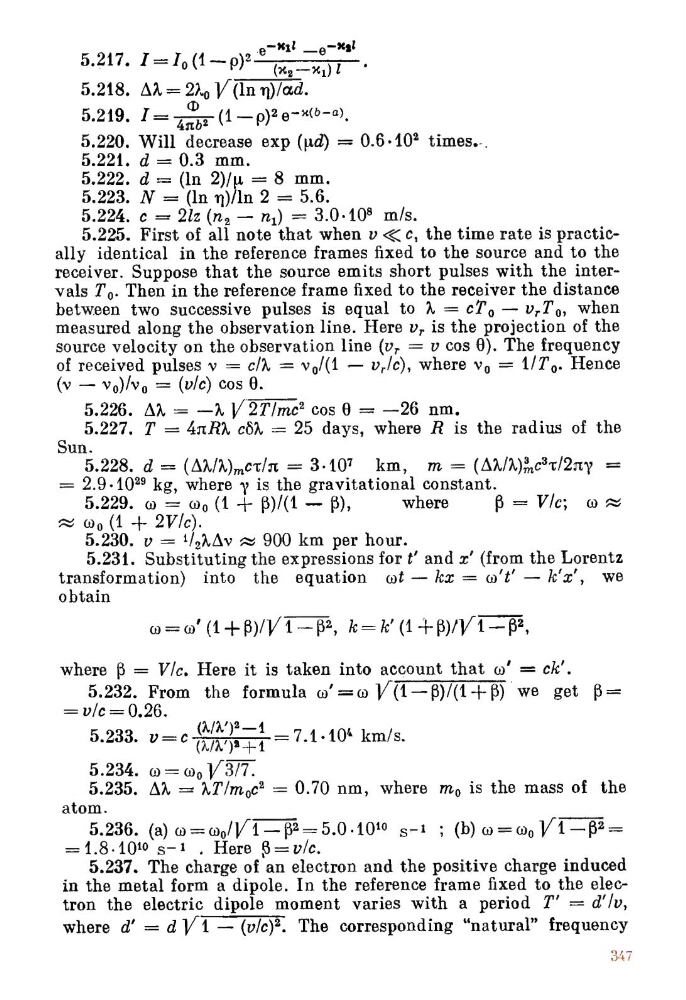
5.217. / = /0 (1 p)
e
(x2
5.218. AX
5.219. I= -4:+2
e-x(b-a).
5.220. Will decrease exp (Rd) = 0.6.102 times.,
5.221. d = 0.3 mm.
5.222. d = (In 2)/p, = 8 mm.
5.223. N = (In 71)/In 2 = 5.6.
5.224. c = 2/z (n2 — n1) = 3.0.108 m/s.
5.225. First of all note that when v < c, the time rate is practically identical in the reference frames fixed to the source and to the
receiver. Suppose that the source emits short pulses with the intervals To. Then in the reference frame fixed to the receiver the distance
between two successive pulses is equal to X = — v,-To, when
measured along the observation line. Here vr is the projection of the
source velocity on the observation line (v,. = v cos 0). The frequency
of received pulses v = clk = v 01(1 — vile), where vo = 1/To. Hence
(v — vo)/vo = (v/c) cos 0.
5.226. AX —X V2T/mc2 cos 0 = —26 nm.
5.227. T = 4nRX c6X. = 25 days, where R is the radius of the
Sun.
5.228. d = (AX.IX),,ctIn = 3.107 km, m = (AX/X4c1/4/27cy
= 2.9.1029 kg, where -v is the gravitational constant.
5.229. co =- coo (1 ± ()1(1 — (3),
where
13 = V/c;
-7-- coo (1 + 2V /c).
5.230. v = 1/2kAv
900 km per hour.
5.231. Substituting the expressions for t' and x' (from the Lorentz
transformation) into the equation cot — kx = co' t' — k' x' , we
obtain
= (1 -1-13)11/ 1 —132, k = k' (1 + ()/V 1 —132,
where 13 = V/c. Here it is taken into account that co' = ck'.
5.232. From the formula co' = w V(1 —13)/(1 +13) we get
= v/c = 0.26.
5.233. v= c " 12-1 = 7' 1.104 km/s.
OAT-HI
5.234. co = coo
5.235. AX = kT/moc2 = 0.70 nm, where mo is the mass of the
atom.
5.236. (a) co coo/111-132 =5.0 .1010 s-1 ; (b) Co = coo li1 —
=1.8.10i0 s-1 . Here 6 = v/c.
5.237. The charge of an electron and the positive charge induced
in the metal form a dipole. In the reference frame fixed to the electron the electric dipole moment varies with a period T' = d'/v,
where d' = d yi - (v/c)2. The corresponding "natural" frequency
347
e
(x2
5.218. AX
5.219. I= -4:+2
e-x(b-a).
5.220. Will decrease exp (Rd) = 0.6.102 times.,
5.221. d = 0.3 mm.
5.222. d = (In 2)/p, = 8 mm.
5.223. N = (In 71)/In 2 = 5.6.
5.224. c = 2/z (n2 — n1) = 3.0.108 m/s.
5.225. First of all note that when v < c, the time rate is practically identical in the reference frames fixed to the source and to the
receiver. Suppose that the source emits short pulses with the intervals To. Then in the reference frame fixed to the receiver the distance
between two successive pulses is equal to X = — v,-To, when
measured along the observation line. Here vr is the projection of the
source velocity on the observation line (v,. = v cos 0). The frequency
of received pulses v = clk = v 01(1 — vile), where vo = 1/To. Hence
(v — vo)/vo = (v/c) cos 0.
5.226. AX —X V2T/mc2 cos 0 = —26 nm.
5.227. T = 4nRX c6X. = 25 days, where R is the radius of the
Sun.
5.228. d = (AX.IX),,ctIn = 3.107 km, m = (AX/X4c1/4/27cy
= 2.9.1029 kg, where -v is the gravitational constant.
5.229. co =- coo (1 ± ()1(1 — (3),
where
13 = V/c;
-7-- coo (1 + 2V /c).
5.230. v = 1/2kAv
900 km per hour.
5.231. Substituting the expressions for t' and x' (from the Lorentz
transformation) into the equation cot — kx = co' t' — k' x' , we
obtain
= (1 -1-13)11/ 1 —132, k = k' (1 + ()/V 1 —132,
where 13 = V/c. Here it is taken into account that co' = ck'.
5.232. From the formula co' = w V(1 —13)/(1 +13) we get
= v/c = 0.26.
5.233. v= c " 12-1 = 7' 1.104 km/s.
OAT-HI
5.234. co = coo
5.235. AX = kT/moc2 = 0.70 nm, where mo is the mass of the
atom.
5.236. (a) co coo/111-132 =5.0 .1010 s-1 ; (b) Co = coo li1 —
=1.8.10i0 s-1 . Here 6 = v/c.
5.237. The charge of an electron and the positive charge induced
in the metal form a dipole. In the reference frame fixed to the electron the electric dipole moment varies with a period T' = d'/v,
where d' = d yi - (v/c)2. The corresponding "natural" frequency
347