

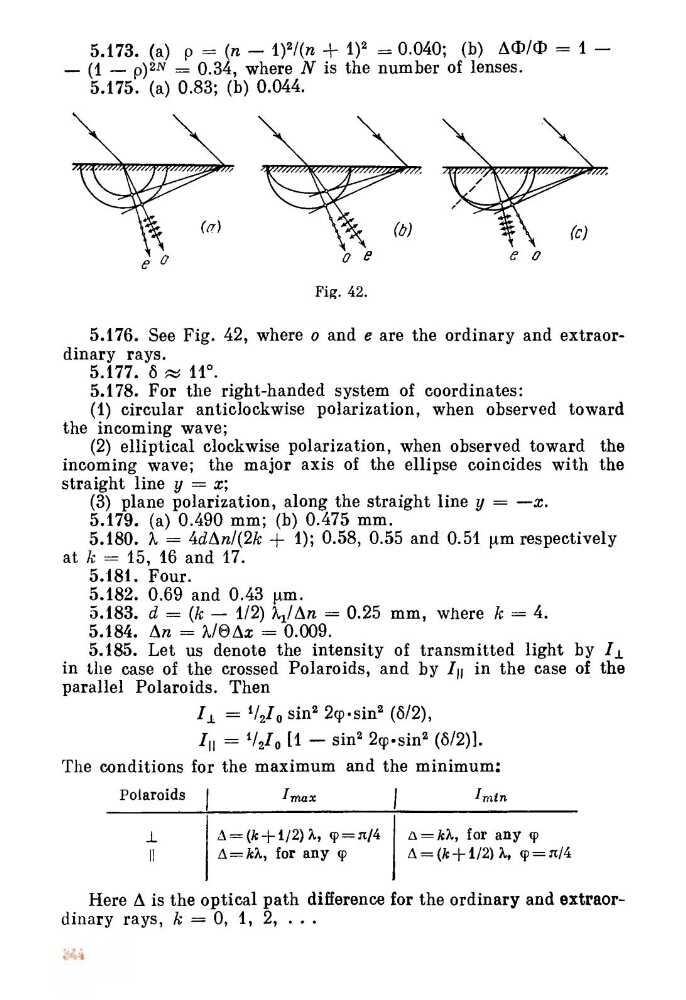
Fig. 42.
e o
5.173. (a) p = (n — 1)2/(n + 1)2 = 0.040; (b) AcI)/(1) = 1 -
- (1 — p)2N = 0.34, where N is the number of lenses.
5.175. (a) 0.83; (b) 0.044.
5.176. See Fig. 42, where o and e are the ordinary and extraordinary rays.
5.177. S
11°.
5.178. For the right-handed system of coordinates:
(1) circular anticlockwise polarization, when observed toward
the incoming wave;
(2) elliptical clockwise polarization, when observed toward the
incoming wave; the major axis of the ellipse coincides with the
straight line y = x;
(3) plane polarization, along the straight line y = —x.
5.179. (a) 0.490 mm; (b) 0.475 mm.
5.180. X = 4dAn/(2k
1); 0.58, 0.55 and 0.51 pm respectively
at k = 15, 16 and 17.
5.181. Four.
5.182. 0.69 and 0.43 pm.
5.183. d = (k — 1/2) Xl/An = 0.25 mm, where k = 4.
5.184. An = 2J€ Ax = 0.009.
5.185. Let us denote the intensity of transmitted light by I .
in the case of the crossed Polaroids, and by Iii in the case of the
parallel Polaroids. Then
Il = 11210 sin2 2y•sin2 (8/2),
= 11210 [1 — sin2 2cp•sin2 (6/2)1.
The conditions for the maximum and the minimum:
Polaroids
'max
I min
II
A= (k + 1/2) X, cp=31/4
A= k7,, for any cp
o =1cX, for any tp
A = (k + 1/2) X, cp= n/4
Here A is the optical path difference for the ordinary and extraordinary rays, k = 0, 1, 2, . . .
e o
5.173. (a) p = (n — 1)2/(n + 1)2 = 0.040; (b) AcI)/(1) = 1 -
- (1 — p)2N = 0.34, where N is the number of lenses.
5.175. (a) 0.83; (b) 0.044.
5.176. See Fig. 42, where o and e are the ordinary and extraordinary rays.
5.177. S
11°.
5.178. For the right-handed system of coordinates:
(1) circular anticlockwise polarization, when observed toward
the incoming wave;
(2) elliptical clockwise polarization, when observed toward the
incoming wave; the major axis of the ellipse coincides with the
straight line y = x;
(3) plane polarization, along the straight line y = —x.
5.179. (a) 0.490 mm; (b) 0.475 mm.
5.180. X = 4dAn/(2k
1); 0.58, 0.55 and 0.51 pm respectively
at k = 15, 16 and 17.
5.181. Four.
5.182. 0.69 and 0.43 pm.
5.183. d = (k — 1/2) Xl/An = 0.25 mm, where k = 4.
5.184. An = 2J€ Ax = 0.009.
5.185. Let us denote the intensity of transmitted light by I .
in the case of the crossed Polaroids, and by Iii in the case of the
parallel Polaroids. Then
Il = 11210 sin2 2y•sin2 (8/2),
= 11210 [1 — sin2 2cp•sin2 (6/2)1.
The conditions for the maximum and the minimum:
Polaroids
'max
I min
II
A= (k + 1/2) X, cp=31/4
A= k7,, for any cp
o =1cX, for any tp
A = (k + 1/2) X, cp= n/4
Here A is the optical path difference for the ordinary and extraordinary rays, k = 0, 1, 2, . . .