

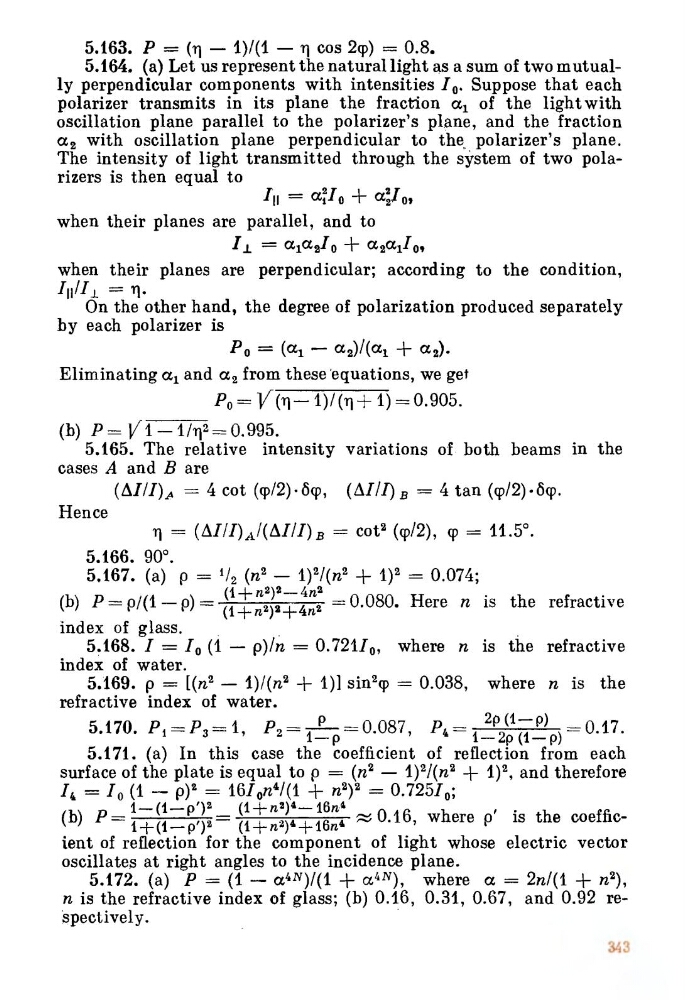
5.163. P = (1 — 1)1(1 — cos 2p) = 0.8.
5.164. (a) Let us represent the natural light as a sum of two mutually perpendicular components with intensities I. Suppose that each
polarizer transmits in its plane the fraction a, of the light with
oscillation plane parallel to the polarizer's plane, and the fraction
cc, with oscillation plane perpendicular to the polarizer's plane.
The intensity of light transmitted through the system of two polarizers is then equal to
II
C4.10
CC2 21
when their planes are parallel, and to
./1 = cticctio -4- a2chio,
when their planes are perpendicular; according to the condition,
/n // = rt.
On the other hand, the degree of polarization produced separately
by each polarizer is
Po = (a1 — %)/(ai a2).
Eliminating al and a2 from these'equations, we get
Po = V(11— 1)/ (11+ 1) = 0.905.
(b) P=171-11112= 0.995.
5.165. The relative intensity variations of both beams in the
cases A and B are
(A///),, = 4 cot (q)/2)• Sy, (AEI) B = 4 tan (q)/2)• Sy.
Hence
= (A///),1/(A///) B = cote (y/2),
= 11.5°.
5.166. 90°.
5.167. (a) p = 1/ 2 ( n2
1)21(n 2 + 1)2
0.074;
(b) P = p/(1 — p)
(al+
d-nn2))2+-44nn: = 0.080. Here n is the refractive
index of glass.
5.168. I = 1.0 (1 — p)In = 0.721/ 0, where n is the refractive
index of water.
5.169. p = [(n2 — 1)/(n2 -1- 1)] sin2q) = 0.038, where n is the
refractive index of water.
(1
5.170. Pi 1 33 = 1, P2= T-12- p. --- 0.087,
4 - 1
2p
2p (1
p)
p)
0 17
5.171. (a) In this case the coefficient of reflection from each
± A ‘2,
surface of the plate is equal to p = ( n2
1)21(n2
1)2, and therefore
/4 = /0 (1 — p)2 = 1610n41(1
n2)2 = 0.725/0;
P —
I
—p')2 (1+ n2)4-16714
4
0.16, where p' is the coeffic(b)
(1-{- n' ) +16n
ient of reflection for the component of light whose electric vector
oscillates at right angles to the incidence plane.
5.172. (a) P = (1
—
cc4N)1(1
a4 '), where a = 2n1(1. -1- n2),
n is the refractive index of glass; (b) 0.16, 0.31, 0.67, and 0.92 respectively.
5.164. (a) Let us represent the natural light as a sum of two mutually perpendicular components with intensities I. Suppose that each
polarizer transmits in its plane the fraction a, of the light with
oscillation plane parallel to the polarizer's plane, and the fraction
cc, with oscillation plane perpendicular to the polarizer's plane.
The intensity of light transmitted through the system of two polarizers is then equal to
II
C4.10
CC2 21
when their planes are parallel, and to
./1 = cticctio -4- a2chio,
when their planes are perpendicular; according to the condition,
/n // = rt.
On the other hand, the degree of polarization produced separately
by each polarizer is
Po = (a1 — %)/(ai a2).
Eliminating al and a2 from these'equations, we get
Po = V(11— 1)/ (11+ 1) = 0.905.
(b) P=171-11112= 0.995.
5.165. The relative intensity variations of both beams in the
cases A and B are
(A///),, = 4 cot (q)/2)• Sy, (AEI) B = 4 tan (q)/2)• Sy.
Hence
= (A///),1/(A///) B = cote (y/2),
= 11.5°.
5.166. 90°.
5.167. (a) p = 1/ 2 ( n2
1)21(n 2 + 1)2
0.074;
(b) P = p/(1 — p)
(al+
d-nn2))2+-44nn: = 0.080. Here n is the refractive
index of glass.
5.168. I = 1.0 (1 — p)In = 0.721/ 0, where n is the refractive
index of water.
5.169. p = [(n2 — 1)/(n2 -1- 1)] sin2q) = 0.038, where n is the
refractive index of water.
(1
5.170. Pi 1 33 = 1, P2= T-12- p. --- 0.087,
4 - 1
2p
2p (1
p)
p)
0 17
5.171. (a) In this case the coefficient of reflection from each
± A ‘2,
surface of the plate is equal to p = ( n2
1)21(n2
1)2, and therefore
/4 = /0 (1 — p)2 = 1610n41(1
n2)2 = 0.725/0;
P —
I
—p')2 (1+ n2)4-16714
4
0.16, where p' is the coeffic(b)
(1-{- n' ) +16n
ient of reflection for the component of light whose electric vector
oscillates at right angles to the incidence plane.
5.172. (a) P = (1
—
cc4N)1(1
a4 '), where a = 2n1(1. -1- n2),
n is the refractive index of glass; (b) 0.16, 0.31, 0.67, and 0.92 respectively.