

4.198. Since t> 7', where 7' is the period of oscillations, W
= 1/21/ Ego/RE 2maR2t = 5 kJ.
4.199. B = Bm sin kx• sin wt, where Bm E m, with BD, = Ernie.
4.200. Sx = 1/4 cocEl sin 2kx• sin 2wt, (Sx ) = 0.
4.201. Wm/We = 1/8calow2R2 = 5.0.10 -1 b
4.202. We/Wm = 1/8 6,110(02R2 = 5.0.10 -15
4.204. 4 :Ds = I 2R.
4.205. S = I 2 1/ mi2eU/4a2eor2.
4.207. To the left.
4.208. (ID = V I.
4.209. (0) = 1/2170/ 0 cos cp.
4.211. The electric dipole moment of the system is p = /eri == (elm) Mrc, where M is the mass of the system, rc is the radius
vector of its centre of inertia. Since the radiation power P oc p 2 oc
cc r t, and in our case rc = 0, P = 0 too.
4nEo
0 6)
4.212. (P)==5 .10-15 W.
4.213. P =
1
2 4 qe2 \ 2
(4neo)3 3c3 mR2 /
4.214. AW 7=4- -
ile4q2
(4neo)3 3c3m2vb3 •
4.215. AW/T = 1/3e3B/e0c3m2 = 2.10-18.
4.216. T = Toe--a't, where a = 1/3e4B2/a80c3m3. After
r 2.5 s
for the electron,
1 1.6.101° s = 0.5.103 years for the proton.
4.217. S1/S2 = tan2 (o)//c) = 3.
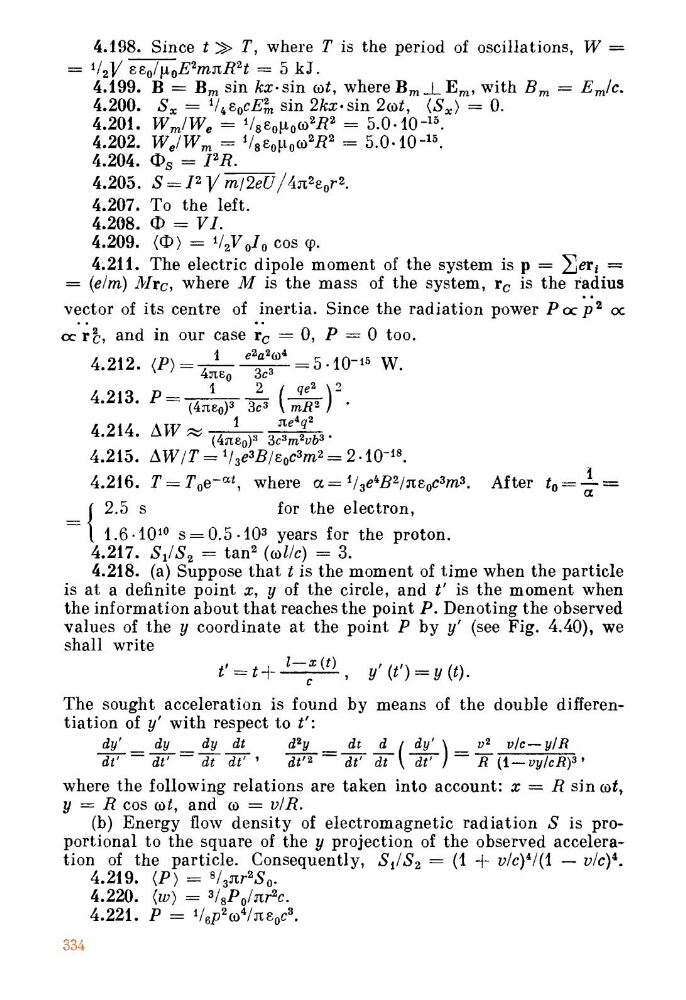
4.218. (a) Suppose that t is the moment of time when the particle
is at a definite point x, y of the circle, and t' is the moment when
the information about that reaches the point P. Denoting the observed
values of the y coordinate at the point P by y' (see Fig. 4.40), we
shall write
The sought acceleration is found by means of
tiation of y' with respect to t':
dy' = dy
dy dt
d2 y
d
dy'
dt'
dt' = dt dt" dt' 2 = dt' dt dt'
the double differen=- v
2 vIc—yIR
_
R (1—vy/cR)3 '
where the following relations are taken into account: x = R sin wt,
y = R cos wt, and w = v/R.
(b) Energy flow density of electromagnetic radiation S is proportional to the square of the y projection of the observed acceleration of the particle. Consequently, S1/S2 = (1 v/c)4/(1 — v/c)4.
4.219. (P) = 8/3ar2S0.
4.220. (w) = 3/8Po/ar2c.
4.221. P = 1/6p26)4/neoc2.
to —=
334
= 1/21/ Ego/RE 2maR2t = 5 kJ.
4.199. B = Bm sin kx• sin wt, where Bm E m, with BD, = Ernie.
4.200. Sx = 1/4 cocEl sin 2kx• sin 2wt, (Sx ) = 0.
4.201. Wm/We = 1/8calow2R2 = 5.0.10 -1 b
4.202. We/Wm = 1/8 6,110(02R2 = 5.0.10 -15
4.204. 4 :Ds = I 2R.
4.205. S = I 2 1/ mi2eU/4a2eor2.
4.207. To the left.
4.208. (ID = V I.
4.209. (0) = 1/2170/ 0 cos cp.
4.211. The electric dipole moment of the system is p = /eri == (elm) Mrc, where M is the mass of the system, rc is the radius
vector of its centre of inertia. Since the radiation power P oc p 2 oc
cc r t, and in our case rc = 0, P = 0 too.
4nEo
0 6)
4.212. (P)==5 .10-15 W.
4.213. P =
1
2 4 qe2 \ 2
(4neo)3 3c3 mR2 /
4.214. AW 7=4- -
ile4q2
(4neo)3 3c3m2vb3 •
4.215. AW/T = 1/3e3B/e0c3m2 = 2.10-18.
4.216. T = Toe--a't, where a = 1/3e4B2/a80c3m3. After
r 2.5 s
for the electron,
1 1.6.101° s = 0.5.103 years for the proton.
4.217. S1/S2 = tan2 (o)//c) = 3.
4.218. (a) Suppose that t is the moment of time when the particle
is at a definite point x, y of the circle, and t' is the moment when
the information about that reaches the point P. Denoting the observed
values of the y coordinate at the point P by y' (see Fig. 4.40), we
shall write
The sought acceleration is found by means of
tiation of y' with respect to t':
dy' = dy
dy dt
d2 y
d
dy'
dt'
dt' = dt dt" dt' 2 = dt' dt dt'
the double differen=- v
2 vIc—yIR
_
R (1—vy/cR)3 '
where the following relations are taken into account: x = R sin wt,
y = R cos wt, and w = v/R.
(b) Energy flow density of electromagnetic radiation S is proportional to the square of the y projection of the observed acceleration of the particle. Consequently, S1/S2 = (1 v/c)4/(1 — v/c)4.
4.219. (P) = 8/3ar2S0.
4.220. (w) = 3/8Po/ar2c.
4.221. P = 1/6p26)4/neoc2.
to —=
334