

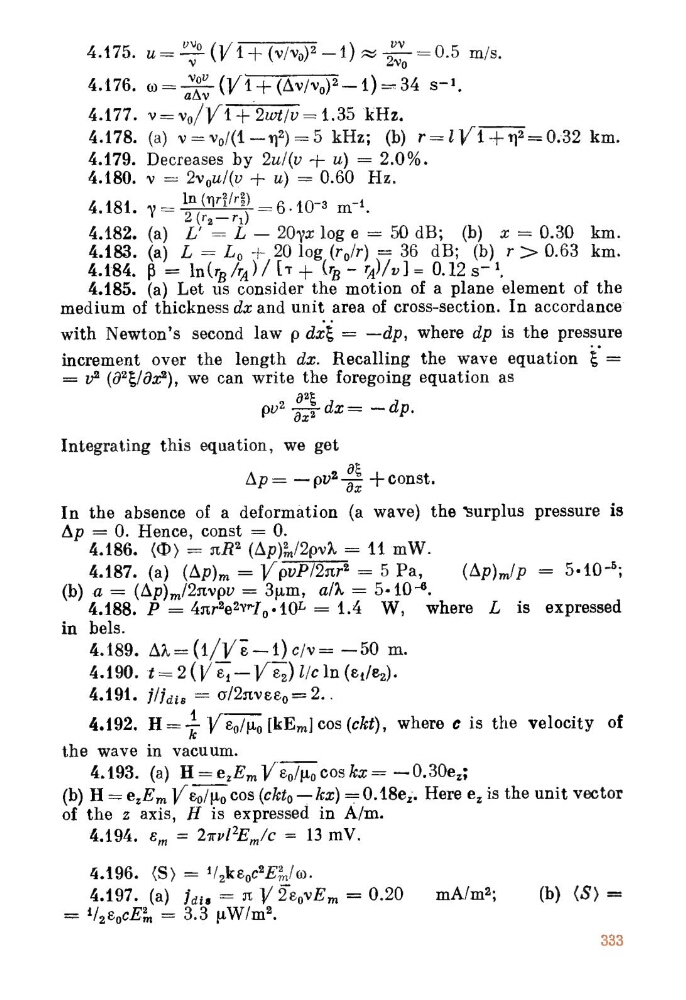
4.175. u=_vvo (V1 + (v/v0)2 —1)
vv = 0.5 m/s.
2vo
4.176. 0.) = aAv (1/1 + (Av/v0)2 — 1) = 34 s-1.
4.177. v= vo/V1 + 2wt I v =1.35 kHz.
4.178. (a) 'v = vo/(1 —12) = 5 kHz; (b) r =11x1 + ii2 = 0.32 km.
4.179. Decreases by 2u/(v + u) = 2.0%.
4.180. v = 2v ou/(v + u) = 0.60 Hz.
4.181.
1n(rlir'ir l) ) = 6 .10-3 m- 1.
2 (
4.182. (a) L' = L — 20Tx log e = 50 dB; (b) x = 0.30 km.
4.183. (a) L = Lo + 20 log (ro/r) = 36 dB; (b) r > 0.63 km.
4.184. [i = ln(rB /rA )
(rB — rA)w1 = 0.12 s- 1.
4.185. (a) Let us consider the motion of a plane element of the
medium of thickness dx and unit area of cross-section. In accordance
with Newton's second law p dx = —dp, where dp is the pressure
increment over the length dx. Recalling the wave equation =
= v2 (a2V0x2), we can write the foregoing equation as
pv2 -adx = — dp.
Integrating this equation, we get
Ap = — pv2 4, + const.
In the absence of a deformation (a wave) the 'surplus pressure is
Op = 0. Hence, coast = 0.
4.186. (D) = 31112 (Ap);„/2pvk = 11 mW.
4.187. (a) (Ap),,., = VpvP/27tr2 = 5 Pa,
(Ap)„,1 p = 5.10 -5;
(b) a = (Ap),,/22tvpv = 311,m, alt = 5.10 -6.
4.188. P = 43tr2e2Yrio • 10L = 1.4 W, where L is expressed
in bels.
4.189. AX = (1/1/Z —1) c/v —50 in.
4.190. t = 2 (1/ — lre;) //c In (ei/ez)•
4.191. j/jdis = a/2nveco = 2..
4.192. H = Ve0/110 [kErn] cos (ckt), where c is the velocity of
the wave in vacuum.
4.193. (a) H = ezEm eo/R0 cos kx = — 0.30ez;
(b) H = ezEm lico/tto cos (ckto — kx) = 0.18ez. Here ez is the unit vector
of the z axis, H is expressed in A/m.
4.194. 8, = 2irv12E,,/c = 13 mV.
4.196. (S) = 1/,keoc2EPe).
4.197. (a) jai, = 1/ 2sovEm = 0.20
mA/m2;
(b) (8) =
112 60cE;ri = 3.3 pW/m2.
333
vv = 0.5 m/s.
2vo
4.176. 0.) = aAv (1/1 + (Av/v0)2 — 1) = 34 s-1.
4.177. v= vo/V1 + 2wt I v =1.35 kHz.
4.178. (a) 'v = vo/(1 —12) = 5 kHz; (b) r =11x1 + ii2 = 0.32 km.
4.179. Decreases by 2u/(v + u) = 2.0%.
4.180. v = 2v ou/(v + u) = 0.60 Hz.
4.181.
1n(rlir'ir l) ) = 6 .10-3 m- 1.
2 (
4.182. (a) L' = L — 20Tx log e = 50 dB; (b) x = 0.30 km.
4.183. (a) L = Lo + 20 log (ro/r) = 36 dB; (b) r > 0.63 km.
4.184. [i = ln(rB /rA )
(rB — rA)w1 = 0.12 s- 1.
4.185. (a) Let us consider the motion of a plane element of the
medium of thickness dx and unit area of cross-section. In accordance
with Newton's second law p dx = —dp, where dp is the pressure
increment over the length dx. Recalling the wave equation =
= v2 (a2V0x2), we can write the foregoing equation as
pv2 -adx = — dp.
Integrating this equation, we get
Ap = — pv2 4, + const.
In the absence of a deformation (a wave) the 'surplus pressure is
Op = 0. Hence, coast = 0.
4.186. (D) = 31112 (Ap);„/2pvk = 11 mW.
4.187. (a) (Ap),,., = VpvP/27tr2 = 5 Pa,
(Ap)„,1 p = 5.10 -5;
(b) a = (Ap),,/22tvpv = 311,m, alt = 5.10 -6.
4.188. P = 43tr2e2Yrio • 10L = 1.4 W, where L is expressed
in bels.
4.189. AX = (1/1/Z —1) c/v —50 in.
4.190. t = 2 (1/ — lre;) //c In (ei/ez)•
4.191. j/jdis = a/2nveco = 2..
4.192. H = Ve0/110 [kErn] cos (ckt), where c is the velocity of
the wave in vacuum.
4.193. (a) H = ezEm eo/R0 cos kx = — 0.30ez;
(b) H = ezEm lico/tto cos (ckto — kx) = 0.18ez. Here ez is the unit vector
of the z axis, H is expressed in A/m.
4.194. 8, = 2irv12E,,/c = 13 mV.
4.196. (S) = 1/,keoc2EPe).
4.197. (a) jai, = 1/ 2sovEm = 0.20
mA/m2;
(b) (8) =
112 60cE;ri = 3.3 pW/m2.
333