

3.397. (a) T =
(e
7E2Vm
2 r B)2 =--- 12 MeV; (b)
T
v
MHz.
r2
3.398. (a) t= m eV
= 17
17 ps;
(b) s
4a9v2mr2
0.74 km.
3eV
N
Instruction. Here s ti E vn
- 1/n, where vn is the velocity of
the particle after the nth passage across the accelerating gap.
Since N is large,
lin z J
V n dn.
3.399. n = 2avW/eBc2 = 9.
3.400. w = wo/l/ I + at, where coo = qB1m, a = qBAWInm2c2.
3.401. v = 112rqB1m, p = r/2.
3.402. N = W led) = 5.106 revolutions, s = 2ItrN = 8.103 km.
3.403. On the one hand,
dp
e
eE=
dt
2ar dt '
where p is the momentum of the electron, r is the radius of the orbit,
41) is the magnetic flux acting inside the orbit.
On the other hand, dp/dt can be found after differentiating the
relation p = erB for r = const. It follows from the comparison of
the expressions obtained that dBoldt = 1 /2 d (B) / dt. In particular,
this condition will be satisfied if Bo = 1/2 (B).
3.404. 7.0 =1/-213o/3a.
3.405. dEldr = B (r0) — 112 (B) = 0.
3.406. OW = 2ar2eB/At = 0.10 keV.
3.407. (a) W= Oil (reBlmoc)2 —1) moc2; (b) s= WAtIreB.
4.1. (a) See Fig. 27; (b) (vx/a(o)2
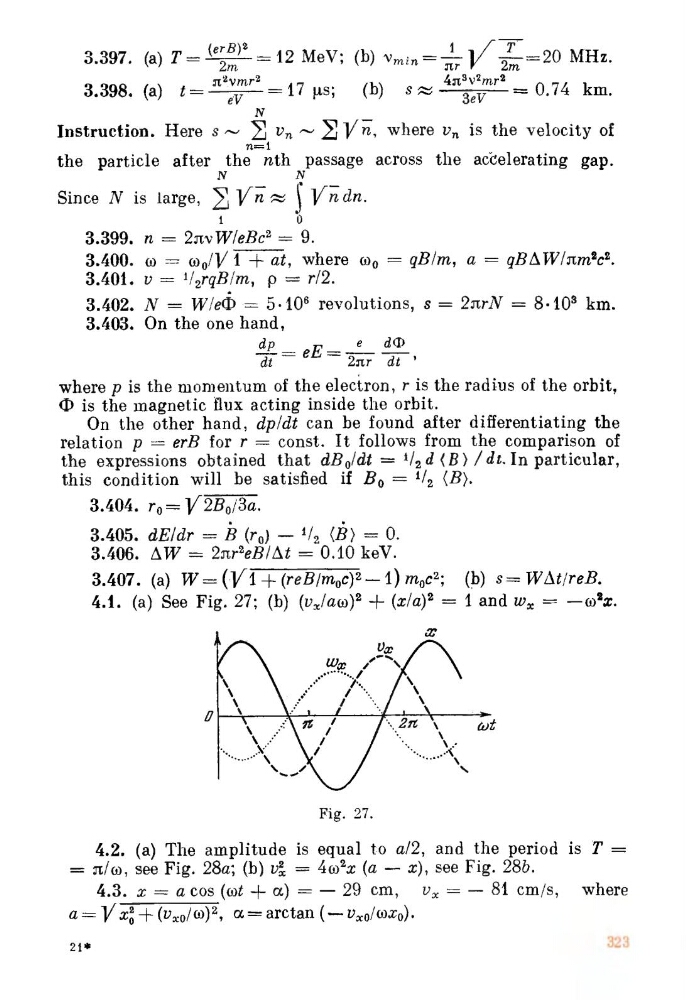
(xla)2 = 1 and wx = —w2x.
Fig. 27.
4.2. (a) The amplitude is equal to a/2, and the period is T
= at/w, see Fig. 28a; (b) vx = 4w2x (a — x), see Fig. 28b.
4.3. x = a cos (wt a) — 29 cm, vx = — 81 cm/s, where
a = Vx: + (Vx0/6))2? a = arctan (— vx0/0)xo)•
21•
(e
7E2Vm
2 r B)2 =--- 12 MeV; (b)
T
v
MHz.
r2
3.398. (a) t= m eV
= 17
17 ps;
(b) s
4a9v2mr2
0.74 km.
3eV
N
Instruction. Here s ti E vn
- 1/n, where vn is the velocity of
the particle after the nth passage across the accelerating gap.
Since N is large,
lin z J
V n dn.
3.399. n = 2avW/eBc2 = 9.
3.400. w = wo/l/ I + at, where coo = qB1m, a = qBAWInm2c2.
3.401. v = 112rqB1m, p = r/2.
3.402. N = W led) = 5.106 revolutions, s = 2ItrN = 8.103 km.
3.403. On the one hand,
dp
e
eE=
dt
2ar dt '
where p is the momentum of the electron, r is the radius of the orbit,
41) is the magnetic flux acting inside the orbit.
On the other hand, dp/dt can be found after differentiating the
relation p = erB for r = const. It follows from the comparison of
the expressions obtained that dBoldt = 1 /2 d (B) / dt. In particular,
this condition will be satisfied if Bo = 1/2 (B).
3.404. 7.0 =1/-213o/3a.
3.405. dEldr = B (r0) — 112 (B) = 0.
3.406. OW = 2ar2eB/At = 0.10 keV.
3.407. (a) W= Oil (reBlmoc)2 —1) moc2; (b) s= WAtIreB.
4.1. (a) See Fig. 27; (b) (vx/a(o)2
(xla)2 = 1 and wx = —w2x.
Fig. 27.
4.2. (a) The amplitude is equal to a/2, and the period is T
= at/w, see Fig. 28a; (b) vx = 4w2x (a — x), see Fig. 28b.
4.3. x = a cos (wt a) — 29 cm, vx = — 81 cm/s, where
a = Vx: + (Vx0/6))2? a = arctan (— vx0/0)xo)•
21•