

3.380. (a) p=qrB; T =m0c2 (1/- 1+ (qrBlmoc)2 —1); (c) w =
C 2
(1)
mv
leB
cos a
3.384. r 2p I sin (cp/2) I , where p —
m eBy sin
a,
3.385. rmax --- - aevo/b, where b= )1°— m I.
2n
V
V
3.386. v —
qlm =
rB (b I a) '
r2B2 In (b la)
3.387. (a) yn = 913,
; (b) tan a = 2nEn •
voB
En 2
2n2m
3.388. z = 1 tan V 2q1
- 7B
—T;- y; for z <1 this equation reduces to
y = (2mElq12B2) z2.
3.389. F = mEl I qB = 20 [IN.
3.390. Al —
2 nmE tan cp 6 cm.
eB2
a (a+2b) B2
3.391.
2EAx
•
3.392. (a) x = a (cot — sin cot); y = a (1 — cos cot), where a =
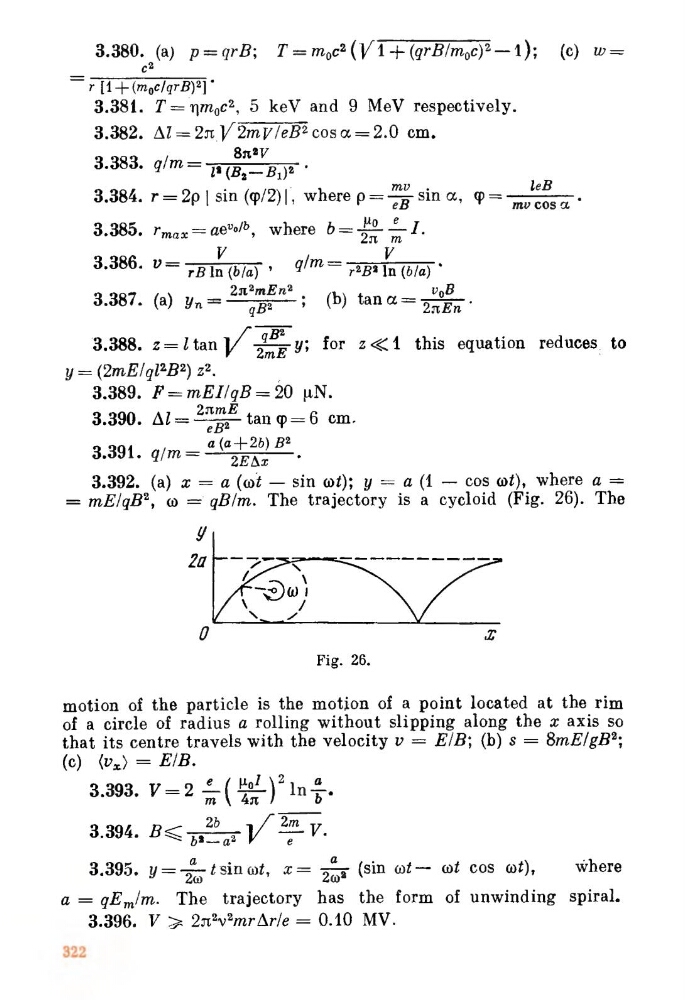
= mElqB2, co qB/m. The trajectory is a cycloid (Fig. 26). The
y
2u
,z•
Fig. 26.
motion of the particle is the motion of a point located at the rim
of a circle of radius a rolling without slipping along the x axis so
that its centre travels with the velocity v = E/B; (b) s = 8mE/gB2;
(c) (v x) = EIB.
3.393. V = 2
21-'1 -) 2 ln -a -
nt 4n
b
3.394. B< b' 2ba2 VIL 11 V.
3.395. y =
t sin cot, x= 2(
÷ 0, (sin cot— cot cos cot),
where
a = qEmlm. The trajectory has the form of unwinding spiral.
3.396. V > 2n2v2mrAr/e = 0.10 MV.
r [1+ (moclqrB)2 ]•
3.381. T = imoc2, 5 keV and 9 MeV respectively.
3.382. Al = lac 2mv I eB2 cos a= 2.0 cm.
8n2v
3.383.
t2 (B2 —B1)2 •
C 2
(1)
mv
leB
cos a
3.384. r 2p I sin (cp/2) I , where p —
m eBy sin
a,
3.385. rmax --- - aevo/b, where b= )1°— m I.
2n
V
V
3.386. v —
qlm =
rB (b I a) '
r2B2 In (b la)
3.387. (a) yn = 913,
; (b) tan a = 2nEn •
voB
En 2
2n2m
3.388. z = 1 tan V 2q1
- 7B
—T;- y; for z <1 this equation reduces to
y = (2mElq12B2) z2.
3.389. F = mEl I qB = 20 [IN.
3.390. Al —
2 nmE tan cp 6 cm.
eB2
a (a+2b) B2
3.391.
2EAx
•
3.392. (a) x = a (cot — sin cot); y = a (1 — cos cot), where a =
= mElqB2, co qB/m. The trajectory is a cycloid (Fig. 26). The
y
2u
,z•
Fig. 26.
motion of the particle is the motion of a point located at the rim
of a circle of radius a rolling without slipping along the x axis so
that its centre travels with the velocity v = E/B; (b) s = 8mE/gB2;
(c) (v x) = EIB.
3.393. V = 2
21-'1 -) 2 ln -a -
nt 4n
b
3.394. B< b' 2ba2 VIL 11 V.
3.395. y =
t sin cot, x= 2(
÷ 0, (sin cot— cot cos cot),
where
a = qEmlm. The trajectory has the form of unwinding spiral.
3.396. V > 2n2v2mrAr/e = 0.10 MV.
r [1+ (moclqrB)2 ]•
3.381. T = imoc2, 5 keV and 9 MeV respectively.
3.382. Al = lac 2mv I eB2 cos a= 2.0 cm.
8n2v
3.383.
t2 (B2 —B1)2 •