

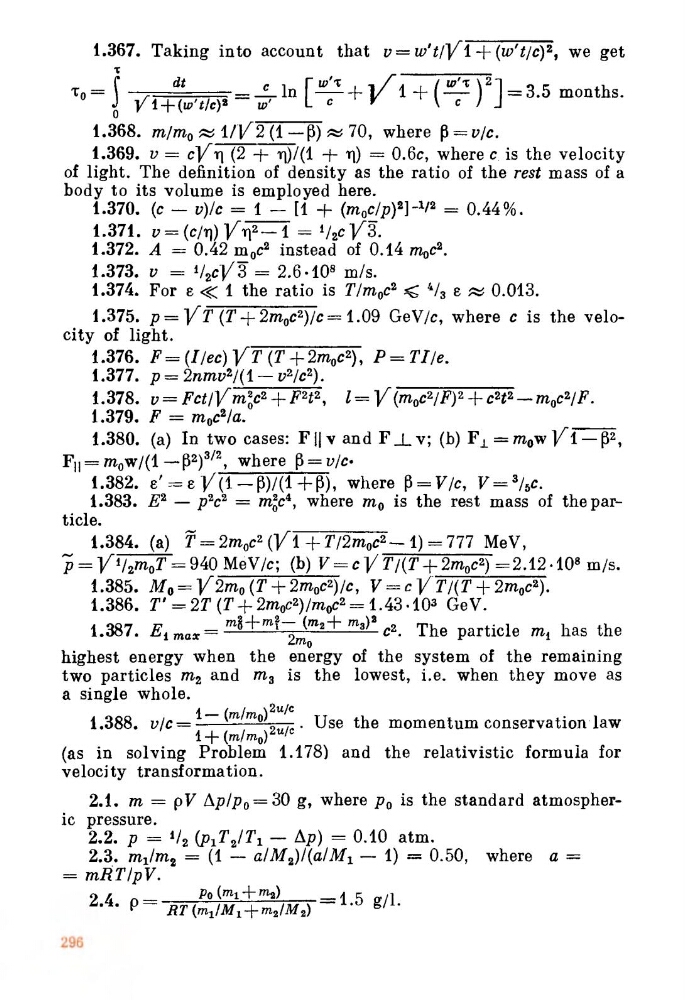
1.367. Taking into account that v =
(w't/c)2, we get
To —
yi+
d
(
t
w,002
In [ 1`
.` ±
+
) 2] = 3.5 months.
0
1.368. m/mo 1/V2 (1. --p) 70, where 13= v/c.
1.369. v
(2
ri)/(1
= 0.6c, where c is the velocity
of light. The definition of density as the ratio of the rest mass of a
body to its volume is employed here.
1.370. (c — v)Ic = 1 — [1 + (m0c/p)2] -1/2 = 0.44%.
1.371. v = (chi)
1 = 1/,c
1.372. A = 0.42 m0c2 instead of 0.14 m0c2.
1.373. v = 1/2cV 3 = 2.6.108 m/s.
1.374. For a < 1 the ratio is T/m0c2 < 4/3
0.013.
1.375. p =V T (T +2m0c2)1c = 1.09 GeV/c, where c is the velocity of light.
1.376. F = (I 1 ec) V T (T +2moc2), P = T I le.
1.377. p= 2nmv2/(1 — v2/c2).
1.378. v= Fct/Vm2 oc2 + F2t2, 1=i1 (moc2IF) 2 + c2t 2 — M0C2/ F
1.379. F = m0c21a.
1.380. (a) In two cases: F v and F v; (b) Fl = mow V-1 —132,
mow/(1 —p2)3/2, where 13= v/c•
1.382. 8' e 17(1 —13)/(1 +13), where f3 = V/c, V = 3/oc.
1.383. E2 — p2c2 = m,;c4, where m0 is the rest mass of the particle.
1.384. (a) T = 2m0c2 (111 +7 72moc2 — 1) = 777 MeV,
=-- -111 /2/noT = 940 MeV/c; (b) V = ci/ T/(T 2m,c2) =2.12 .108 m/s.
1.385. M0 -=-112mo
2m0c2)/c, V =c1/ T 1(T +2m0c2).
1.386. T' = 2T (T +2m0c2)1moc2 =1.43.103 GeV.
1.387. Ei max =
ma -Fm?— (m2+ m3)2 c2. The particle mi has the
27no
highest energy when the energy of the system of the remaining
two particles m2 and m3 is the lowest, i.e. when they move as
a single whole.
N2uc
1.388. v/c =
oninio
'0 , Use the momentum conservation law
1+ ( nondau/c
(as in solving Problem 1.178) and the relativistic formula for
velocity transformation.
2.1. m = pV Ap/p0 = 30 g, where p0 is the standard atmospheric pressure.
2.2. p = 112 (piT 2ITi — Ap) = 0.10 atm.
2.3. ml/m2 = (1 — alM2)1(alMi — 1) = 0.50, where a =
mRT/pV.
2.4. 0
Po (nil-Fr%)
—1.5 g/1
RT (ml/Ml -1-m2/M2))
•
(w't/c)2, we get
To —
yi+
d
(
t
w,002
In [ 1`
.` ±
+
) 2] = 3.5 months.
0
1.368. m/mo 1/V2 (1. --p) 70, where 13= v/c.
1.369. v
(2
ri)/(1
= 0.6c, where c is the velocity
of light. The definition of density as the ratio of the rest mass of a
body to its volume is employed here.
1.370. (c — v)Ic = 1 — [1 + (m0c/p)2] -1/2 = 0.44%.
1.371. v = (chi)
1 = 1/,c
1.372. A = 0.42 m0c2 instead of 0.14 m0c2.
1.373. v = 1/2cV 3 = 2.6.108 m/s.
1.374. For a < 1 the ratio is T/m0c2 < 4/3
0.013.
1.375. p =V T (T +2m0c2)1c = 1.09 GeV/c, where c is the velocity of light.
1.376. F = (I 1 ec) V T (T +2moc2), P = T I le.
1.377. p= 2nmv2/(1 — v2/c2).
1.378. v= Fct/Vm2 oc2 + F2t2, 1=i1 (moc2IF) 2 + c2t 2 — M0C2/ F
1.379. F = m0c21a.
1.380. (a) In two cases: F v and F v; (b) Fl = mow V-1 —132,
mow/(1 —p2)3/2, where 13= v/c•
1.382. 8' e 17(1 —13)/(1 +13), where f3 = V/c, V = 3/oc.
1.383. E2 — p2c2 = m,;c4, where m0 is the rest mass of the particle.
1.384. (a) T = 2m0c2 (111 +7 72moc2 — 1) = 777 MeV,
=-- -111 /2/noT = 940 MeV/c; (b) V = ci/ T/(T 2m,c2) =2.12 .108 m/s.
1.385. M0 -=-112mo
2m0c2)/c, V =c1/ T 1(T +2m0c2).
1.386. T' = 2T (T +2m0c2)1moc2 =1.43.103 GeV.
1.387. Ei max =
ma -Fm?— (m2+ m3)2 c2. The particle mi has the
27no
highest energy when the energy of the system of the remaining
two particles m2 and m3 is the lowest, i.e. when they move as
a single whole.
N2uc
1.388. v/c =
oninio
'0 , Use the momentum conservation law
1+ ( nondau/c
(as in solving Problem 1.178) and the relativistic formula for
velocity transformation.
2.1. m = pV Ap/p0 = 30 g, where p0 is the standard atmospheric pressure.
2.2. p = 112 (piT 2ITi — Ap) = 0.10 atm.
2.3. ml/m2 = (1 — alM2)1(alMi — 1) = 0.50, where a =
mRT/pV.
2.4. 0
Po (nil-Fr%)
—1.5 g/1
RT (ml/Ml -1-m2/M2))
•