

(b) to — tB = (1 — y1— (v/c)2) /0/v or tB —tA= (1+V 1— (v/c)2) 10/v.
1.353. ( a ) t (B)=101v, t (B') = (10/v) - 111 —(v/c)2; (b) t (A) =
(10Iv)1 y1— (vIc) 2, t (A') = 10/v.
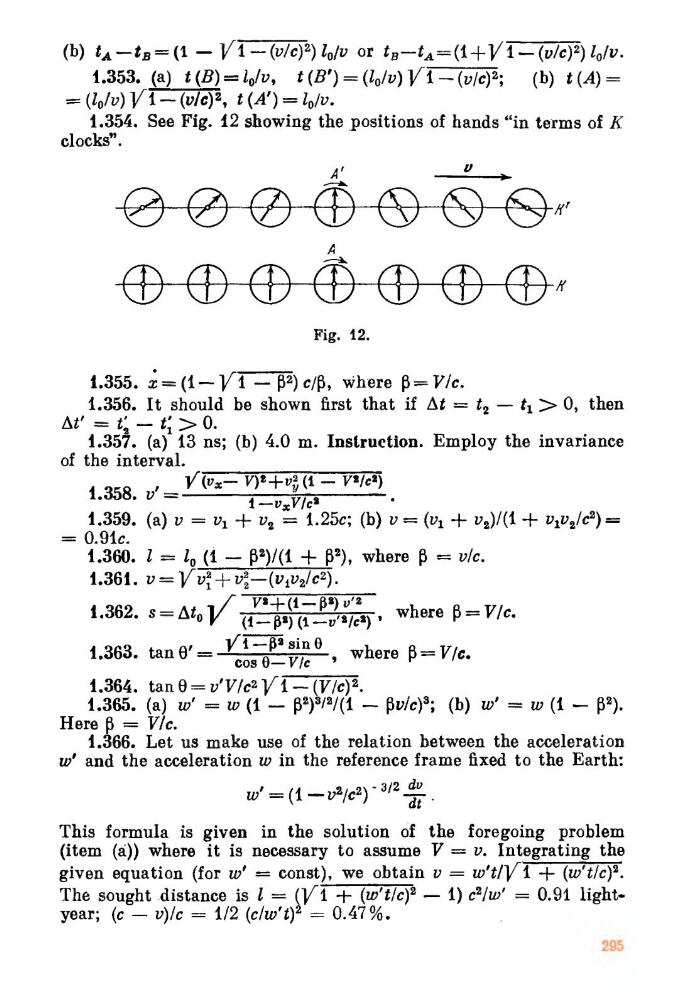
1.354. See Fig. 12 showing the positions of hands "in terms of K
clocks".
Af
A
H
Fig. 12.
1.355. x = (1— y1 — [32) c/I3, where p = V/c.
1.356. It should be shown first that if At = t2 — tl > 0, then
At' =- - to — t; > 0.
1.357. (a) 13 ns; (b) 4.0 m. Instruction. Employ the invariance
of the interval.
ii(v,— V)1+1(1 — V21c2)
1.358. v' =
1 — v,V/c2
•
1.359. (a) v = vi + v2 = 1.25c; (b) v = (v1 + v 2)/(1
viv2/c2).
= 0.91c.
1.360. 1 = 10 (1 — 2)/(1
p2), where p = v/c.
1.361. v =
v2 ,—(v1v2/c2).
1.362. s = Ato
(1
2
_ 02) _ v , where 0. V/c.
1.363. tan 0'
cos 0
—02 sin 0 , where 3 =
— vic
1.364. tan 0 = vie y1— (V/c)2.
1.365. (a) w' = w (1 — 132)3/2/(1 — 13v/c)3; (b) w' = w (1 — 32).
Here 13 = V/c.
1.366. Let us make use of the relation hetween the acceleration
w' and the acceleration w in the reference frame fixed to the Earth:
= (1 — v2Ic2)3/2 dv
dt •
This formula is given in the solution of the foregoing problem
(item (a)) where it is necessary to assume V = v. Integrating the
given equation (for w' = const), we obtain v = w't/V1
(w't/c)2.
The sought distance is 1 = (y1 + (w't/c)2 — 1) c2I w' = 0.91 lightyear; (c — v)/c = 1/2 (c/w't)2 = 0.47%.
1.353. ( a ) t (B)=101v, t (B') = (10/v) - 111 —(v/c)2; (b) t (A) =
(10Iv)1 y1— (vIc) 2, t (A') = 10/v.
1.354. See Fig. 12 showing the positions of hands "in terms of K
clocks".
Af
A
H
Fig. 12.
1.355. x = (1— y1 — [32) c/I3, where p = V/c.
1.356. It should be shown first that if At = t2 — tl > 0, then
At' =- - to — t; > 0.
1.357. (a) 13 ns; (b) 4.0 m. Instruction. Employ the invariance
of the interval.
ii(v,— V)1+1(1 — V21c2)
1.358. v' =
1 — v,V/c2
•
1.359. (a) v = vi + v2 = 1.25c; (b) v = (v1 + v 2)/(1
viv2/c2).
= 0.91c.
1.360. 1 = 10 (1 — 2)/(1
p2), where p = v/c.
1.361. v =
v2 ,—(v1v2/c2).
1.362. s = Ato
(1
2
_ 02) _ v , where 0. V/c.
1.363. tan 0'
cos 0
—02 sin 0 , where 3 =
— vic
1.364. tan 0 = vie y1— (V/c)2.
1.365. (a) w' = w (1 — 132)3/2/(1 — 13v/c)3; (b) w' = w (1 — 32).
Here 13 = V/c.
1.366. Let us make use of the relation hetween the acceleration
w' and the acceleration w in the reference frame fixed to the Earth:
= (1 — v2Ic2)3/2 dv
dt •
This formula is given in the solution of the foregoing problem
(item (a)) where it is necessary to assume V = v. Integrating the
given equation (for w' = const), we obtain v = w't/V1
(w't/c)2.
The sought distance is 1 = (y1 + (w't/c)2 — 1) c2I w' = 0.91 lightyear; (c — v)/c = 1/2 (c/w't)2 = 0.47%.