

1.217. (a) Let us subdivide the spherical layer into small elements, each of mass Sm. In this case the energy of interaction of
each element with all others is SU = —vm SmIR. Summing over all
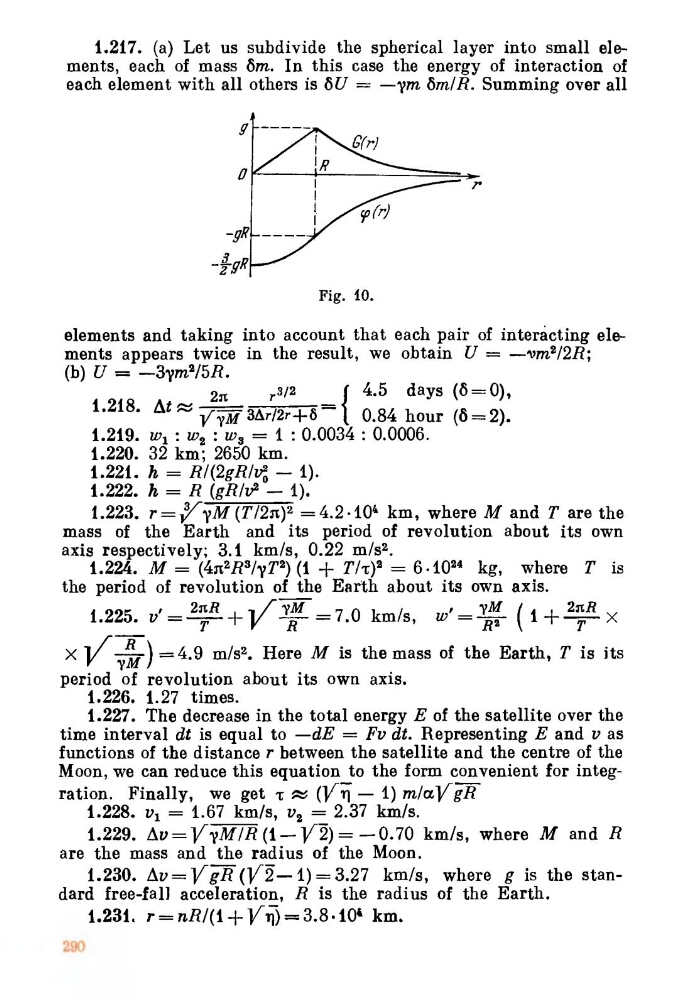
Fig. 10.
elements and taking into account that each pair of interacting elements appears twice in the result, we obtain U = —vm2/2R;
(b) U = —3ym2/5R.
r3/2
f 4.5 days (6 = 0),
1.218. At ^...;
2x
3Ar/2r - 1-8 1 0.84 hour (6= 2).
1.219. w1 : w2 : w3 = 1 : 0.0034 : 0.0006.
1.220. 32 km; 2650 km.
1.221. h = RI(2gRiv: — 1).
1.222. h = R (gR/v2 — 1).
1.223. r = ryM (77231)2 = 4.2.104 km, where M and T are the
mass of the Earth and its period of revolution about its own
axis respectively; 3.1 km/s, 0.22 m/s2.
1.224. M = (4n2R3/?T2) (1
T/'02 = 6.1024 kg, where T is
the period of revolution of the Earth about its own axis.
1.225. v' = 2n T
R
TM
V
= 7.0 km/s,
R2 ( 1+..x
R
X V
= 4.9 m/s2. Here M is the mass of the Earth, T is its
period of revolution about its own axis.
1.226. 1.27 times.
1.227. The decrease in the total energy E of the satellite over the
time interval dt is equal to —dE = Fy dt. Representing E and v as
functions of the distance r between the satellite and the centre of the
Moon, we can reduce this equation_ to the form convenient for integration. Finally, we get 't WI — 1) mlal gR
1.228. v1 = 1.67 km/s, v2 = 2.37 km/s.
1.229. Au= liyM/R (1 —1/- ) = — 0.70 km/s, where M and R
are the mass and the radius of the Moon.
1.230. Av =
(1/- —1) = 3.27 km/s, where g is the standard free-fall acceleration, R is the radius of the Earth.
1.231. r = nR/(1 Vri). 3.8.104 km.
each element with all others is SU = —vm SmIR. Summing over all
Fig. 10.
elements and taking into account that each pair of interacting elements appears twice in the result, we obtain U = —vm2/2R;
(b) U = —3ym2/5R.
r3/2
f 4.5 days (6 = 0),
1.218. At ^...;
2x
3Ar/2r - 1-8 1 0.84 hour (6= 2).
1.219. w1 : w2 : w3 = 1 : 0.0034 : 0.0006.
1.220. 32 km; 2650 km.
1.221. h = RI(2gRiv: — 1).
1.222. h = R (gR/v2 — 1).
1.223. r = ryM (77231)2 = 4.2.104 km, where M and T are the
mass of the Earth and its period of revolution about its own
axis respectively; 3.1 km/s, 0.22 m/s2.
1.224. M = (4n2R3/?T2) (1
T/'02 = 6.1024 kg, where T is
the period of revolution of the Earth about its own axis.
1.225. v' = 2n T
R
TM
V
= 7.0 km/s,
R2 ( 1+..x
R
X V
= 4.9 m/s2. Here M is the mass of the Earth, T is its
period of revolution about its own axis.
1.226. 1.27 times.
1.227. The decrease in the total energy E of the satellite over the
time interval dt is equal to —dE = Fy dt. Representing E and v as
functions of the distance r between the satellite and the centre of the
Moon, we can reduce this equation_ to the form convenient for integration. Finally, we get 't WI — 1) mlal gR
1.228. v1 = 1.67 km/s, v2 = 2.37 km/s.
1.229. Au= liyM/R (1 —1/- ) = — 0.70 km/s, where M and R
are the mass and the radius of the Moon.
1.230. Av =
(1/- —1) = 3.27 km/s, where g is the standard free-fall acceleration, R is the radius of the Earth.
1.231. r = nR/(1 Vri). 3.8.104 km.