

1.207. M= m V2ymsrir2/(r i ±r2), where ms is the mass of
the Sun.
1.208. E = T U = —ymms12a, where ms is the mass of
the Sun.
1.209. r m =
[1. ±111 — (2 — T1) 11 Sill2 cd,
where
2—
=
rov2 0/7ms, ms being the mass of the Sun.
1.210. rmin = (Trasiv0) [111 (//,0 2/yrns)2 —11, where ms is the
mass of the Sun.
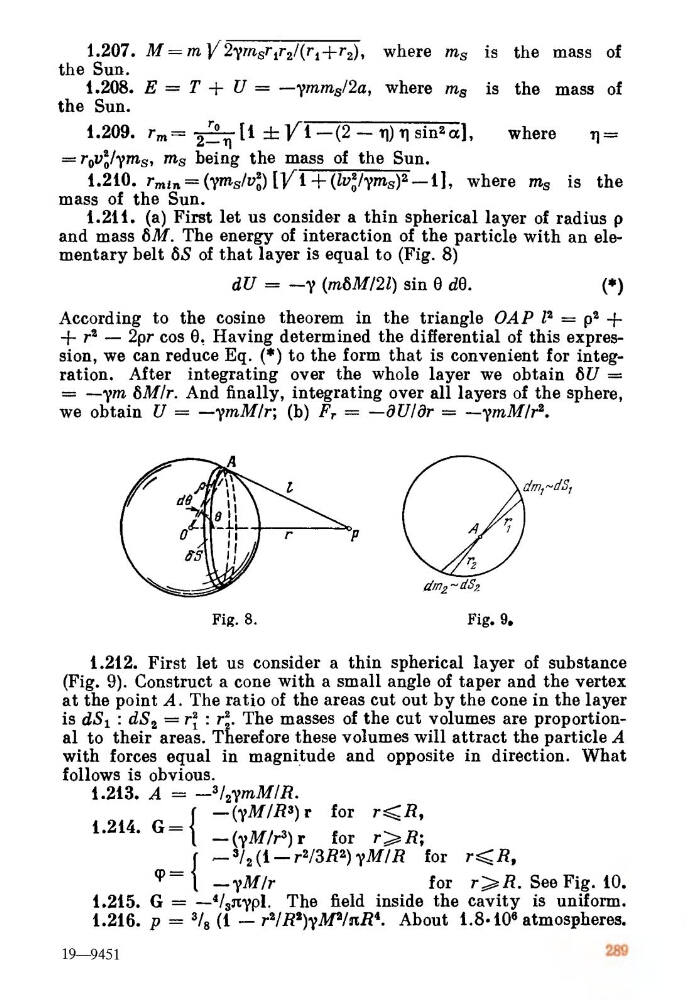
1.211. (a) First let us consider a thin spherical layer of radius p
and mass SM. The energy of interaction of the particle with an elementary belt SS of that layer is equal to (Fig. 8)
dU = —y (m8M/2/) sin 0 dO.
According to the cosine theorem in the triangle OAP 12 = p2
r2 — 2pr cos 0. Having determined the differential of this expression, we can reduce Eq. (*) to the form that is convenient for integration. After integrating over the whole layer we obtain SU =
= —ym 61111r. And finally, integrating over all layers of the sphere,
we obtain U = —ymM/r; (b) Fr = —0U/Or = —ymM/r2.
dm2 -fag
Fig. 8.
Fig. 9.
1.212. First let us consider a thin spherical layer of substance
(Fig. 9). Construct a cone with a small angle of taper and the vertex
at the point A. The ratio of the areas cut out by the cone in the layer
is dSi : dS2 =71 : 71. The masses of the cut volumes are proportional to their areas. Therefore these volumes will attract the particle A
with forces equal in magnitude and opposite in direction. What
follows is obvious.
1.213. A = —3/2ymM/R.
—(yMIR3)r for r
1r
for r> R. See Fig. 10.
1.215. G = —4/33-typ1. The field inside the cavity is uniform.
1.216. p = 318 (1 — r2/R2)?mainR4. About 1.8.108 atmospheres.
(*)
1.214. G=
— (yM/r3) r for r >R;
— 312 (1— r213112)TMIR for r
the Sun.
1.208. E = T U = —ymms12a, where ms is the mass of
the Sun.
1.209. r m =
[1. ±111 — (2 — T1) 11 Sill2 cd,
where
2—
=
rov2 0/7ms, ms being the mass of the Sun.
1.210. rmin = (Trasiv0) [111 (//,0 2/yrns)2 —11, where ms is the
mass of the Sun.
1.211. (a) First let us consider a thin spherical layer of radius p
and mass SM. The energy of interaction of the particle with an elementary belt SS of that layer is equal to (Fig. 8)
dU = —y (m8M/2/) sin 0 dO.
According to the cosine theorem in the triangle OAP 12 = p2
r2 — 2pr cos 0. Having determined the differential of this expression, we can reduce Eq. (*) to the form that is convenient for integration. After integrating over the whole layer we obtain SU =
= —ym 61111r. And finally, integrating over all layers of the sphere,
we obtain U = —ymM/r; (b) Fr = —0U/Or = —ymM/r2.
dm2 -fag
Fig. 8.
Fig. 9.
1.212. First let us consider a thin spherical layer of substance
(Fig. 9). Construct a cone with a small angle of taper and the vertex
at the point A. The ratio of the areas cut out by the cone in the layer
is dSi : dS2 =71 : 71. The masses of the cut volumes are proportional to their areas. Therefore these volumes will attract the particle A
with forces equal in magnitude and opposite in direction. What
follows is obvious.
1.213. A = —3/2ymM/R.
—(yMIR3)r for r
1r
for r> R. See Fig. 10.
1.215. G = —4/33-typ1. The field inside the cavity is uniform.
1.216. p = 318 (1 — r2/R2)?mainR4. About 1.8.108 atmospheres.
(*)
1.214. G=
— (yM/r3) r for r >R;
— 312 (1— r213112)TMIR for r