

2
5 6
7t
1.16. Two particles, 1 and 2, move with constant velocities vi
and v2 along two mutually perpendicular straight lines toward the
intersection point 0. At the moment t = 0 the particles were located
at the distances 11 and 12 from the point 0. How soon will the distance
between the particles become the smallest? What is it equal to?
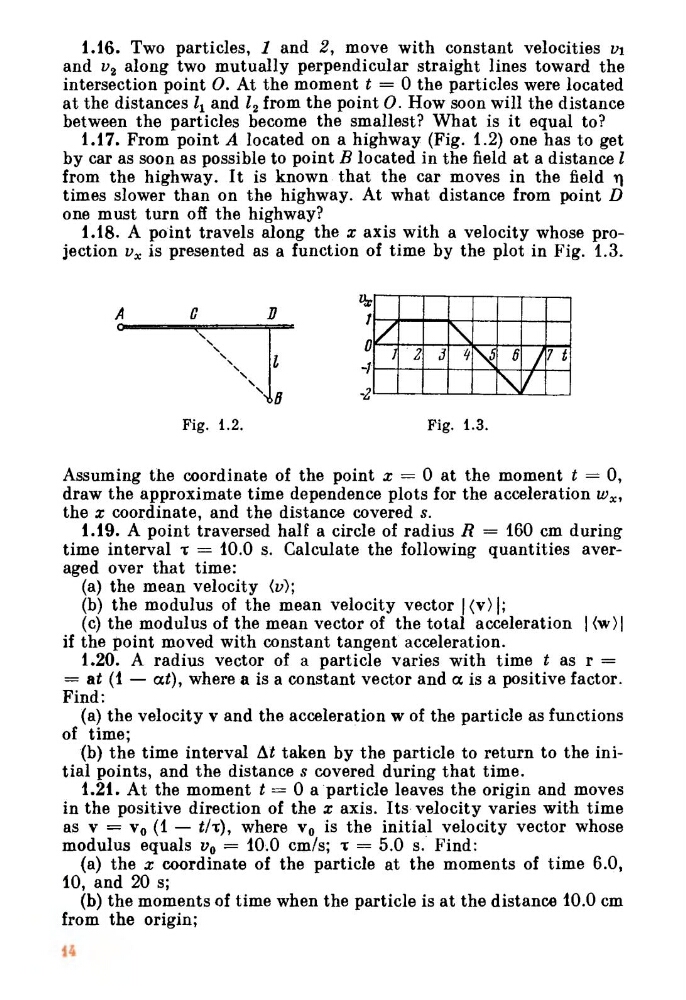
1.17. From point A located on a highway (Fig. 1.2) one has to get
by car as soon as possible to point B located in the field at a distance 1
from the highway. It is known that the car moves in the field ri
times slower than on the highway. At what distance from point D
one must turn off the highway?
1.18. A point travels along the x axis with a velocity whose projection vx is presented as a function of time by the plot in Fig. 1.3.
vs
1
0
-1
-2
Fig. 1.2.
Fig. 1.3.
Assuming the coordinate of the point x = 0 at the moment t = 0,
draw the approximate time dependence plots for the acceleration wx,
the x coordinate, and the distance covered s.
1.19. A point traversed half a circle of radius R = 160 cm during
time interval x = 10.0 s. Calculate the following quantities averaged over that time:
(a) the mean velocity (v);
(b) the modulus of the mean velocity vector (v) I;
(c) the modulus of the mean vector of the total acceleration I (w)I
if the point moved with constant tangent acceleration.
1.20. A radius vector of a particle varies with time t as r =
= at (1 — cct), where a is a constant vector and a is a positive factor.
Find:
(a) the velocity v and the acceleration w of the particle as functions
of time;
(b) the time interval At taken by the particle to return to the initial points, and the distance s covered during that time.
1.21. At the moment t = 0 a particle leaves the origin and moves
in the positive direction of the x axis. Its velocity varies with time
as v = vc, (1 — tit), where v(, is the initial velocity vector whose
modulus equals vo = 10.0 cm/s; i = 5.0 s. Find:
(a) the x coordinate of the particle at the moments of time 6.0,
10, and 20 s;
(b) the moments of time when the particle is at the distance 10.0 cm
from the origin;
5 6
7t
1.16. Two particles, 1 and 2, move with constant velocities vi
and v2 along two mutually perpendicular straight lines toward the
intersection point 0. At the moment t = 0 the particles were located
at the distances 11 and 12 from the point 0. How soon will the distance
between the particles become the smallest? What is it equal to?
1.17. From point A located on a highway (Fig. 1.2) one has to get
by car as soon as possible to point B located in the field at a distance 1
from the highway. It is known that the car moves in the field ri
times slower than on the highway. At what distance from point D
one must turn off the highway?
1.18. A point travels along the x axis with a velocity whose projection vx is presented as a function of time by the plot in Fig. 1.3.
vs
1
0
-1
-2
Fig. 1.2.
Fig. 1.3.
Assuming the coordinate of the point x = 0 at the moment t = 0,
draw the approximate time dependence plots for the acceleration wx,
the x coordinate, and the distance covered s.
1.19. A point traversed half a circle of radius R = 160 cm during
time interval x = 10.0 s. Calculate the following quantities averaged over that time:
(a) the mean velocity (v);
(b) the modulus of the mean velocity vector (v) I;
(c) the modulus of the mean vector of the total acceleration I (w)I
if the point moved with constant tangent acceleration.
1.20. A radius vector of a particle varies with time t as r =
= at (1 — cct), where a is a constant vector and a is a positive factor.
Find:
(a) the velocity v and the acceleration w of the particle as functions
of time;
(b) the time interval At taken by the particle to return to the initial points, and the distance s covered during that time.
1.21. At the moment t = 0 a particle leaves the origin and moves
in the positive direction of the x axis. Its velocity varies with time
as v = vc, (1 — tit), where v(, is the initial velocity vector whose
modulus equals vo = 10.0 cm/s; i = 5.0 s. Find:
(a) the x coordinate of the particle at the moments of time 6.0,
10, and 20 s;
(b) the moments of time when the particle is at the distance 10.0 cm
from the origin;