

3.5 Jet Substructure Tagging
79
efficiency (depending on the needs of the analysis). In order to achieve a flat signal
efficiency, ATLAS developed a p T -dependent selection on the value of D
(β=1)
2
, as
this distribution shows a strong dependence on p T [484]. No p T -dependent selection
is made on the trimmed jet mass, as the calibrated jet mass is used to define the V
tagging working point. While the jet mass resolution increases with p T , a constant
window of ±15 GeV around the mean reconstructed W or Z boson mass is used.
This results in a p T -dependent signal and background efficiency, which can also
be countered with the p T -dependent cut on D
(β=1)
2
. This leads to a constant signal
efficiency, while the background efficiency shows a residual p T dependence [484].
Another possibility has been explored by CMS. Instead of introducing p T -
dependent selection criteria, a linear transformation of the ratio τ 21 has been studied [436], given by τ
DDT
21
= τ 21 − M · log(m
2
/ p T /1 GeV) [251], where M is a constant determined from simulation. The replacement of τ 21 with DDT version τ
DDT
21
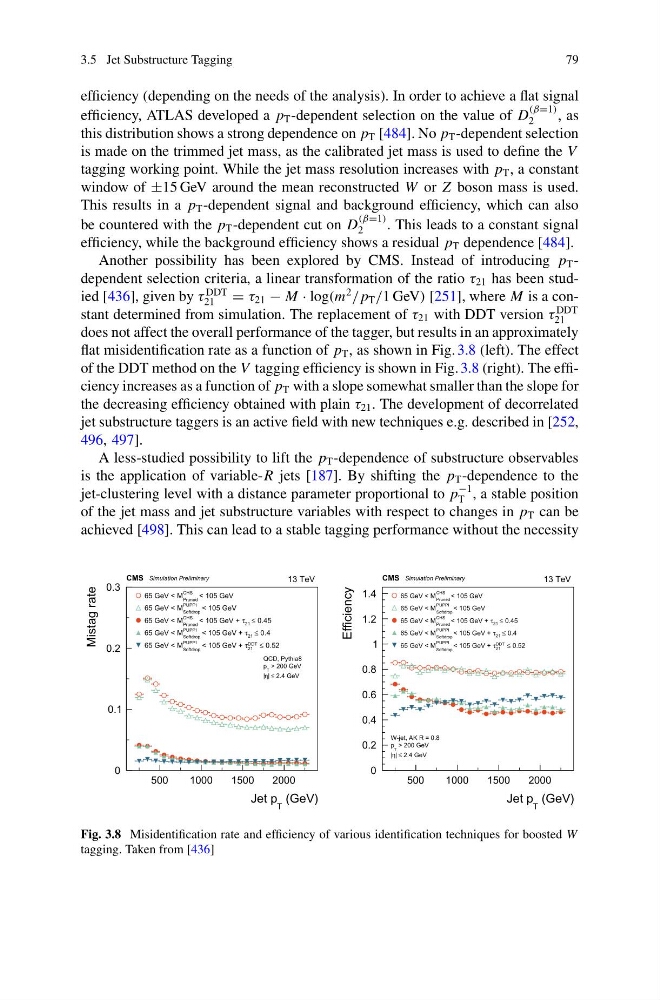
does not affect the overall performance of the tagger, but results in an approximately
flat misidentification rate as a function of p T , as shown in Fig. 3.8 (left). The effect
of the DDT method on the V tagging efficiency is shown in Fig. 3.8 (right). The efficiency increases as a function of p T with a slope somewhat smaller than the slope for
the decreasing efficiency obtained with plain τ 21 . The development of decorrelated
jet substructure taggers is an active field with new techniques e.g. described in [252,
496, 497].
A less-studied possibility to lift the p T -dependence of substructure observables
is the application of variable-R jets [187]. By shifting the p T -dependence to the
jet-clustering level with a distance parameter proportional to p
−1
T , a stable position
of the jet mass and jet substructure variables with respect to changes in p T can be
achieved [498]. This can lead to a stable tagging performance without the necessity
(GeV)
T
Jet p
500
1000
1500
2000
Mistag rate
0
0.1
0.2
0.3
13 TeV
CMS Simulation Preliminary
< 105 GeV
CHS
Pruned
65 GeV < M
< 105 GeV
PUPPI
Softdrop
65 GeV < M
0.45
≤
21
τ
< 105 GeV +
CHS
Pruned
65 GeV < M
0.4
≤
21
τ
< 105 GeV +
PUPPI
Softdrop
65 GeV < M
0.52
≤
DDT
21
τ
< 105 GeV +
PUPPI
Softdrop
65 GeV < M
QCD, Pythia8
> 200 GeV
T
p
2.4 GeV
≤
|
η
|
(GeV)
T
Jet p
500
1000
1500
2000
Efficiency
0
0.2
0.4
0.6
0.8
1
1.2
1.4
13 TeV
CMS Simulation Preliminary
< 105 GeV
CHS
Pruned
65 GeV < M
< 105 GeV
PUPPI
Softdrop
65 GeV < M
0.45
≤
21
τ
< 105 GeV +
CHS
Pruned
65 GeV < M
0.4
≤
21
τ
< 105 GeV +
PUPPI
Softdrop
65 GeV < M
0.52
≤
DDT
21
τ
< 105 GeV +
PUPPI
Softdrop
65 GeV < M
W-jet, AK R = 0.8
> 200 GeV
T
p
2.4 GeV
≤
|
η
|
Fig. 3.8 Misidentification rate and efficiency of various identification techniques for boosted W
tagging. Taken from [436]
79
efficiency (depending on the needs of the analysis). In order to achieve a flat signal
efficiency, ATLAS developed a p T -dependent selection on the value of D
(β=1)
2
, as
this distribution shows a strong dependence on p T [484]. No p T -dependent selection
is made on the trimmed jet mass, as the calibrated jet mass is used to define the V
tagging working point. While the jet mass resolution increases with p T , a constant
window of ±15 GeV around the mean reconstructed W or Z boson mass is used.
This results in a p T -dependent signal and background efficiency, which can also
be countered with the p T -dependent cut on D
(β=1)
2
. This leads to a constant signal
efficiency, while the background efficiency shows a residual p T dependence [484].
Another possibility has been explored by CMS. Instead of introducing p T -
dependent selection criteria, a linear transformation of the ratio τ 21 has been studied [436], given by τ
DDT
21
= τ 21 − M · log(m
2
/ p T /1 GeV) [251], where M is a constant determined from simulation. The replacement of τ 21 with DDT version τ
DDT
21
does not affect the overall performance of the tagger, but results in an approximately
flat misidentification rate as a function of p T , as shown in Fig. 3.8 (left). The effect
of the DDT method on the V tagging efficiency is shown in Fig. 3.8 (right). The efficiency increases as a function of p T with a slope somewhat smaller than the slope for
the decreasing efficiency obtained with plain τ 21 . The development of decorrelated
jet substructure taggers is an active field with new techniques e.g. described in [252,
496, 497].
A less-studied possibility to lift the p T -dependence of substructure observables
is the application of variable-R jets [187]. By shifting the p T -dependence to the
jet-clustering level with a distance parameter proportional to p
−1
T , a stable position
of the jet mass and jet substructure variables with respect to changes in p T can be
achieved [498]. This can lead to a stable tagging performance without the necessity
(GeV)
T
Jet p
500
1000
1500
2000
Mistag rate
0
0.1
0.2
0.3
13 TeV
CMS Simulation Preliminary
< 105 GeV
CHS
Pruned
65 GeV < M
< 105 GeV
PUPPI
Softdrop
65 GeV < M
0.45
≤
21
τ
< 105 GeV +
CHS
Pruned
65 GeV < M
0.4
≤
21
τ
< 105 GeV +
PUPPI
Softdrop
65 GeV < M
0.52
≤
DDT
21
τ
< 105 GeV +
PUPPI
Softdrop
65 GeV < M
QCD, Pythia8
> 200 GeV
T
p
2.4 GeV
≤
|
η
|
(GeV)
T
Jet p
500
1000
1500
2000
Efficiency
0
0.2
0.4
0.6
0.8
1
1.2
1.4
13 TeV
CMS Simulation Preliminary
< 105 GeV
CHS
Pruned
65 GeV < M
< 105 GeV
PUPPI
Softdrop
65 GeV < M
0.45
≤
21
τ
< 105 GeV +
CHS
Pruned
65 GeV < M
0.4
≤
21
τ
< 105 GeV +
PUPPI
Softdrop
65 GeV < M
0.52
≤
DDT
21
τ
< 105 GeV +
PUPPI
Softdrop
65 GeV < M
W-jet, AK R = 0.8
> 200 GeV
T
p
2.4 GeV
≤
|
η
|
Fig. 3.8 Misidentification rate and efficiency of various identification techniques for boosted W
tagging. Taken from [436]