

78
3 Jet Substructure at the LHC
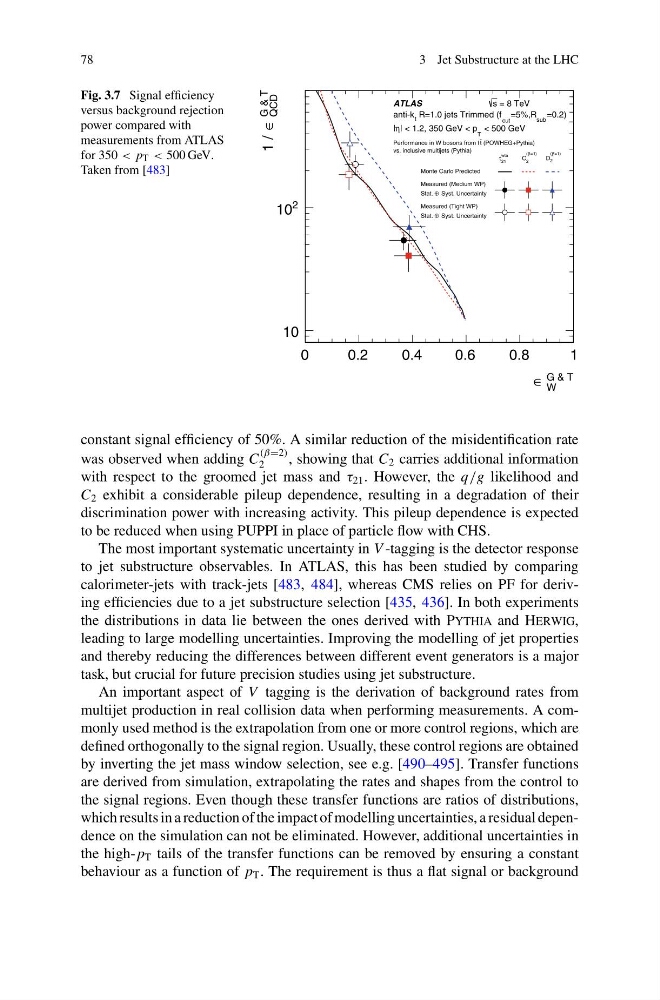
Fig. 3.7 Signal efficiency
versus background rejection
power compared with
measurements from ATLAS
for 350 < p T < 500 GeV.
Taken from [483]
W
G & T
∈
0
0.2
0.4
0.6
0.8
1
QCD
G & T
∈
1 /
10
2
10
ATLAS
s
V
e
T
8
=
=0.2)
sub
=5%,R
cut
R=1.0 jets Trimmed (f
t
anti-k
< 500 GeV
T
| < 1.2, 350 GeV < p
η
|
(POWHEG+Pythia)
t
Performance in W bosons from t
vs. inclusive multijets (Pythia)
wta
21
τ
=1)
β
(
2
C
=1)
β
(
2
D
Monte Carlo Predicted
Measured (Medium WP)
Syst. Uncertainty
⊕
Stat.
Measured (Tight WP)
Syst. Uncertainty
⊕
Stat.
constant signal efficiency of 50%. A similar reduction of the misidentification rate
was observed when adding C
(β=2)
2
, showing that C 2 carries additional information
with respect to the groomed jet mass and τ 21 . However, the q/g likelihood and
C 2 exhibit a considerable pileup dependence, resulting in a degradation of their
discrimination power with increasing activity. This pileup dependence is expected
to be reduced when using PUPPI in place of particle flow with CHS.
The most important systematic uncertainty in V -tagging is the detector response
to jet substructure observables. In ATLAS, this has been studied by comparing
calorimeter-jets with track-jets [483, 484], whereas CMS relies on PF for deriving efficiencies due to a jet substructure selection [435, 436]. In both experiments
the distributions in data lie between the ones derived with Pythia and Herwig,
leading to large modelling uncertainties. Improving the modelling of jet properties
and thereby reducing the differences between different event generators is a major
task, but crucial for future precision studies using jet substructure.
An important aspect of V tagging is the derivation of background rates from
multijet production in real collision data when performing measurements. A commonly used method is the extrapolation from one or more control regions, which are
defined orthogonally to the signal region. Usually, these control regions are obtained
by inverting the jet mass window selection, see e.g. [490–495]. Transfer functions
are derived from simulation, extrapolating the rates and shapes from the control to
the signal regions. Even though these transfer functions are ratios of distributions,
which results in a reduction of the impact of modelling uncertainties, a residual dependence on the simulation can not be eliminated. However, additional uncertainties in
the high- p T tails of the transfer functions can be removed by ensuring a constant
behaviour as a function of p T . The requirement is thus a flat signal or background
3 Jet Substructure at the LHC
Fig. 3.7 Signal efficiency
versus background rejection
power compared with
measurements from ATLAS
for 350 < p T < 500 GeV.
Taken from [483]
W
G & T
∈
0
0.2
0.4
0.6
0.8
1
QCD
G & T
∈
1 /
10
2
10
ATLAS
s
V
e
T
8
=
=0.2)
sub
=5%,R
cut
R=1.0 jets Trimmed (f
t
anti-k
< 500 GeV
T
| < 1.2, 350 GeV < p
η
|
(POWHEG+Pythia)
t
Performance in W bosons from t
vs. inclusive multijets (Pythia)
wta
21
τ
=1)
β
(
2
C
=1)
β
(
2
D
Monte Carlo Predicted
Measured (Medium WP)
Syst. Uncertainty
⊕
Stat.
Measured (Tight WP)
Syst. Uncertainty
⊕
Stat.
constant signal efficiency of 50%. A similar reduction of the misidentification rate
was observed when adding C
(β=2)
2
, showing that C 2 carries additional information
with respect to the groomed jet mass and τ 21 . However, the q/g likelihood and
C 2 exhibit a considerable pileup dependence, resulting in a degradation of their
discrimination power with increasing activity. This pileup dependence is expected
to be reduced when using PUPPI in place of particle flow with CHS.
The most important systematic uncertainty in V -tagging is the detector response
to jet substructure observables. In ATLAS, this has been studied by comparing
calorimeter-jets with track-jets [483, 484], whereas CMS relies on PF for deriving efficiencies due to a jet substructure selection [435, 436]. In both experiments
the distributions in data lie between the ones derived with Pythia and Herwig,
leading to large modelling uncertainties. Improving the modelling of jet properties
and thereby reducing the differences between different event generators is a major
task, but crucial for future precision studies using jet substructure.
An important aspect of V tagging is the derivation of background rates from
multijet production in real collision data when performing measurements. A commonly used method is the extrapolation from one or more control regions, which are
defined orthogonally to the signal region. Usually, these control regions are obtained
by inverting the jet mass window selection, see e.g. [490–495]. Transfer functions
are derived from simulation, extrapolating the rates and shapes from the control to
the signal regions. Even though these transfer functions are ratios of distributions,
which results in a reduction of the impact of modelling uncertainties, a residual dependence on the simulation can not be eliminated. However, additional uncertainties in
the high- p T tails of the transfer functions can be removed by ensuring a constant
behaviour as a function of p T . The requirement is thus a flat signal or background