

3.2 Jet Reconstruction and Calibration
65
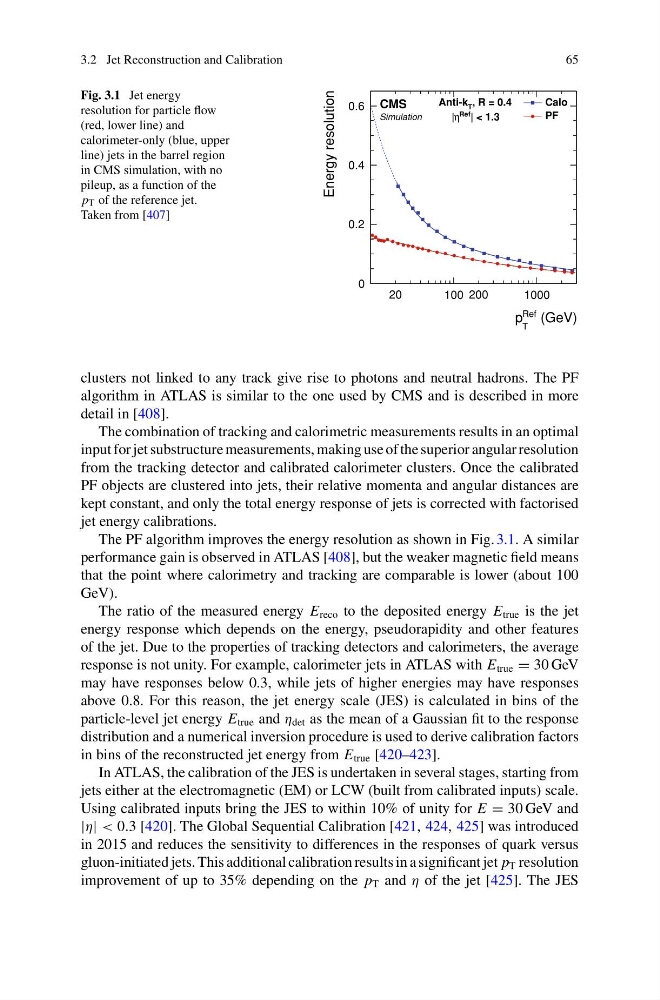
Fig. 3.1 Jet energy
resolution for particle flow
(red, lower line) and
calorimeter-only (blue, upper
line) jets in the barrel region
in CMS simulation, with no
pileup, as a function of the
p T of the reference jet.
Taken from [407]
(GeV)
Ref
T
p
20
100 200
1000
Energy resolution
0
0.2
0.4
0.6 CMS
Simulation
Calo
PF
, R = 0.4
T
Anti-k
| < 1.3
Ref
η
|
clusters not linked to any track give rise to photons and neutral hadrons. The PF
algorithm in ATLAS is similar to the one used by CMS and is described in more
detail in [408].
The combination of tracking and calorimetric measurements results in an optimal
input for jet substructure measurements, making use of the superior angular resolution
from the tracking detector and calibrated calorimeter clusters. Once the calibrated
PF objects are clustered into jets, their relative momenta and angular distances are
kept constant, and only the total energy response of jets is corrected with factorised
jet energy calibrations.
The PF algorithm improves the energy resolution as shown in Fig. 3.1. A similar
performance gain is observed in ATLAS [408], but the weaker magnetic field means
that the point where calorimetry and tracking are comparable is lower (about 100
GeV).
The ratio of the measured energy E reco to the deposited energy E true is the jet
energy response which depends on the energy, pseudorapidity and other features
of the jet. Due to the properties of tracking detectors and calorimeters, the average
response is not unity. For example, calorimeter jets in ATLAS with E true = 30 GeV
may have responses below 0.3, while jets of higher energies may have responses
above 0.8. For this reason, the jet energy scale (JES) is calculated in bins of the
particle-level jet energy E true and η det as the mean of a Gaussian fit to the response
distribution and a numerical inversion procedure is used to derive calibration factors
in bins of the reconstructed jet energy from E true [420–423].
In ATLAS, the calibration of the JES is undertaken in several stages, starting from
jets either at the electromagnetic (EM) or LCW (built from calibrated inputs) scale.
Using calibrated inputs bring the JES to within 10% of unity for E = 30 GeV and
|η| < 0.3 [420]. The Global Sequential Calibration [421, 424, 425] was introduced
in 2015 and reduces the sensitivity to differences in the responses of quark versus
gluon-initiated jets. This additional calibration results in a significant jet p T resolution
improvement of up to 35% depending on the p T and η of the jet [425]. The JES
65
Fig. 3.1 Jet energy
resolution for particle flow
(red, lower line) and
calorimeter-only (blue, upper
line) jets in the barrel region
in CMS simulation, with no
pileup, as a function of the
p T of the reference jet.
Taken from [407]
(GeV)
Ref
T
p
20
100 200
1000
Energy resolution
0
0.2
0.4
0.6 CMS
Simulation
Calo
PF
, R = 0.4
T
Anti-k
| < 1.3
Ref
η
|
clusters not linked to any track give rise to photons and neutral hadrons. The PF
algorithm in ATLAS is similar to the one used by CMS and is described in more
detail in [408].
The combination of tracking and calorimetric measurements results in an optimal
input for jet substructure measurements, making use of the superior angular resolution
from the tracking detector and calibrated calorimeter clusters. Once the calibrated
PF objects are clustered into jets, their relative momenta and angular distances are
kept constant, and only the total energy response of jets is corrected with factorised
jet energy calibrations.
The PF algorithm improves the energy resolution as shown in Fig. 3.1. A similar
performance gain is observed in ATLAS [408], but the weaker magnetic field means
that the point where calorimetry and tracking are comparable is lower (about 100
GeV).
The ratio of the measured energy E reco to the deposited energy E true is the jet
energy response which depends on the energy, pseudorapidity and other features
of the jet. Due to the properties of tracking detectors and calorimeters, the average
response is not unity. For example, calorimeter jets in ATLAS with E true = 30 GeV
may have responses below 0.3, while jets of higher energies may have responses
above 0.8. For this reason, the jet energy scale (JES) is calculated in bins of the
particle-level jet energy E true and η det as the mean of a Gaussian fit to the response
distribution and a numerical inversion procedure is used to derive calibration factors
in bins of the reconstructed jet energy from E true [420–423].
In ATLAS, the calibration of the JES is undertaken in several stages, starting from
jets either at the electromagnetic (EM) or LCW (built from calibrated inputs) scale.
Using calibrated inputs bring the JES to within 10% of unity for E = 30 GeV and
|η| < 0.3 [420]. The Global Sequential Calibration [421, 424, 425] was introduced
in 2015 and reduces the sensitivity to differences in the responses of quark versus
gluon-initiated jets. This additional calibration results in a significant jet p T resolution
improvement of up to 35% depending on the p T and η of the jet [425]. The JES