

48
2 Phenomenology of Jet Substructure
result regulates the divergence of fixed-order calculations at low masses, a matching
to fixed-order calculations is needed in order to obtain reliable predictions also at
high values of the jet mass.
Calculations in SCET are based on a division of the multiscale problem into appropriate kinematic domains. In each of these kinematic domains an effective Lagrangian
is constructed encoding the relevant dynamics of the system. In this way, the hard
scattering can still be described by the full QCD Lagrangian, which is obtained by
matching QCD to the effective theory. Below the hard scale the effective theory splits
into several distinct collinear and soft sectors. Before and after the hard interaction
takes place, the jets described by the different collinear sectors evolve independently
from each other with only soft, but no hard interactions between them. The radiation
between collinear jets is described by soft quark and gluon fields [283]. This simplification is the basis of factorisation theorems in SCET, which allow differential
cross sections to be written as convolutions of independent pieces. These pieces are
the hard functions, given by the scattering amplitudes to produce N partons, N jet
functions encapsulating the evolution of partons to jets due to collinear radiation
within jets, non-perturbative soft functions describing soft cross-talk between jets
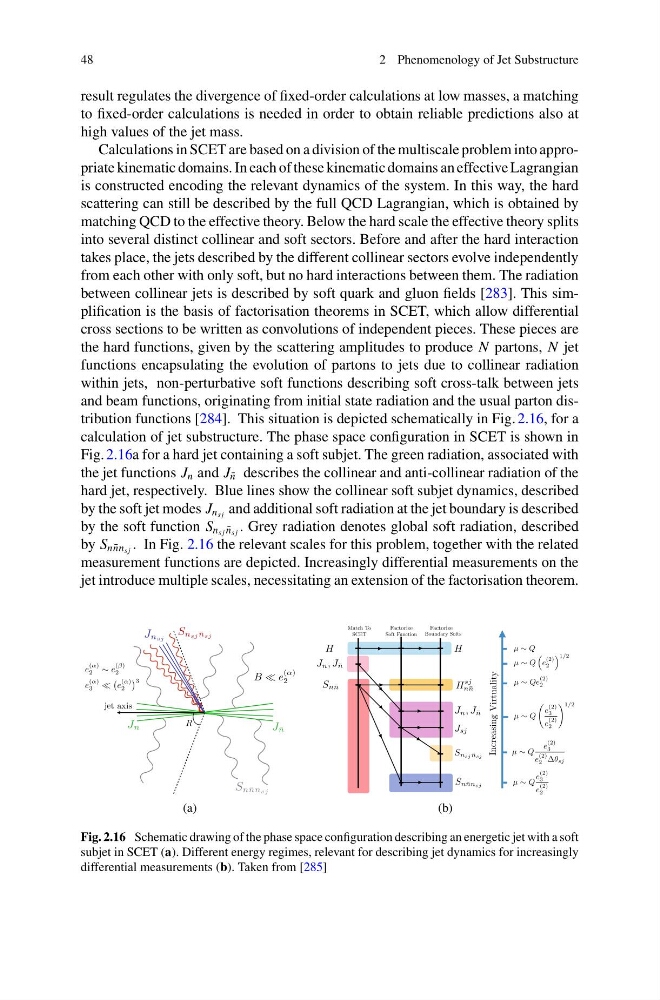
and beam functions, originating from initial state radiation and the usual parton distribution functions [284]. This situation is depicted schematically in Fig. 2.16, for a
calculation of jet substructure. The phase space configuration in SCET is shown in
Fig. 2.16a for a hard jet containing a soft subjet. The green radiation, associated with
the jet functions J n and J ¯
n describes the collinear and anti-collinear radiation of the
hard jet, respectively. Blue lines show the collinear soft subjet dynamics, described
by the soft jet modes J n sj and additional soft radiation at the jet boundary is described
by the soft function S n sj ¯
n sj . Grey radiation denotes global soft radiation, described
by S n ¯
nn sj . In Fig. 2.16 the relevant scales for this problem, together with the related
measurement functions are depicted. Increasingly differential measurements on the
jet introduce multiple scales, necessitating an extension of the factorisation theorem.
J ¯
n
J n
jet axis
R
e
(α)
2
∼ e
(β)
2
e
(α)
3
e
(α)
2
3
J nsj S nsj ¯
nsj
S n¯ nnsj
B
e
(α)
2
(a)
μ ∼ Q
μ ∼ Qe
(2)
2
μ ∼ Q
e
(2)
3
e
(2)
2
1/2
μ ∼ Q
e
(2)
3
e
(2)
2 Δθsj
μ ∼ Q
e
(2)
3
e
(2)
2
μ ∼ Q e
(2)
2
1/2
y
t
i
l
a
u
t
r
i
V
g
n
i
s
a
e
r
c
n
I
S n¯ n
H
sj
n¯ n
Sn¯ nnsj
Sn sj ¯
nsj
SCET
Factorize
Match To
Soft Function
Factorize
Boundary Softs
J n , J ¯
n
J n , J ¯
n
Jsj
H
H
(b)
Fig. 2.16 Schematic drawing of the phase space configuration describing an energetic jet with a soft
subjet in SCET (a). Different energy regimes, relevant for describing jet dynamics for increasingly
differential measurements (b). Taken from [285]
2 Phenomenology of Jet Substructure
result regulates the divergence of fixed-order calculations at low masses, a matching
to fixed-order calculations is needed in order to obtain reliable predictions also at
high values of the jet mass.
Calculations in SCET are based on a division of the multiscale problem into appropriate kinematic domains. In each of these kinematic domains an effective Lagrangian
is constructed encoding the relevant dynamics of the system. In this way, the hard
scattering can still be described by the full QCD Lagrangian, which is obtained by
matching QCD to the effective theory. Below the hard scale the effective theory splits
into several distinct collinear and soft sectors. Before and after the hard interaction
takes place, the jets described by the different collinear sectors evolve independently
from each other with only soft, but no hard interactions between them. The radiation
between collinear jets is described by soft quark and gluon fields [283]. This simplification is the basis of factorisation theorems in SCET, which allow differential
cross sections to be written as convolutions of independent pieces. These pieces are
the hard functions, given by the scattering amplitudes to produce N partons, N jet
functions encapsulating the evolution of partons to jets due to collinear radiation
within jets, non-perturbative soft functions describing soft cross-talk between jets
and beam functions, originating from initial state radiation and the usual parton distribution functions [284]. This situation is depicted schematically in Fig. 2.16, for a
calculation of jet substructure. The phase space configuration in SCET is shown in
Fig. 2.16a for a hard jet containing a soft subjet. The green radiation, associated with
the jet functions J n and J ¯
n describes the collinear and anti-collinear radiation of the
hard jet, respectively. Blue lines show the collinear soft subjet dynamics, described
by the soft jet modes J n sj and additional soft radiation at the jet boundary is described
by the soft function S n sj ¯
n sj . Grey radiation denotes global soft radiation, described
by S n ¯
nn sj . In Fig. 2.16 the relevant scales for this problem, together with the related
measurement functions are depicted. Increasingly differential measurements on the
jet introduce multiple scales, necessitating an extension of the factorisation theorem.
J ¯
n
J n
jet axis
R
e
(α)
2
∼ e
(β)
2
e
(α)
3
e
(α)
2
3
J nsj S nsj ¯
nsj
S n¯ nnsj
B
e
(α)
2
(a)
μ ∼ Q
μ ∼ Qe
(2)
2
μ ∼ Q
e
(2)
3
e
(2)
2
1/2
μ ∼ Q
e
(2)
3
e
(2)
2 Δθsj
μ ∼ Q
e
(2)
3
e
(2)
2
μ ∼ Q e
(2)
2
1/2
y
t
i
l
a
u
t
r
i
V
g
n
i
s
a
e
r
c
n
I
S n¯ n
H
sj
n¯ n
Sn¯ nnsj
Sn sj ¯
nsj
SCET
Factorize
Match To
Soft Function
Factorize
Boundary Softs
J n , J ¯
n
J n , J ¯
n
Jsj
H
H
(b)
Fig. 2.16 Schematic drawing of the phase space configuration describing an energetic jet with a soft
subjet in SCET (a). Different energy regimes, relevant for describing jet dynamics for increasingly
differential measurements (b). Taken from [285]