

2.5 (Semi-)Analytical Calculations
47
and collinear limit (see [263] for a recent comprehensive review) and Soft-Collinear
Effective Theory (SCET) [264–270] (an extensive review is given in [271]). While
these two approaches are formally very different, their equivalence is discussed in
recent studies [272–275].
The calculations in direct QCD rely on the factorisation properties of the real
and virtual amplitudes in the soft and collinear limit. While the individual real and
virtual contributions can be divergent, these divergencies cancel for IRC safe [47,
159] observables due to the virtues of the Bloch-Nordsieck [276] and KinoshitaLee-Nauenberg [277, 278] theorems. While in the case of inclusive variables the
cancellation is complete, in exclusive measurements the kinematic dependence on
the observable can cause an unbalance between the real and virtual contributions. This
manifests in the appearance of potentially large logarithmic corrections at any order in
the perturbative series. These contributions spoil the convergence of the perturbative
series and must be resummed to obtain reliable predictions. A further complication
arises in the case of non-global observables [205]. Contrary to global observables,
which are sensitive to emissions anywhere in the phase space, non-global ones are
sensitive to emissions only in a part of the phase space. The resulting corrections
emerge as non-global logarithms, which also need to be resummed to achieve nextto-leading-logarithmic (NLL) or higher accuracy. These calculations are highly nontrivial and no closed analytical solution of the resummed expression exists [235, 279–
281]. In fact, when calculating observables obtained by jet substructure algorithms
(e.g. jet grooming, see Sect. 2.4.3), there are several cases where the phase space for
gluon emissions is sliced in a non-trivial way which leads to a further complications
when aiming for an all-order resummation [237].
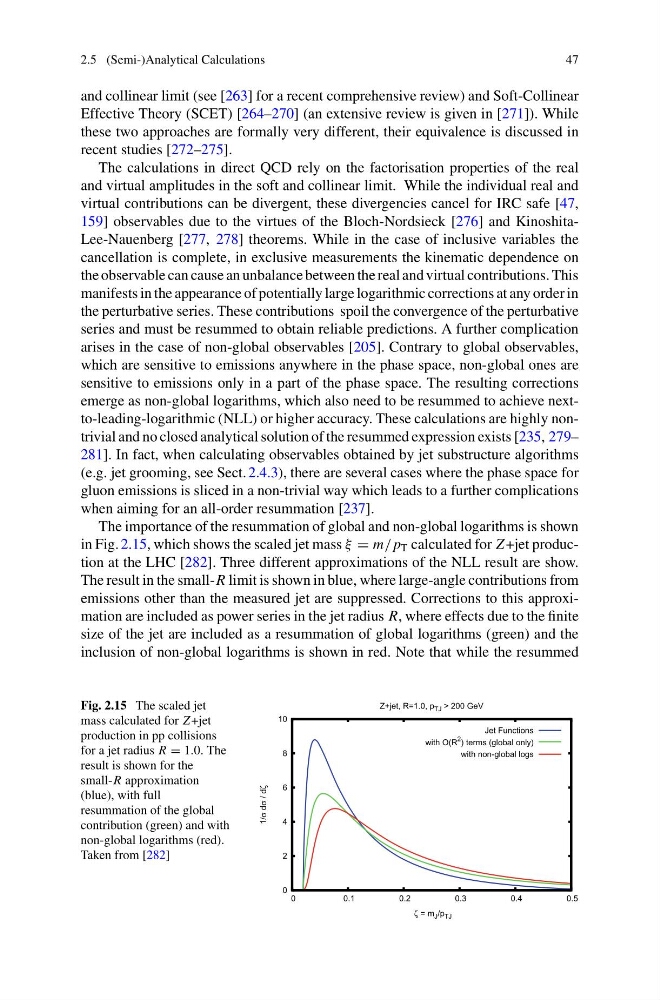
The importance of the resummation of global and non-global logarithms is shown
in Fig. 2.15, which shows the scaled jet mass ξ = m/ p T calculated for Z +jet production at the LHC [282]. Three different approximations of the NLL result are show.
The result in the small-R limit is shown in blue, where large-angle contributions from
emissions other than the measured jet are suppressed. Corrections to this approximation are included as power series in the jet radius R, where effects due to the finite
size of the jet are included as a resummation of global logarithms (green) and the
inclusion of non-global logarithms is shown in red. Note that while the resummed
Fig. 2.15 The scaled jet
mass calculated for Z +jet
production in pp collisions
for a jet radius R = 1.0. The
result is shown for the
small-R approximation
(blue), with full
resummation of the global
contribution (green) and with
non-global logarithms (red).
Taken from [282]
0
2
4
6
8
10
0
0.1
0.2
0.3
0.4
0.5
1/σ dσ
/ dζ
ζ = m J /p TJ
Z+jet, R=1.0, p TJ > 200 GeV
Jet Functions
with O(R
2
) terms (global only)
with non-global logs
47
and collinear limit (see [263] for a recent comprehensive review) and Soft-Collinear
Effective Theory (SCET) [264–270] (an extensive review is given in [271]). While
these two approaches are formally very different, their equivalence is discussed in
recent studies [272–275].
The calculations in direct QCD rely on the factorisation properties of the real
and virtual amplitudes in the soft and collinear limit. While the individual real and
virtual contributions can be divergent, these divergencies cancel for IRC safe [47,
159] observables due to the virtues of the Bloch-Nordsieck [276] and KinoshitaLee-Nauenberg [277, 278] theorems. While in the case of inclusive variables the
cancellation is complete, in exclusive measurements the kinematic dependence on
the observable can cause an unbalance between the real and virtual contributions. This
manifests in the appearance of potentially large logarithmic corrections at any order in
the perturbative series. These contributions spoil the convergence of the perturbative
series and must be resummed to obtain reliable predictions. A further complication
arises in the case of non-global observables [205]. Contrary to global observables,
which are sensitive to emissions anywhere in the phase space, non-global ones are
sensitive to emissions only in a part of the phase space. The resulting corrections
emerge as non-global logarithms, which also need to be resummed to achieve nextto-leading-logarithmic (NLL) or higher accuracy. These calculations are highly nontrivial and no closed analytical solution of the resummed expression exists [235, 279–
281]. In fact, when calculating observables obtained by jet substructure algorithms
(e.g. jet grooming, see Sect. 2.4.3), there are several cases where the phase space for
gluon emissions is sliced in a non-trivial way which leads to a further complications
when aiming for an all-order resummation [237].
The importance of the resummation of global and non-global logarithms is shown
in Fig. 2.15, which shows the scaled jet mass ξ = m/ p T calculated for Z +jet production at the LHC [282]. Three different approximations of the NLL result are show.
The result in the small-R limit is shown in blue, where large-angle contributions from
emissions other than the measured jet are suppressed. Corrections to this approximation are included as power series in the jet radius R, where effects due to the finite
size of the jet are included as a resummation of global logarithms (green) and the
inclusion of non-global logarithms is shown in red. Note that while the resummed
Fig. 2.15 The scaled jet
mass calculated for Z +jet
production in pp collisions
for a jet radius R = 1.0. The
result is shown for the
small-R approximation
(blue), with full
resummation of the global
contribution (green) and with
non-global logarithms (red).
Taken from [282]
0
2
4
6
8
10
0
0.1
0.2
0.3
0.4
0.5
1/σ dσ
/ dζ
ζ = m J /p TJ
Z+jet, R=1.0, p TJ > 200 GeV
Jet Functions
with O(R
2
) terms (global only)
with non-global logs