

40
2 Phenomenology of Jet Substructure
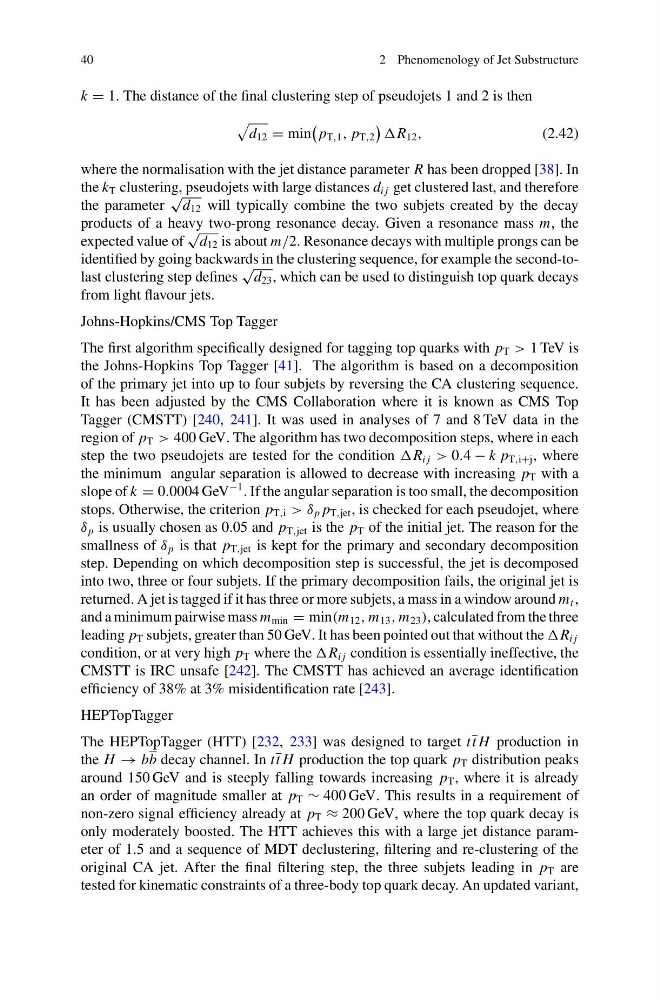
k = 1. The distance of the final clustering step of pseudojets 1 and 2 is then
d 12 = min
p T,1 , p T,2
R 12 ,
(2.42)
where the normalisation with the jet distance parameter R has been dropped [38]. In
the k T clustering, pseudojets with large distances d i j get clustered last, and therefore
the parameter
√
d 12 will typically combine the two subjets created by the decay
products of a heavy two-prong resonance decay. Given a resonance mass m, the
expected value of
√
d 12 is about m/2. Resonance decays with multiple prongs can be
identified by going backwards in the clustering sequence, for example the second-tolast clustering step defines
√
d 23 , which can be used to distinguish top quark decays
from light flavour jets.
Johns-Hopkins/CMS Top Tagger
The first algorithm specifically designed for tagging top quarks with p T > 1 TeV is
the Johns-Hopkins Top Tagger [41]. The algorithm is based on a decomposition
of the primary jet into up to four subjets by reversing the CA clustering sequence.
It has been adjusted by the CMS Collaboration where it is known as CMS Top
Tagger (CMSTT) [240, 241]. It was used in analyses of 7 and 8 TeV data in the
region of p T > 400 GeV. The algorithm has two decomposition steps, where in each
step the two pseudojets are tested for the condition R i j > 0.4 − k p T,i+j , where
the minimum angular separation is allowed to decrease with increasing p T with a
slope of k = 0.0004 GeV
−1 . If the angular separation is too small, the decomposition
stops. Otherwise, the criterion p T,i > δ p p T,jet , is checked for each pseudojet, where
δ p is usually chosen as 0.05 and p T,jet is the p T of the initial jet. The reason for the
smallness of δ p is that p T,jet is kept for the primary and secondary decomposition
step. Depending on which decomposition step is successful, the jet is decomposed
into two, three or four subjets. If the primary decomposition fails, the original jet is
returned. A jet is tagged if it has three or more subjets, a mass in a window around m t ,
and a minimum pairwise mass m min = min(m 12 , m 13 , m 23 ), calculated from the three
leading p T subjets, greater than 50 GeV. It has been pointed out that without the R i j
condition, or at very high p T where the R i j condition is essentially ineffective, the
CMSTT is IRC unsafe [242]. The CMSTT has achieved an average identification
efficiency of 38% at 3% misidentification rate [243].
HEPTopTagger
The HEPTopTagger (HTT) [232, 233] was designed to target tt H production in
the H → bb decay channel. In tt H production the top quark p T distribution peaks
around 150 GeV and is steeply falling towards increasing p T , where it is already
an order of magnitude smaller at p T ∼ 400 GeV. This results in a requirement of
non-zero signal efficiency already at p T ≈ 200 GeV, where the top quark decay is
only moderately boosted. The HTT achieves this with a large jet distance parameter of 1.5 and a sequence of MDT declustering, filtering and re-clustering of the
original CA jet. After the final filtering step, the three subjets leading in p T are
tested for kinematic constraints of a three-body top quark decay. An updated variant,
2 Phenomenology of Jet Substructure
k = 1. The distance of the final clustering step of pseudojets 1 and 2 is then
d 12 = min
p T,1 , p T,2
R 12 ,
(2.42)
where the normalisation with the jet distance parameter R has been dropped [38]. In
the k T clustering, pseudojets with large distances d i j get clustered last, and therefore
the parameter
√
d 12 will typically combine the two subjets created by the decay
products of a heavy two-prong resonance decay. Given a resonance mass m, the
expected value of
√
d 12 is about m/2. Resonance decays with multiple prongs can be
identified by going backwards in the clustering sequence, for example the second-tolast clustering step defines
√
d 23 , which can be used to distinguish top quark decays
from light flavour jets.
Johns-Hopkins/CMS Top Tagger
The first algorithm specifically designed for tagging top quarks with p T > 1 TeV is
the Johns-Hopkins Top Tagger [41]. The algorithm is based on a decomposition
of the primary jet into up to four subjets by reversing the CA clustering sequence.
It has been adjusted by the CMS Collaboration where it is known as CMS Top
Tagger (CMSTT) [240, 241]. It was used in analyses of 7 and 8 TeV data in the
region of p T > 400 GeV. The algorithm has two decomposition steps, where in each
step the two pseudojets are tested for the condition R i j > 0.4 − k p T,i+j , where
the minimum angular separation is allowed to decrease with increasing p T with a
slope of k = 0.0004 GeV
−1 . If the angular separation is too small, the decomposition
stops. Otherwise, the criterion p T,i > δ p p T,jet , is checked for each pseudojet, where
δ p is usually chosen as 0.05 and p T,jet is the p T of the initial jet. The reason for the
smallness of δ p is that p T,jet is kept for the primary and secondary decomposition
step. Depending on which decomposition step is successful, the jet is decomposed
into two, three or four subjets. If the primary decomposition fails, the original jet is
returned. A jet is tagged if it has three or more subjets, a mass in a window around m t ,
and a minimum pairwise mass m min = min(m 12 , m 13 , m 23 ), calculated from the three
leading p T subjets, greater than 50 GeV. It has been pointed out that without the R i j
condition, or at very high p T where the R i j condition is essentially ineffective, the
CMSTT is IRC unsafe [242]. The CMSTT has achieved an average identification
efficiency of 38% at 3% misidentification rate [243].
HEPTopTagger
The HEPTopTagger (HTT) [232, 233] was designed to target tt H production in
the H → bb decay channel. In tt H production the top quark p T distribution peaks
around 150 GeV and is steeply falling towards increasing p T , where it is already
an order of magnitude smaller at p T ∼ 400 GeV. This results in a requirement of
non-zero signal efficiency already at p T ≈ 200 GeV, where the top quark decay is
only moderately boosted. The HTT achieves this with a large jet distance parameter of 1.5 and a sequence of MDT declustering, filtering and re-clustering of the
original CA jet. After the final filtering step, the three subjets leading in p T are
tested for kinematic constraints of a three-body top quark decay. An updated variant,