

2.4 Identifying Particle Decays with Jet Substructure
39
are tested. If both criteria are met, the combined pseudojet is kept. Otherwise, the
least massive of pseudojets i and j is discarded and the procedure continues on the
other pseudojet. Typical parameter choices are μ cut = 2/3 and y cut in the range 0.09–
0.15. This results in a significant mass drop, i.e. while the original jet is massive,
as expected from the decay of a heavy boson, the subjets originate from massless
quarks. In addition, the momentum splitting between the two subjets is symmetric,
as expected from a two-body decay, whereas soft QCD radiation is rejected. In its
original version, mass drop has been introduced to identify the two-prong structure
of H → bb decays and distinguish it from QCD background. The algorithm also
acts as a jet groomer since it iteratively removes soft radiation.
Modified Mass Drop Tagger and Soft Drop
An improvement of the mass drop tagger has been suggested in an analytic study [237],
where it was found that following the most massive branch in the declustering can
lead to the algorithm following the wrong branch. This happens if a soft emission results in a large mass, and the MDT recurses into this branch even though
it is soft. A modification has been introduced to avoid these configurations. In
the modified Mass Drop Tagger (mMDT) the symmetry condition is replaced by
min( p T,i , p T,j ) > z cut ( p T,i + p T,j ), and the hardest branch in p T is followed in the
declustering. The mass-drop criterion has been found to be sub-leading and can be
dropped without a performance penalty. The mMDT has been found to greatly facilitate analytic calculations and even slightly improve the performance in relation to
the MDT. The soft drop algorithm [231] is a generalisation of the mMDT, obtained
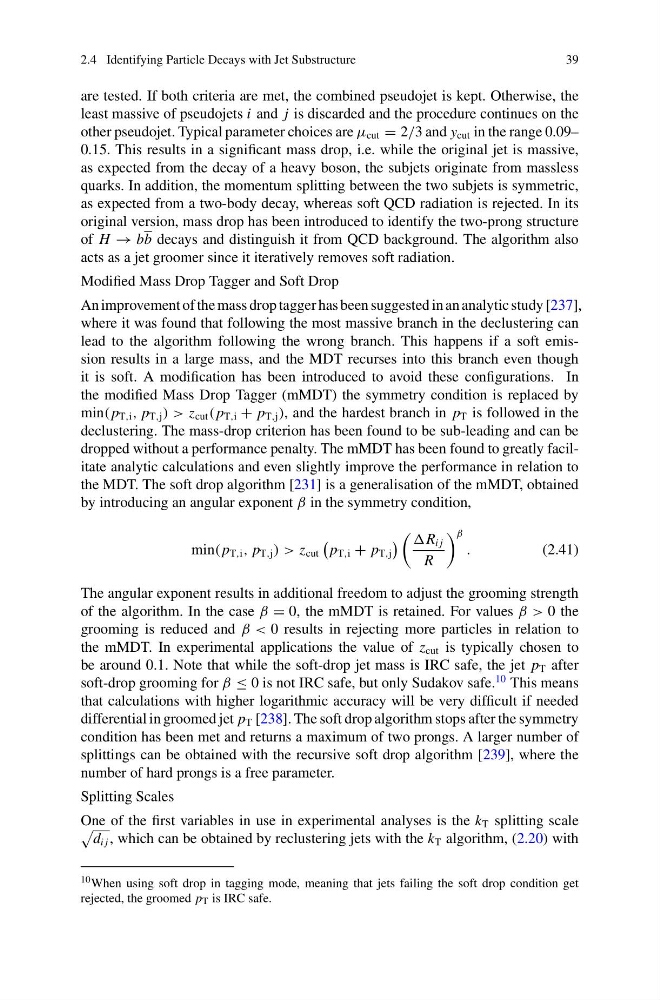
by introducing an angular exponent β in the symmetry condition,
min( p T,i , p T,j ) > z cut
p T,i + p T,j
R i j
R
β
.
(2.41)
The angular exponent results in additional freedom to adjust the grooming strength
of the algorithm. In the case β = 0, the mMDT is retained. For values β > 0 the
grooming is reduced and β < 0 results in rejecting more particles in relation to
the mMDT. In experimental applications the value of z cut is typically chosen to
be around 0.1. Note that while the soft-drop jet mass is IRC safe, the jet p T after
soft-drop grooming for β ≤ 0 is not IRC safe, but only Sudakov safe.
10 This means
that calculations with higher logarithmic accuracy will be very difficult if needed
differential in groomed jet p T [238]. The soft drop algorithm stops after the symmetry
condition has been met and returns a maximum of two prongs. A larger number of
splittings can be obtained with the recursive soft drop algorithm [239], where the
number of hard prongs is a free parameter.
Splitting Scales
One of the first variables in use in experimental analyses is the k T splitting scale
d i j , which can be obtained by reclustering jets with the k T algorithm, (2.20) with
10 When using soft drop in tagging mode, meaning that jets failing the soft drop condition get
rejected, the groomed p T is IRC safe.
39
are tested. If both criteria are met, the combined pseudojet is kept. Otherwise, the
least massive of pseudojets i and j is discarded and the procedure continues on the
other pseudojet. Typical parameter choices are μ cut = 2/3 and y cut in the range 0.09–
0.15. This results in a significant mass drop, i.e. while the original jet is massive,
as expected from the decay of a heavy boson, the subjets originate from massless
quarks. In addition, the momentum splitting between the two subjets is symmetric,
as expected from a two-body decay, whereas soft QCD radiation is rejected. In its
original version, mass drop has been introduced to identify the two-prong structure
of H → bb decays and distinguish it from QCD background. The algorithm also
acts as a jet groomer since it iteratively removes soft radiation.
Modified Mass Drop Tagger and Soft Drop
An improvement of the mass drop tagger has been suggested in an analytic study [237],
where it was found that following the most massive branch in the declustering can
lead to the algorithm following the wrong branch. This happens if a soft emission results in a large mass, and the MDT recurses into this branch even though
it is soft. A modification has been introduced to avoid these configurations. In
the modified Mass Drop Tagger (mMDT) the symmetry condition is replaced by
min( p T,i , p T,j ) > z cut ( p T,i + p T,j ), and the hardest branch in p T is followed in the
declustering. The mass-drop criterion has been found to be sub-leading and can be
dropped without a performance penalty. The mMDT has been found to greatly facilitate analytic calculations and even slightly improve the performance in relation to
the MDT. The soft drop algorithm [231] is a generalisation of the mMDT, obtained
by introducing an angular exponent β in the symmetry condition,
min( p T,i , p T,j ) > z cut
p T,i + p T,j
R i j
R
β
.
(2.41)
The angular exponent results in additional freedom to adjust the grooming strength
of the algorithm. In the case β = 0, the mMDT is retained. For values β > 0 the
grooming is reduced and β < 0 results in rejecting more particles in relation to
the mMDT. In experimental applications the value of z cut is typically chosen to
be around 0.1. Note that while the soft-drop jet mass is IRC safe, the jet p T after
soft-drop grooming for β ≤ 0 is not IRC safe, but only Sudakov safe.
10 This means
that calculations with higher logarithmic accuracy will be very difficult if needed
differential in groomed jet p T [238]. The soft drop algorithm stops after the symmetry
condition has been met and returns a maximum of two prongs. A larger number of
splittings can be obtained with the recursive soft drop algorithm [239], where the
number of hard prongs is a free parameter.
Splitting Scales
One of the first variables in use in experimental analyses is the k T splitting scale
d i j , which can be obtained by reclustering jets with the k T algorithm, (2.20) with
10 When using soft drop in tagging mode, meaning that jets failing the soft drop condition get
rejected, the groomed p T is IRC safe.