

28
2 Phenomenology of Jet Substructure
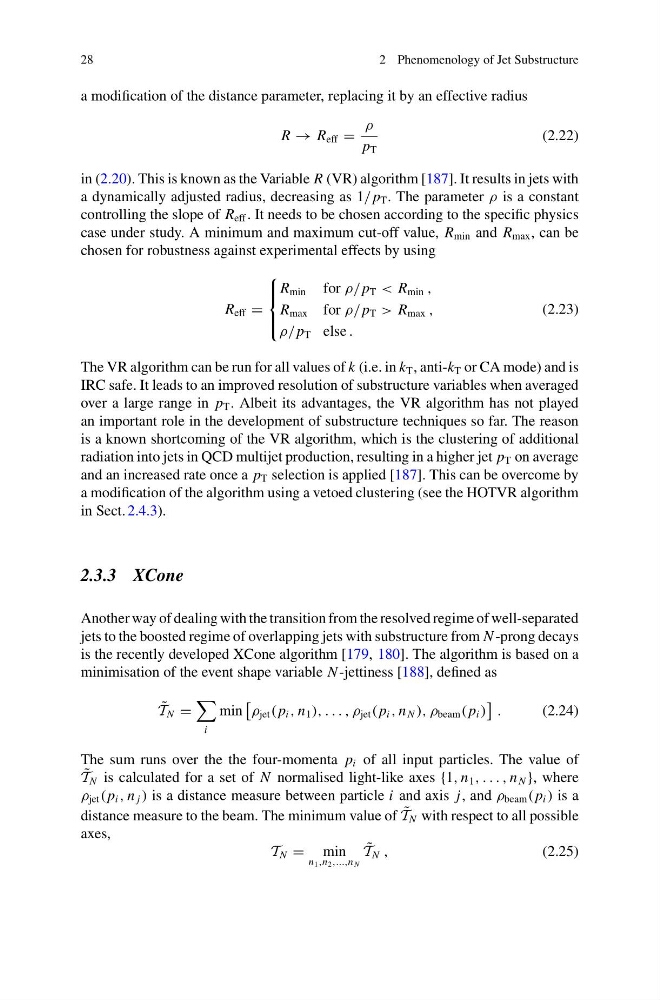
a modification of the distance parameter, replacing it by an effective radius
R → R eff =
ρ
p T
(2.22)
in (2.20). This is known as the Variable R (VR) algorithm [187]. It results in jets with
a dynamically adjusted radius, decreasing as 1/ p T . The parameter ρ is a constant
controlling the slope of R eff . It needs to be chosen according to the specific physics
case under study. A minimum and maximum cut-off value, R min and R max , can be
chosen for robustness against experimental effects by using
R eff =
⎧
⎪ ⎨
⎪ ⎩
R min for ρ/ p T < R min ,
R max for ρ/ p T > R max ,
ρ/ p T else .
(2.23)
The VR algorithm can be run for all values of k (i.e. in k T , anti-k T or CA mode) and is
IRC safe. It leads to an improved resolution of substructure variables when averaged
over a large range in p T . Albeit its advantages, the VR algorithm has not played
an important role in the development of substructure techniques so far. The reason
is a known shortcoming of the VR algorithm, which is the clustering of additional
radiation into jets in QCD multijet production, resulting in a higher jet p T on average
and an increased rate once a p T selection is applied [187]. This can be overcome by
a modification of the algorithm using a vetoed clustering (see the HOTVR algorithm
in Sect. 2.4.3).
2.3.3 XCone
Another way of dealing with the transition from the resolved regime of well-separated
jets to the boosted regime of overlapping jets with substructure from N -prong decays
is the recently developed XCone algorithm [179, 180]. The algorithm is based on a
minimisation of the event shape variable N -jettiness [188], defined as
˜
T N =
i
min
ρ jet ( p i , n 1 ), . . . , ρ jet ( p i , n N ), ρ beam ( p i )
.
(2.24)
The sum runs over the the four-momenta p i of all input particles. The value of
˜
T N is calculated for a set of N normalised light-like axes {1, n 1 , . . . , n N }, where
ρ jet ( p i , n j ) is a distance measure between particle i and axis j, and ρ beam ( p i ) is a
distance measure to the beam. The minimum value of ˜
T N with respect to all possible
axes,
T N = min
n 1 ,n 2 ,...,n N
˜
T N ,
(2.25)
2 Phenomenology of Jet Substructure
a modification of the distance parameter, replacing it by an effective radius
R → R eff =
ρ
p T
(2.22)
in (2.20). This is known as the Variable R (VR) algorithm [187]. It results in jets with
a dynamically adjusted radius, decreasing as 1/ p T . The parameter ρ is a constant
controlling the slope of R eff . It needs to be chosen according to the specific physics
case under study. A minimum and maximum cut-off value, R min and R max , can be
chosen for robustness against experimental effects by using
R eff =
⎧
⎪ ⎨
⎪ ⎩
R min for ρ/ p T < R min ,
R max for ρ/ p T > R max ,
ρ/ p T else .
(2.23)
The VR algorithm can be run for all values of k (i.e. in k T , anti-k T or CA mode) and is
IRC safe. It leads to an improved resolution of substructure variables when averaged
over a large range in p T . Albeit its advantages, the VR algorithm has not played
an important role in the development of substructure techniques so far. The reason
is a known shortcoming of the VR algorithm, which is the clustering of additional
radiation into jets in QCD multijet production, resulting in a higher jet p T on average
and an increased rate once a p T selection is applied [187]. This can be overcome by
a modification of the algorithm using a vetoed clustering (see the HOTVR algorithm
in Sect. 2.4.3).
2.3.3 XCone
Another way of dealing with the transition from the resolved regime of well-separated
jets to the boosted regime of overlapping jets with substructure from N -prong decays
is the recently developed XCone algorithm [179, 180]. The algorithm is based on a
minimisation of the event shape variable N -jettiness [188], defined as
˜
T N =
i
min
ρ jet ( p i , n 1 ), . . . , ρ jet ( p i , n N ), ρ beam ( p i )
.
(2.24)
The sum runs over the the four-momenta p i of all input particles. The value of
˜
T N is calculated for a set of N normalised light-like axes {1, n 1 , . . . , n N }, where
ρ jet ( p i , n j ) is a distance measure between particle i and axis j, and ρ beam ( p i ) is a
distance measure to the beam. The minimum value of ˜
T N with respect to all possible
axes,
T N = min
n 1 ,n 2 ,...,n N
˜
T N ,
(2.25)