

8
2 Phenomenology of Jet Substructure
consists of calorimeter clusters, reconstructed particle tracks or combinations thereof.
This ensemble is the only one available in real collision data recorded by particle
physics experiments. Jet algorithms using these different ensembles as input result
in parton, particle or detector level jets, respectively. Ideally, in any given event,
the jets obtained on parton, particle and detector level are as similar as possible.
Realistically, agreement can not be achieved, but a close correspondence ensures the
possibility to study the underlying partonic dynamics with the use of jets. It is this
correspondence, paired with calculability in pQCD, which makes jets indispensable
tools at high energy particle colliders. For a theoretical introduction to jets, see [24,
25, 58, 59].
Soon after their discovery, it was realised that not only the kinematics of jets
but also their internal structure carry information. The parton shower and subsequent
hadronisation leads to a characteristic multiplicity, as well as angular and momentum
distributions of hadrons inside jets, which depend on the parton that initiated the
shower. For example, the probability of a q → qg splitting is proportional to the
colour factor C F = 4/3 at leading order in QCD, while the probability of g → gg
is proportional to C A = 3. The larger value of C A results in a larger multiplicity
of hadrons and in broader jets. This lead to the suggestion of measuring jet shapes,
defined as the fractional transverse momentum profile of particles within a concentric
inner cone, smaller than the jet cone of the original jet, and pointed to their usefulness
for distinguishing quark from gluon jets [60]. Experimental results from LEP [61–
64], Tevatron [65, 66] and HERA [67–69] confirmed this and can be considered the
starting point of physics with jet substructure in particle physics.
At the LHC, jet substructure is used to identify highly boosted heavy SM particles
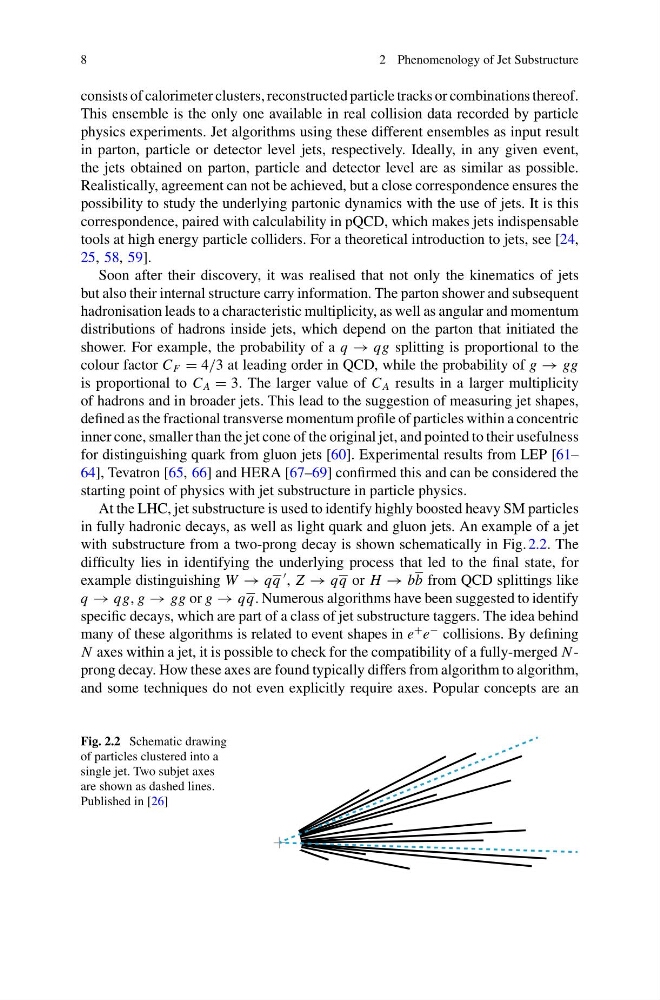
in fully hadronic decays, as well as light quark and gluon jets. An example of a jet
with substructure from a two-prong decay is shown schematically in Fig. 2.2. The
difficulty lies in identifying the underlying process that led to the final state, for
example distinguishing W → qq
, Z → qq or H → bb from QCD splittings like
q → qg, g → gg or g → qq. Numerous algorithms have been suggested to identify
specific decays, which are part of a class of jet substructure taggers. The idea behind
many of these algorithms is related to event shapes in e
+ e
− collisions. By defining
N axes within a jet, it is possible to check for the compatibility of a fully-merged N -
prong decay. How these axes are found typically differs from algorithm to algorithm,
and some techniques do not even explicitly require axes. Popular concepts are an
Fig. 2.2 Schematic drawing
of particles clustered into a
single jet. Two subjet axes
are shown as dashed lines.
Published in [26]
2 Phenomenology of Jet Substructure
consists of calorimeter clusters, reconstructed particle tracks or combinations thereof.
This ensemble is the only one available in real collision data recorded by particle
physics experiments. Jet algorithms using these different ensembles as input result
in parton, particle or detector level jets, respectively. Ideally, in any given event,
the jets obtained on parton, particle and detector level are as similar as possible.
Realistically, agreement can not be achieved, but a close correspondence ensures the
possibility to study the underlying partonic dynamics with the use of jets. It is this
correspondence, paired with calculability in pQCD, which makes jets indispensable
tools at high energy particle colliders. For a theoretical introduction to jets, see [24,
25, 58, 59].
Soon after their discovery, it was realised that not only the kinematics of jets
but also their internal structure carry information. The parton shower and subsequent
hadronisation leads to a characteristic multiplicity, as well as angular and momentum
distributions of hadrons inside jets, which depend on the parton that initiated the
shower. For example, the probability of a q → qg splitting is proportional to the
colour factor C F = 4/3 at leading order in QCD, while the probability of g → gg
is proportional to C A = 3. The larger value of C A results in a larger multiplicity
of hadrons and in broader jets. This lead to the suggestion of measuring jet shapes,
defined as the fractional transverse momentum profile of particles within a concentric
inner cone, smaller than the jet cone of the original jet, and pointed to their usefulness
for distinguishing quark from gluon jets [60]. Experimental results from LEP [61–
64], Tevatron [65, 66] and HERA [67–69] confirmed this and can be considered the
starting point of physics with jet substructure in particle physics.
At the LHC, jet substructure is used to identify highly boosted heavy SM particles
in fully hadronic decays, as well as light quark and gluon jets. An example of a jet
with substructure from a two-prong decay is shown schematically in Fig. 2.2. The
difficulty lies in identifying the underlying process that led to the final state, for
example distinguishing W → qq
, Z → qq or H → bb from QCD splittings like
q → qg, g → gg or g → qq. Numerous algorithms have been suggested to identify
specific decays, which are part of a class of jet substructure taggers. The idea behind
many of these algorithms is related to event shapes in e
+ e
− collisions. By defining
N axes within a jet, it is possible to check for the compatibility of a fully-merged N -
prong decay. How these axes are found typically differs from algorithm to algorithm,
and some techniques do not even explicitly require axes. Popular concepts are an
Fig. 2.2 Schematic drawing
of particles clustered into a
single jet. Two subjet axes
are shown as dashed lines.
Published in [26]