

2.1 Introduction to Jet Substructure
7
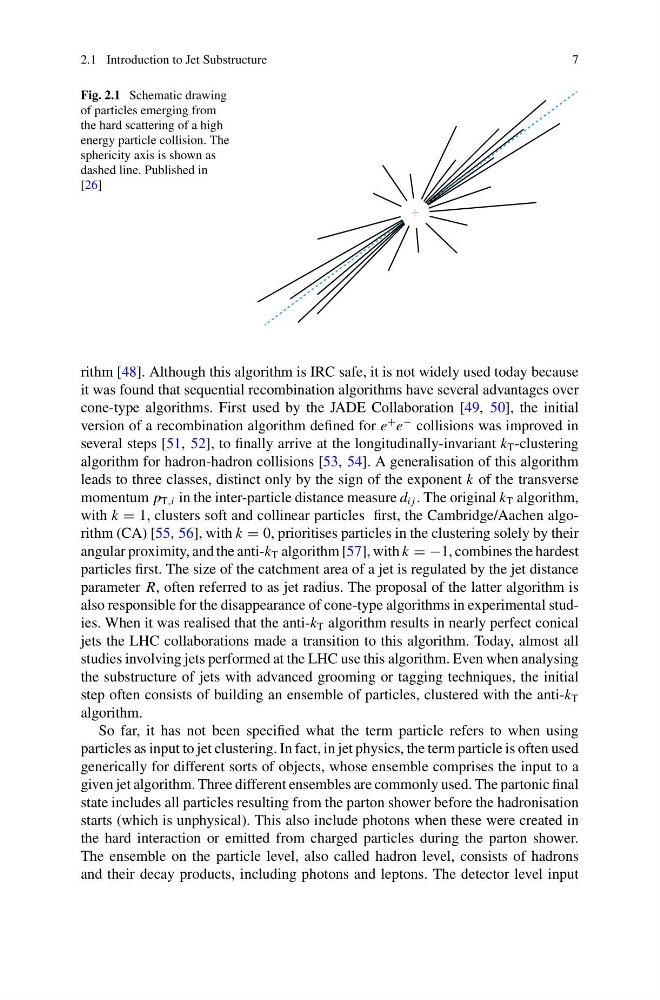
Fig. 2.1 Schematic drawing
of particles emerging from
the hard scattering of a high
energy particle collision. The
sphericity axis is shown as
dashed line. Published in
[26]
rithm [48]. Although this algorithm is IRC safe, it is not widely used today because
it was found that sequential recombination algorithms have several advantages over
cone-type algorithms. First used by the JADE Collaboration [49, 50], the initial
version of a recombination algorithm defined for e
+ e
− collisions was improved in
several steps [51, 52], to finally arrive at the longitudinally-invariant k T -clustering
algorithm for hadron-hadron collisions [53, 54]. A generalisation of this algorithm
leads to three classes, distinct only by the sign of the exponent k of the transverse
momentum p T,i in the inter-particle distance measure d i j . The original k T algorithm,
with k = 1, clusters soft and collinear particles first, the Cambridge/Aachen algorithm (CA) [55, 56], with k = 0, prioritises particles in the clustering solely by their
angular proximity, and the anti-k T algorithm [57], with k = −1, combines the hardest
particles first. The size of the catchment area of a jet is regulated by the jet distance
parameter R, often referred to as jet radius. The proposal of the latter algorithm is
also responsible for the disappearance of cone-type algorithms in experimental studies. When it was realised that the anti-k T algorithm results in nearly perfect conical
jets the LHC collaborations made a transition to this algorithm. Today, almost all
studies involving jets performed at the LHC use this algorithm. Even when analysing
the substructure of jets with advanced grooming or tagging techniques, the initial
step often consists of building an ensemble of particles, clustered with the anti-k T
algorithm.
So far, it has not been specified what the term particle refers to when using
particles as input to jet clustering. In fact, in jet physics, the term particle is often used
generically for different sorts of objects, whose ensemble comprises the input to a
given jet algorithm. Three different ensembles are commonly used. The partonic final
state includes all particles resulting from the parton shower before the hadronisation
starts (which is unphysical). This also include photons when these were created in
the hard interaction or emitted from charged particles during the parton shower.
The ensemble on the particle level, also called hadron level, consists of hadrons
and their decay products, including photons and leptons. The detector level input
7
Fig. 2.1 Schematic drawing
of particles emerging from
the hard scattering of a high
energy particle collision. The
sphericity axis is shown as
dashed line. Published in
[26]
rithm [48]. Although this algorithm is IRC safe, it is not widely used today because
it was found that sequential recombination algorithms have several advantages over
cone-type algorithms. First used by the JADE Collaboration [49, 50], the initial
version of a recombination algorithm defined for e
+ e
− collisions was improved in
several steps [51, 52], to finally arrive at the longitudinally-invariant k T -clustering
algorithm for hadron-hadron collisions [53, 54]. A generalisation of this algorithm
leads to three classes, distinct only by the sign of the exponent k of the transverse
momentum p T,i in the inter-particle distance measure d i j . The original k T algorithm,
with k = 1, clusters soft and collinear particles first, the Cambridge/Aachen algorithm (CA) [55, 56], with k = 0, prioritises particles in the clustering solely by their
angular proximity, and the anti-k T algorithm [57], with k = −1, combines the hardest
particles first. The size of the catchment area of a jet is regulated by the jet distance
parameter R, often referred to as jet radius. The proposal of the latter algorithm is
also responsible for the disappearance of cone-type algorithms in experimental studies. When it was realised that the anti-k T algorithm results in nearly perfect conical
jets the LHC collaborations made a transition to this algorithm. Today, almost all
studies involving jets performed at the LHC use this algorithm. Even when analysing
the substructure of jets with advanced grooming or tagging techniques, the initial
step often consists of building an ensemble of particles, clustered with the anti-k T
algorithm.
So far, it has not been specified what the term particle refers to when using
particles as input to jet clustering. In fact, in jet physics, the term particle is often used
generically for different sorts of objects, whose ensemble comprises the input to a
given jet algorithm. Three different ensembles are commonly used. The partonic final
state includes all particles resulting from the parton shower before the hadronisation
starts (which is unphysical). This also include photons when these were created in
the hard interaction or emitted from charged particles during the parton shower.
The ensemble on the particle level, also called hadron level, consists of hadrons
and their decay products, including photons and leptons. The detector level input