

176
5 Direct Searches for New Physics
0
1000
2000
3000
4000
5000
6000
Events / 20 GeV
Data
Total bkg unc.
t
t
Multijet
(2.4 TeV)
LH LH
b*
(13 TeV)
-1 -1
137 fb
CMS
Preliminary
120 140 160 180 200 220 240 260 280
[GeV]
t
m
2
−
1
−
0
1
2
σ σ
(Data-Bkg)/
3
−
10
2
−
10
1
−
10
1
10
2
10
3
10
4
10
5
10
6
10
Events / bin
Data
Total bkg unc.
Multijet
t
t
Single top
(2.4 TeV)
LH LH LH
b*
(13 TeV)
-1 -1
137 fb
CMS
Preliminary
1500
2000
2500
3000
3500
4000
[GeV]
tW tW
m
2
−
1
−
0
1
2
σ σ
(Data-Bkg)/
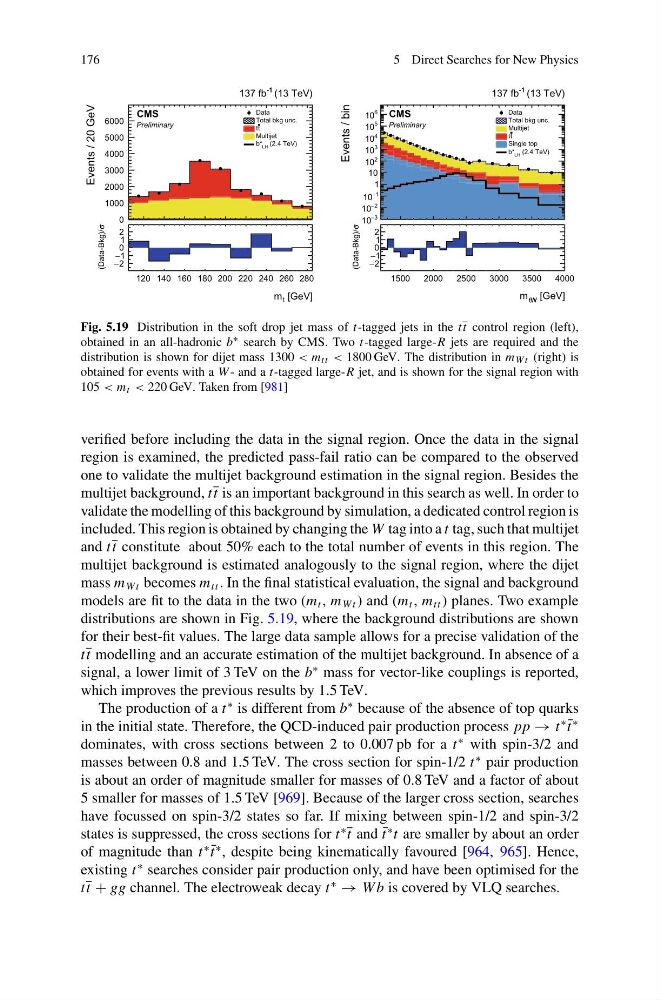
Fig. 5.19 Distribution in the soft drop jet mass of t-tagged jets in the tt control region (left),
obtained in an all-hadronic b ∗ search by CMS. Two t-tagged large-R jets are required and the
distribution is shown for dijet mass 1300 < m tt < 1800 GeV. The distribution in m W t (right) is
obtained for events with a W - and a t-tagged large-R jet, and is shown for the signal region with
105 < m t < 220 GeV. Taken from [981]
verified before including the data in the signal region. Once the data in the signal
region is examined, the predicted pass-fail ratio can be compared to the observed
one to validate the multijet background estimation in the signal region. Besides the
multijet background, tt is an important background in this search as well. In order to
validate the modelling of this background by simulation, a dedicated control region is
included. This region is obtained by changing the W tag into a t tag, such that multijet
and tt constitute about 50% each to the total number of events in this region. The
multijet background is estimated analogously to the signal region, where the dijet
mass m W t becomes m tt . In the final statistical evaluation, the signal and background
models are fit to the data in the two (m t , m W t ) and (m t , m tt ) planes. Two example
distributions are shown in Fig. 5.19, where the background distributions are shown
for their best-fit values. The large data sample allows for a precise validation of the
tt modelling and an accurate estimation of the multijet background. In absence of a
signal, a lower limit of 3 TeV on the b
∗ mass for vector-like couplings is reported,
which improves the previous results by 1.5 TeV.
The production of a t
∗ is different from b
∗ because of the absence of top quarks
in the initial state. Therefore, the QCD-induced pair production process pp → t
∗ ¯
t
∗
dominates, with cross sections between 2 to 0.007 pb for a t
∗ with spin-3/2 and
masses between 0.8 and 1.5 TeV. The cross section for spin-1/2 t
∗ pair production
is about an order of magnitude smaller for masses of 0.8 TeV and a factor of about
5 smaller for masses of 1.5 TeV [969]. Because of the larger cross section, searches
have focussed on spin-3/2 states so far. If mixing between spin-1/2 and spin-3/2
states is suppressed, the cross sections for t
∗ t and ¯
t
∗ t are smaller by about an order
of magnitude than t
∗ ¯
t
∗ , despite being kinematically favoured [964, 965]. Hence,
existing t
∗ searches consider pair production only, and have been optimised for the
tt + gg channel. The electroweak decay t
∗
→ W b is covered by VLQ searches.
5 Direct Searches for New Physics
0
1000
2000
3000
4000
5000
6000
Events / 20 GeV
Data
Total bkg unc.
t
t
Multijet
(2.4 TeV)
LH LH
b*
(13 TeV)
-1 -1
137 fb
CMS
Preliminary
120 140 160 180 200 220 240 260 280
[GeV]
t
m
2
−
1
−
0
1
2
σ σ
(Data-Bkg)/
3
−
10
2
−
10
1
−
10
1
10
2
10
3
10
4
10
5
10
6
10
Events / bin
Data
Total bkg unc.
Multijet
t
t
Single top
(2.4 TeV)
LH LH LH
b*
(13 TeV)
-1 -1
137 fb
CMS
Preliminary
1500
2000
2500
3000
3500
4000
[GeV]
tW tW
m
2
−
1
−
0
1
2
σ σ
(Data-Bkg)/
Fig. 5.19 Distribution in the soft drop jet mass of t-tagged jets in the tt control region (left),
obtained in an all-hadronic b ∗ search by CMS. Two t-tagged large-R jets are required and the
distribution is shown for dijet mass 1300 < m tt < 1800 GeV. The distribution in m W t (right) is
obtained for events with a W - and a t-tagged large-R jet, and is shown for the signal region with
105 < m t < 220 GeV. Taken from [981]
verified before including the data in the signal region. Once the data in the signal
region is examined, the predicted pass-fail ratio can be compared to the observed
one to validate the multijet background estimation in the signal region. Besides the
multijet background, tt is an important background in this search as well. In order to
validate the modelling of this background by simulation, a dedicated control region is
included. This region is obtained by changing the W tag into a t tag, such that multijet
and tt constitute about 50% each to the total number of events in this region. The
multijet background is estimated analogously to the signal region, where the dijet
mass m W t becomes m tt . In the final statistical evaluation, the signal and background
models are fit to the data in the two (m t , m W t ) and (m t , m tt ) planes. Two example
distributions are shown in Fig. 5.19, where the background distributions are shown
for their best-fit values. The large data sample allows for a precise validation of the
tt modelling and an accurate estimation of the multijet background. In absence of a
signal, a lower limit of 3 TeV on the b
∗ mass for vector-like couplings is reported,
which improves the previous results by 1.5 TeV.
The production of a t
∗ is different from b
∗ because of the absence of top quarks
in the initial state. Therefore, the QCD-induced pair production process pp → t
∗ ¯
t
∗
dominates, with cross sections between 2 to 0.007 pb for a t
∗ with spin-3/2 and
masses between 0.8 and 1.5 TeV. The cross section for spin-1/2 t
∗ pair production
is about an order of magnitude smaller for masses of 0.8 TeV and a factor of about
5 smaller for masses of 1.5 TeV [969]. Because of the larger cross section, searches
have focussed on spin-3/2 states so far. If mixing between spin-1/2 and spin-3/2
states is suppressed, the cross sections for t
∗ t and ¯
t
∗ t are smaller by about an order
of magnitude than t
∗ ¯
t
∗ , despite being kinematically favoured [964, 965]. Hence,
existing t
∗ searches consider pair production only, and have been optimised for the
tt + gg channel. The electroweak decay t
∗
→ W b is covered by VLQ searches.