

5.3 Vector-Like Quarks
171
3
−
10
2
−
10
1
−
10
1
10
2
10
Events / GeV
3
−
2
−
1
−
1
10
2
10
Z t
→
T
= 1.3 TeV
T
M
Data
t
t
W+Jets
DY+ST
Tot. unc.
= 1.5 TeV
Z’
M
= 2.0 TeV
Z’
M
= 2.5 TeV
Z’
M
(13 TeV)
-1
35.9 fb
t tag
W
/
Z +
CMS
channel
μ
1000
2000
3000
4000
5000
[GeV]
rec
Z’
M
0
0.5
1
1.5
2
Data / Pred.
0.1
0.2
0.3
0.4
0.5
0.6
0.7
0.8
Events / GeV
H t
→
T
= 1.3 TeV
T
M
Data
t
t
W+Jets
DY+ST
Tot. unc.
= 1.5 TeV
Z’
M
= 2.0 TeV
Z’
M
= 2.5 TeV
Z’
M
(13 TeV)
-1
35.9 fb
no t tag
+
2b
H
CMS
channel
μ
1000
2000
3000
4000
5000
[GeV]
rec
Z’
M
0
0.5
1
1.5
2
Data / Pred.
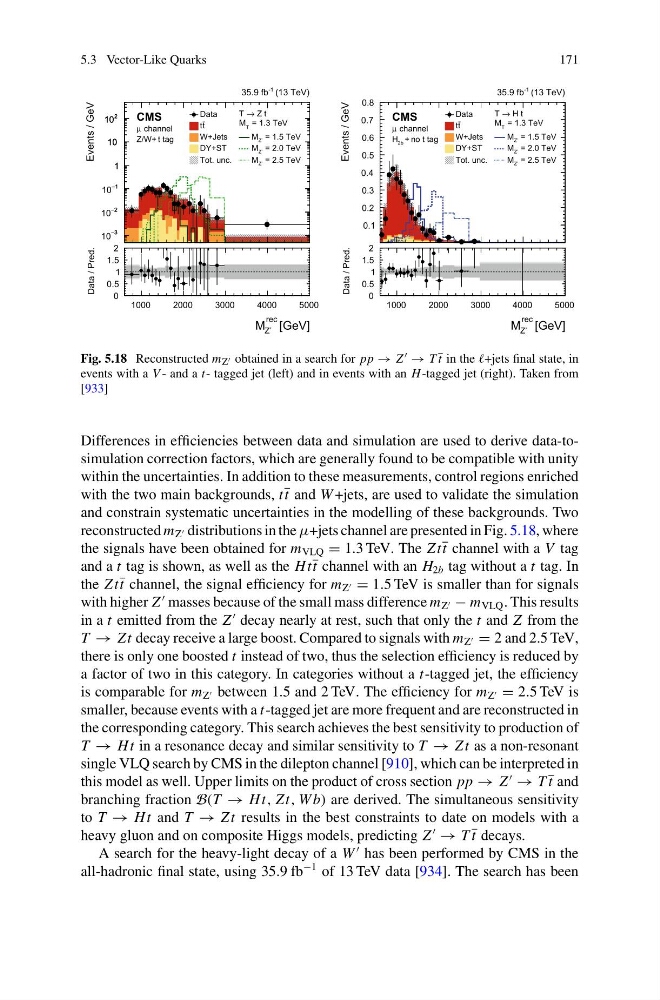
Fig. 5.18 Reconstructed m Z obtained in a search for pp → Z → T t in the +jets final state, in
events with a V - and a t- tagged jet (left) and in events with an H -tagged jet (right). Taken from
[933]
Differences in efficiencies between data and simulation are used to derive data-tosimulation correction factors, which are generally found to be compatible with unity
within the uncertainties. In addition to these measurements, control regions enriched
with the two main backgrounds, tt and W +jets, are used to validate the simulation
and constrain systematic uncertainties in the modelling of these backgrounds. Two
reconstructed m Z distributions in the μ+jets channel are presented in Fig. 5.18, where
the signals have been obtained for m VLQ = 1.3 TeV. The Ztt channel with a V tag
and a t tag is shown, as well as the Htt channel with an H 2b tag without a t tag. In
the Ztt channel, the signal efficiency for m Z = 1.5 TeV is smaller than for signals
with higher Z
masses because of the small mass difference m Z − m VLQ . This results
in a t emitted from the Z
decay nearly at rest, such that only the t and Z from the
T → Zt decay receive a large boost. Compared to signals with m Z = 2 and 2.5 TeV,
there is only one boosted t instead of two, thus the selection efficiency is reduced by
a factor of two in this category. In categories without a t-tagged jet, the efficiency
is comparable for m Z between 1.5 and 2 TeV. The efficiency for m Z = 2.5 TeV is
smaller, because events with a t-tagged jet are more frequent and are reconstructed in
the corresponding category. This search achieves the best sensitivity to production of
T → Ht in a resonance decay and similar sensitivity to T → Zt as a non-resonant
single VLQ search by CMS in the dilepton channel [910], which can be interpreted in
this model as well. Upper limits on the product of cross section pp → Z
→ T t and
branching fraction B(T → Ht, Zt, W b) are derived. The simultaneous sensitivity
to T → Ht and T → Zt results in the best constraints to date on models with a
heavy gluon and on composite Higgs models, predicting Z
→ T t decays.
A search for the heavy-light decay of a W
has been performed by CMS in the
all-hadronic final state, using 35.9 fb
−1 of 13 TeV data [934]. The search has been
171
3
−
10
2
−
10
1
−
10
1
10
2
10
Events / GeV
3
−
2
−
1
−
1
10
2
10
Z t
→
T
= 1.3 TeV
T
M
Data
t
t
W+Jets
DY+ST
Tot. unc.
= 1.5 TeV
Z’
M
= 2.0 TeV
Z’
M
= 2.5 TeV
Z’
M
(13 TeV)
-1
35.9 fb
t tag
W
/
Z +
CMS
channel
μ
1000
2000
3000
4000
5000
[GeV]
rec
Z’
M
0
0.5
1
1.5
2
Data / Pred.
0.1
0.2
0.3
0.4
0.5
0.6
0.7
0.8
Events / GeV
H t
→
T
= 1.3 TeV
T
M
Data
t
t
W+Jets
DY+ST
Tot. unc.
= 1.5 TeV
Z’
M
= 2.0 TeV
Z’
M
= 2.5 TeV
Z’
M
(13 TeV)
-1
35.9 fb
no t tag
+
2b
H
CMS
channel
μ
1000
2000
3000
4000
5000
[GeV]
rec
Z’
M
0
0.5
1
1.5
2
Data / Pred.
Fig. 5.18 Reconstructed m Z obtained in a search for pp → Z → T t in the +jets final state, in
events with a V - and a t- tagged jet (left) and in events with an H -tagged jet (right). Taken from
[933]
Differences in efficiencies between data and simulation are used to derive data-tosimulation correction factors, which are generally found to be compatible with unity
within the uncertainties. In addition to these measurements, control regions enriched
with the two main backgrounds, tt and W +jets, are used to validate the simulation
and constrain systematic uncertainties in the modelling of these backgrounds. Two
reconstructed m Z distributions in the μ+jets channel are presented in Fig. 5.18, where
the signals have been obtained for m VLQ = 1.3 TeV. The Ztt channel with a V tag
and a t tag is shown, as well as the Htt channel with an H 2b tag without a t tag. In
the Ztt channel, the signal efficiency for m Z = 1.5 TeV is smaller than for signals
with higher Z
masses because of the small mass difference m Z − m VLQ . This results
in a t emitted from the Z
decay nearly at rest, such that only the t and Z from the
T → Zt decay receive a large boost. Compared to signals with m Z = 2 and 2.5 TeV,
there is only one boosted t instead of two, thus the selection efficiency is reduced by
a factor of two in this category. In categories without a t-tagged jet, the efficiency
is comparable for m Z between 1.5 and 2 TeV. The efficiency for m Z = 2.5 TeV is
smaller, because events with a t-tagged jet are more frequent and are reconstructed in
the corresponding category. This search achieves the best sensitivity to production of
T → Ht in a resonance decay and similar sensitivity to T → Zt as a non-resonant
single VLQ search by CMS in the dilepton channel [910], which can be interpreted in
this model as well. Upper limits on the product of cross section pp → Z
→ T t and
branching fraction B(T → Ht, Zt, W b) are derived. The simultaneous sensitivity
to T → Ht and T → Zt results in the best constraints to date on models with a
heavy gluon and on composite Higgs models, predicting Z
→ T t decays.
A search for the heavy-light decay of a W
has been performed by CMS in the
all-hadronic final state, using 35.9 fb
−1 of 13 TeV data [934]. The search has been